
VR (virtual reality) device based display method and system
A display method and technology of a display system, which are applied in the input/output process of data processing, the input/output of user/computer interaction, optics, etc., can solve the problems of delayed display, dizziness or even vomiting, and the display is not updated in time. Achieve the effect of reducing display delay, avoiding dizziness, and improving anti-shake effect
- Summary
- Abstract
- Description
- Claims
- Application Information
AI Technical Summary
Problems solved by technology
Method used
Image

Examples
Embodiment 1
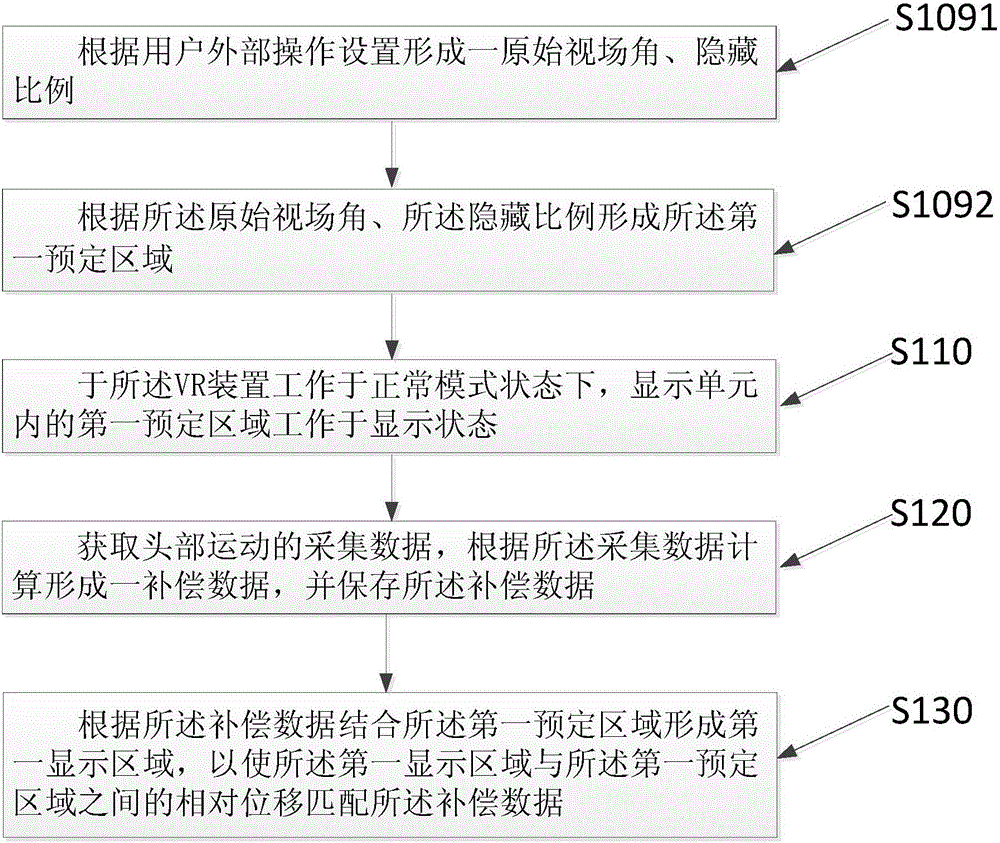
[0066] Such as figure 1 As shown, the present invention provides a display method based on a VR device, which includes:
[0067] Step S110, when the VR device is working in the normal mode, the first predetermined area in the display unit is working in the display state; further, the first predetermined area can be formed according to the user operation, specifically, with the execution of step S110 Previously also included,
[0068] Step S1091, forming an original viewing angle and hidden ratio according to the user's external operation setting;
[0069] Step S1092, forming the first predetermined area according to the original viewing angle and the hiding ratio.
[0070] Step S120, acquire the collected data of the head movement, calculate and form a compensation data according to the collected data, and save the compensated data; the collection unit can be one of a somatosensory sensor, a gravity sensor, or a gyroscope. The collection unit is designed to collect the user...
Embodiment 2
[0089] In the above-mentioned embodiment, the first predetermined area is formed according to the user's operation, that is, the user needs to set the first predetermined area every time the VR device is used, thereby increasing the operational complexity of using the VR device. The present invention further provides a A display method based on a VR device reduces the complexity of using the VR device.
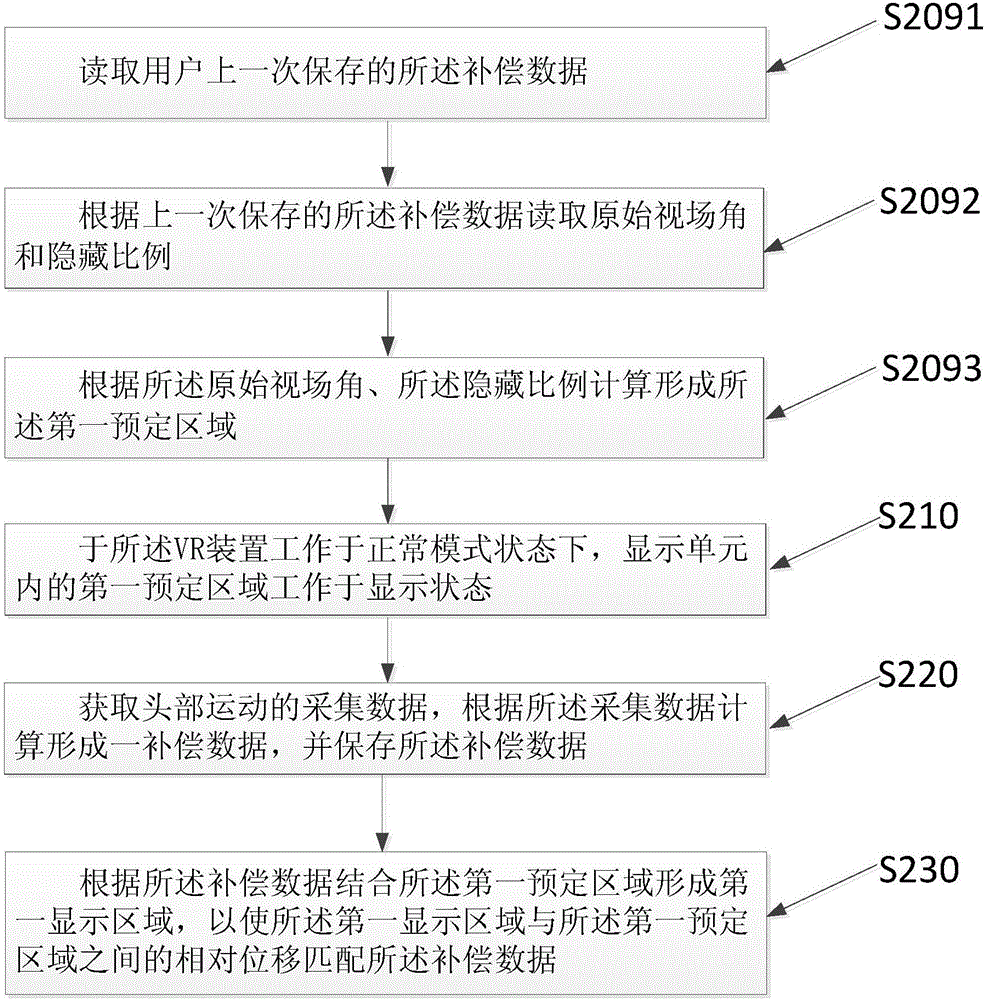
[0090] Such as image 3 As shown, a display method based on a VR device, including,
[0091] Step S2091. Read the compensation data saved by the user last time;
[0092] Step S2092, read the original viewing angle and hidden ratio according to the compensation data saved last time;
[0093] Step S2093, calculating and forming the first predetermined area according to the original viewing angle and the hiding ratio.
[0094] Step S210, when the VR device is working in the normal mode, the first predetermined area in the display unit is working in the display state;
[0095]...
Embodiment 3
[0099] In Embodiment 1 and Embodiment 2 above, when the user generates head movement, the display unit switches the display area, but when the user is in a relatively unstable state, such as in the state of riding a vehicle, the head cannot be in the In a stable state, that is, the head continues to move, the display unit needs to switch the display area frequently, and such frequent switching is also likely to cause dizziness. In view of this technical defect, the present invention provides a display method based on a VR device. Designed to improve the anti-shake effect of VR settings in unstable environments.
[0100] Such as Figure 4 As shown, a display method based on a VR device, including,
[0101] Step S310, when the VR device is working in the normal mode, the first predetermined area in the display unit is working in the display state,
[0102] Step S320, acquire the collected data of the head movement, calculate and form a compensation data according to the collec...
PUM
 Login to View More
 Abstract
Description
Claims
Application Information
 Login to View More