
Microbial agent, greening waste soil remediation agent and application thereof
A technology for microbial inoculants and soil remediation agents, applied in the directions of microorganisms, microorganisms, and microorganism-based methods, can solve problems such as environmental pollution and waste of resources, and achieve the effects of shortening fermentation time, strong practicability, and cheap raw materials
- Summary
- Abstract
- Description
- Claims
- Application Information
AI Technical Summary
Problems solved by technology
Method used
Image

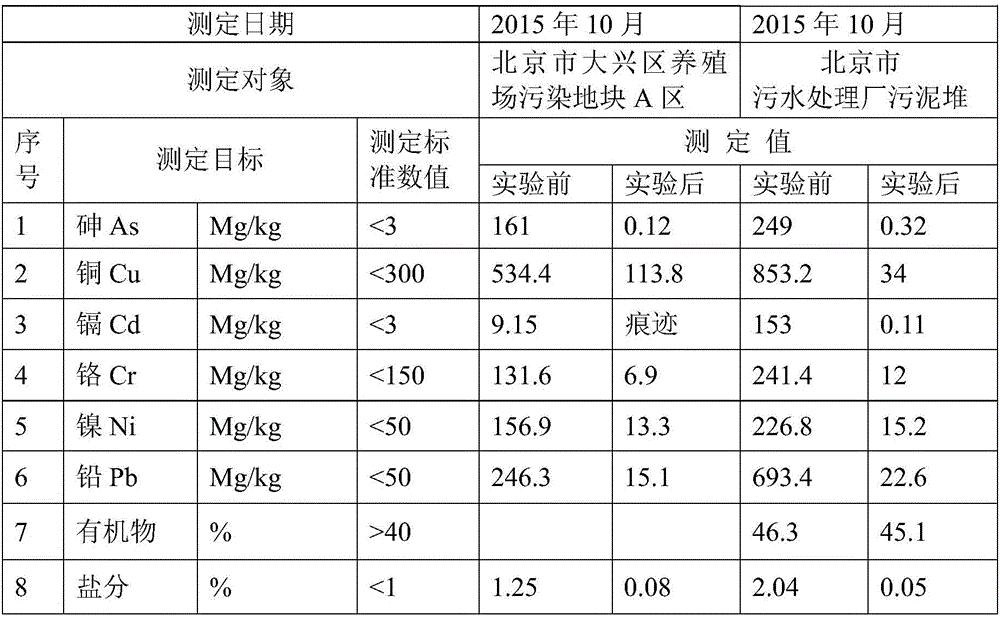
Examples
Embodiment 1
[0039] Present embodiment provides the microbial inoculant containing Trichoderma aculeatus spore powder and preparation method thereof, and the method comprises the steps:
[0040] 1), the preserved bacterial classification is first received on the PDA medium plate, activated and cultivated at 28°C until sporulation, and the resulting spore powder is sieved (200 mesh), to obtain the Trichoderma aculeatus spore powder;
[0041] Take the spore powder and make it into a concentration of 1×10 11 spore / mL suspension to obtain the first microbial liquid inoculant.
[0042]Wherein, the configuration method contained in the PDA medium mentioned above is as follows: Weigh 200g of potatoes, wash, peel and cut into small pieces, add 1000ml of water to boil for half an hour, filter with gauze, add 10-20g of glucose, fully dissolve Set the volume to 1000ml, and sterilize at 121 degrees for 30 minutes.
[0043] 2), conventionally culturing and counting Geobacillus stearothermophilus and ...
Embodiment 2
[0047] In this example, the preparation operation is the same as in Example 1. The difference from Example 1 is that in this example, in addition to adding Geobacillus stearothermophilus, Bacillus subtilis and Thermoanaerobacillus metalophilus are additionally added. , Dispospora thermophila, and Bacillus licheniformis, the above-mentioned bacteria are added after the composite bacteria liquid formed according to the proportion of the bacteria liquid volume in equal proportions, and the bacteria content is 1-9×10 10 pieces / ml.
Embodiment 3
[0049] In this example, the preparation operation is the same as in Example 1. The difference from Example 1 is that in this example, in addition to adding Geobacillus stearothermophilus, Lactobacillus plantarum, Lactobacillus delbrueckii, Lactobacillus delbrueckii, Methanothermophilic micrococcus, white thermophilic actinomycetes and citric acid bacteria, the above-mentioned bacteria are added in the composite bacteria liquid formed according to the proportion of the bacteria liquid volume ratio, and the bacteria content is 1-9×10 10 pieces / ml.
PUM
 Login to View More
 Abstract
Description
Claims
Application Information
 Login to View More