
A kind of lysate and its application in preserving tissue or cell and extracting rna
A technology of lysate and tissue, applied in the extraction of RNA, lysate and its application in the field of preserving tissue or cells, can solve the problems of low extraction efficiency, incompatibility of components, etc., and achieve fast speed, stable properties, and simplified operation steps Effect
- Summary
- Abstract
- Description
- Claims
- Application Information
AI Technical Summary
Problems solved by technology
Method used
Image

Examples
Embodiment 1
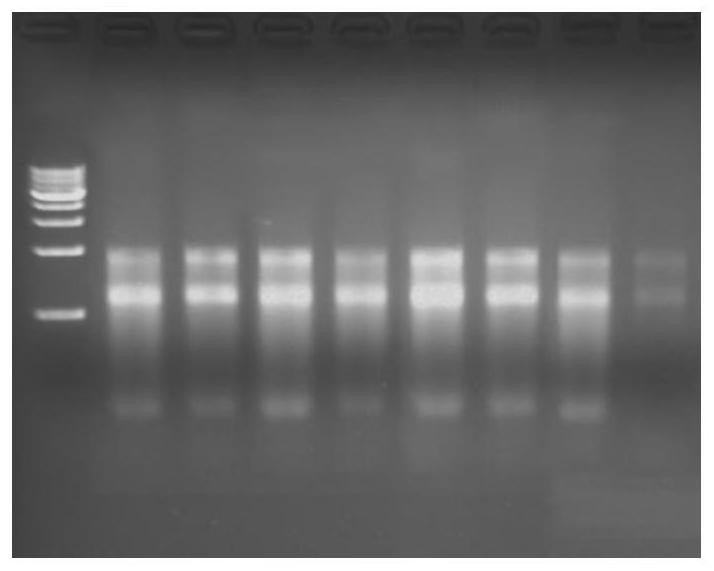
[0039](1) Take eight 1.5ml EP tubes, add 4mg of rat liver tissue to each EP tube, and number each EP tube, among them, add 250ul lysate A to EP tubes 1, 3, 5, and 7 respectively, and Store at room temperature for 4h, 8h, 24h, and 48h respectively, add 250ul RNA later solution to EP tubes 2, 4, 6, and 8, and store at room temperature for 4h, 8h, 24h, and 48h respectively;
[0040] (2) Add 750ul lysate B to the EP tubes No. 1, 3, 5, and 7 above; discard the RNA later solution in the EP tubes No. 2, 4, 6, and 8 above, add 1×PBS to wash 3 times Discard the solution, and then add 1ml of TRIzol solution;
[0041] (3) The EP tubes No. 1-8 above were mixed upside down and subjected to ultrasonic cracking, the ultrasonic time was 5s, the frequency was 20kHz, and the power was 100W;
[0042] (4) Invert the ultrasonicated EP tube several times to mix the mixture evenly;
[0043] (5) Add 200 ul of chloroform to the EP tubes treated in step (4), and vigorously invert and mix for 30 s, ce...
Embodiment 2
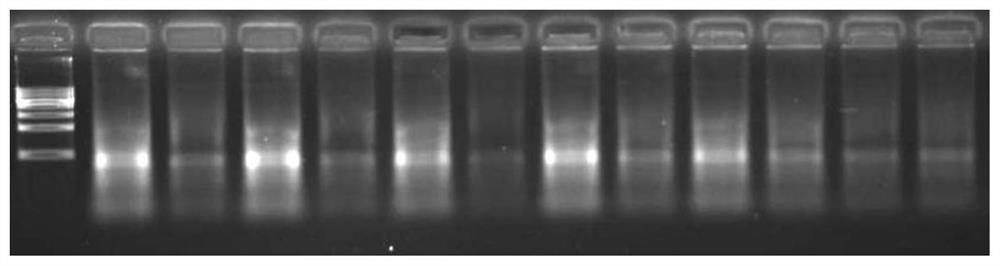
[0051] (1) Take 12 1.5ml EP tubes and number each EP tube. Add 250ul lysate A and 750ul lysate B to EP tubes 1, 3, 5, 7, 9, and 11, respectively. , No. 6, No. 8, No. 10 and No. 12 EP tubes were added with 1ml TRIzol respectively;
[0052] (2) Put 4 mg of rat heart tissue into EP tubes 1 and 2, 3 mg of rat liver tissue into EP tubes 3 and 4, and 5 mg of rat liver tissue into EP tubes 5 and 6. Spleen tissue, put 4mg of rat lung tissue into EP tubes No. 7 and 8 respectively, put 5 mg of rat kidney tissue into EP tubes No. 9 and 10 respectively, put 3 mg of rat sciatic nerve tissue into EP tubes No. 11 and 12 respectively ;
[0053] (3) The EP tubes No. 1-12 above were mixed upside down and subjected to ultrasonic cracking, the ultrasonic time was 5s, the frequency was 20kHz, and the power was 125W;
[0054] (4) Invert the ultrasonicated EP tube several times to mix the mixture evenly;
[0055] (5) Add 200 ul of chloroform to the EP tubes treated in step (4), and vigorously inv...
Embodiment 3
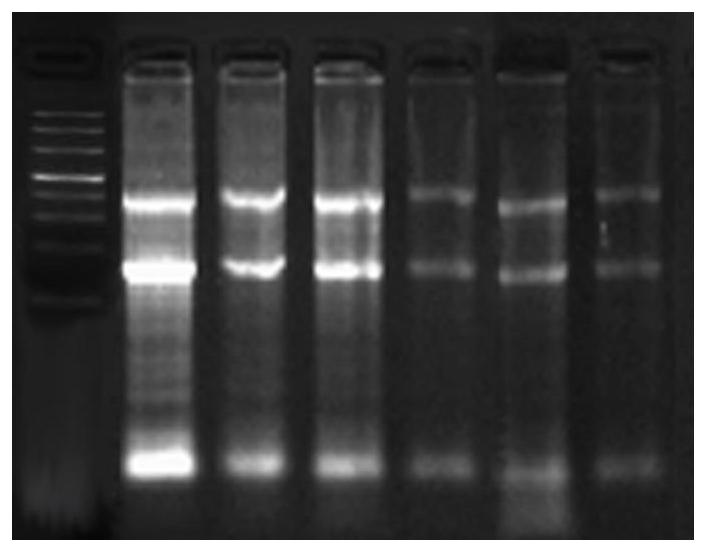
[0063] (1) Take six 1.5ml EP tubes and add about 10 6 number each Panc-1 cell, and add 250ul lysate A and 750ul lysate B to EP tubes 1, 2, and 3 respectively, and add 1ml TRIzol to EP tubes 4, 5, and 6; Invert the EP tube several times to mix the mixture in it;
[0064] (2) Add 200ul of chloroform to the above-mentioned EP tubes, vigorously invert and mix for 10s, centrifuge for 1min under a centrifugal force of 10000g, and take the upper liquid;
[0065] (3) Pour the upper layer liquid obtained in step (2) into another batch of clean EP tubes with corresponding numbers, then add 500ul of isopropanol, slowly invert and mix for 50s, centrifuge at 10000g for 1min, discard To remove the liquid, to obtain a precipitate;
[0066] (4) Add 600ul of 75vt% ethanol solution to the above precipitate, slowly invert and mix for 30s, centrifuge for 1min under a centrifugal force of 10000g, and discard the liquid;
[0067] (5) Dry the EP tube in step (4) in the air for 5 minutes and add 4...
PUM
 Login to View More
 Abstract
Description
Claims
Application Information
 Login to View More