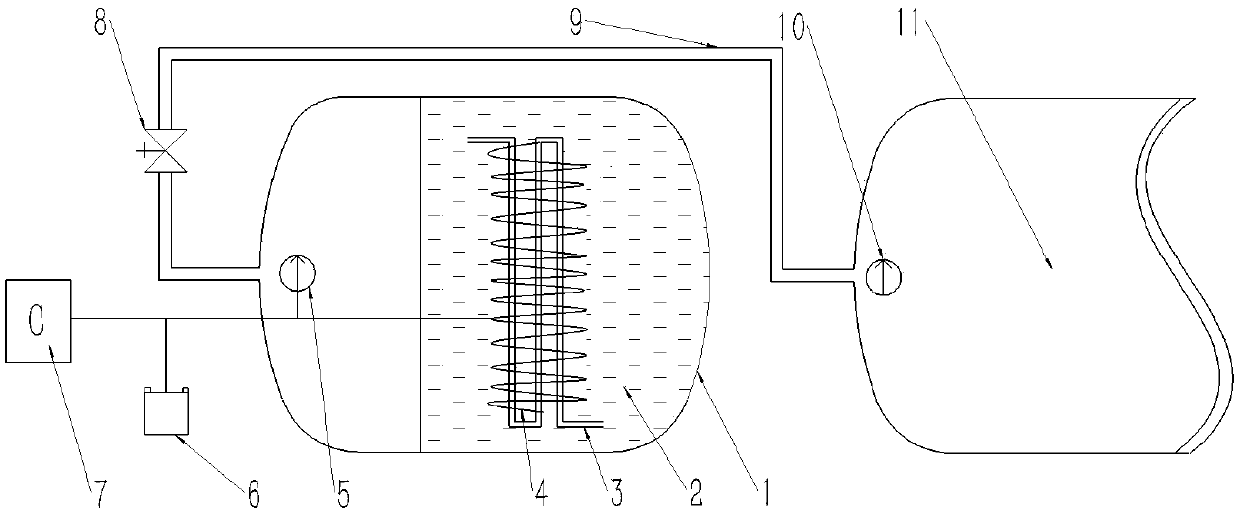
Nitrous oxide temperature control pressurization system

A technology of nitrous oxide and supercharging system, which is applied in the direction of jet propulsion devices, rocket engine devices, machines/engines, etc. It can solve problems such as changes in supercharging pressure, unsuitability for rocket engines to work stably, and pressure reduction, etc., to achieve The effect of variable pressure

CN107829842AInactive Publication Date: 2018-03-23BEIHANG UNIV
5 Cites 2 Cited by

Patent Information

Authority / Receiving Office
CN · China
Current Assignee / Owner
Publication Date
2018-03-23
Estimated Expiration
Not applicable · inactive patent

Smart Images

  • Figure 1
    Figure 1
Patent Text Reader

Abstract

The invention relates to the technical field of rocket pressurization propulsion systems, in particular to a nitrous oxide temperature control pressurization system. The nitrous oxide temperature control pressurization system comprises a propellant storage box, a nitrous oxide storage box, nitrous oxide, an evaporator, a heater, a valve, a pipeline, an intelligent pressure adjuster, a pressure sensor and a temperature sensor; the nitrous oxide, the evaporator and the heater are all arranged in the nitrous oxide storage box; the propellant storage box communicates with the nitrous oxide storagebox through the pipeline; the valve is arranged on the pipeline; the intelligent pressure adjuster is connected with the heater, the evaporator and the valve and arranged outside the nitrous oxide storage box; the temperature sensor is arranged in the nitrous oxide storage box; the pressure sensor is arranged in the propellant storage box; and the intelligent pressure adjuster is in signal connection with the pressure sensor, the temperature sensor, the heater, the evaporator and the valve. According to the nitrous oxide temperature control pressurization system, the pressure of the propellant storage box can be adjusted, stable pressurized gas is provided, and moreover variable pressure of the pressurized gas is achieved.
Need to check novelty before this filing date? Find Prior Art

Description

technical field

[0001] The invention relates to the technical field of rocket booster propulsion systems, in particular to a nitrous oxide temperature-controlled booster system. Background technique

[0002] The extruded pressurized delivery system consists of a propellant tank, a pressurized system and a pipeline delivery system. Cylinder-type gas pressurization system is a commonly used pressurization system. For solid-liquid mixed rocket engines that work for a long time, the pressure in the bottle is as high as 30MPa or even higher; Liquefied and stored in a low-pressure liquid state.

[0003] Nitrous oxide (N 2 O) It has the characteristics of high saturated vapor pressure, about 5MPa at normal temperature, and its pressure changes approximately linearly with temperature, which can be used as pressurized gas for extrusion pressurization system; it is also non-toxic, non-corrosive and stable at normal temperature Good stability and other advantages.

[0004] Compared...

Examples

Embodiment Construction

[0028] The technical solutions of the present invention will be clearly and completely described below in conjunction with the accompanying drawings. Apparently, the described embodiments are some of the embodiments of the present invention, but not all of them. Based on the embodiments of the present invention, all other embodiments obtained by persons of ordinary skill in the art without making creative efforts belong to the protection scope of the present invention.

[0029] In the description of the present invention, it should be noted that the terms "center", "upper", "lower", "left", "right", "vertical", "horizontal", "inner", "outer" etc. The indicated orientation or positional relationship is based on the orientation or positional relationship shown in the drawings, and is only for the convenience of describing the present invention and simplifying the description, rather than indicating or implying that the referred device or element must have a specific orientation, ...