
Calcium ion and zinc ion double-channel rhodamine fluorescent probe as well as preparation method and application thereof
A technology of fluorescent probes and zinc ions, which is applied in the field of fluorescent probe materials and their preparation, can solve problems such as inability to realize detection, achieve good selectivity and sensitivity, good use effect, and easy-to-operate equipment requirements
- Summary
- Abstract
- Description
- Claims
- Application Information
AI Technical Summary
Problems solved by technology
Method used
Image

Examples
Embodiment 1
[0049] The calcium ion and zinc ion dual-channel rhodamine-based fluorescent probes of the present embodiment have a structural formula of:
[0050]
[0051] Its preparation method, the steps are:
[0052] Step 1: Dissolve rhodamine B in absolute ethanol, add excess hydrazine hydrate (98wt%) dropwise, heat and reflux at 78°C for 5 hours, remove the solvent and unreacted hydrazine hydrate by rotary evaporation, and obtain crude rhodamine B hydrazide . Dissolve the crude product in dilute hydrochloric acid solution (4.0-5.0 wt%), adjust the pH of the system (9-10) until the product is completely precipitated, filter it with suction, and dry it to obtain the rhodamine B hydrazide product;
[0053] Step 2: Dissolve methyl p-aminobenzoate in absolute ethanol, add excess hydrazine hydrate (98wt%) dropwise, heat and reflux at 78°C for 3 hours, remove the solvent and unreacted hydrazine hydrate by rotary evaporation, and obtain the crude product p-aminobenzoate Benzohydrazide, fo...
Embodiment 2
[0058] Utilize the calcium ion and zinc ion dual-channel rhodamine fluorescent probe in embodiment 1 to test:
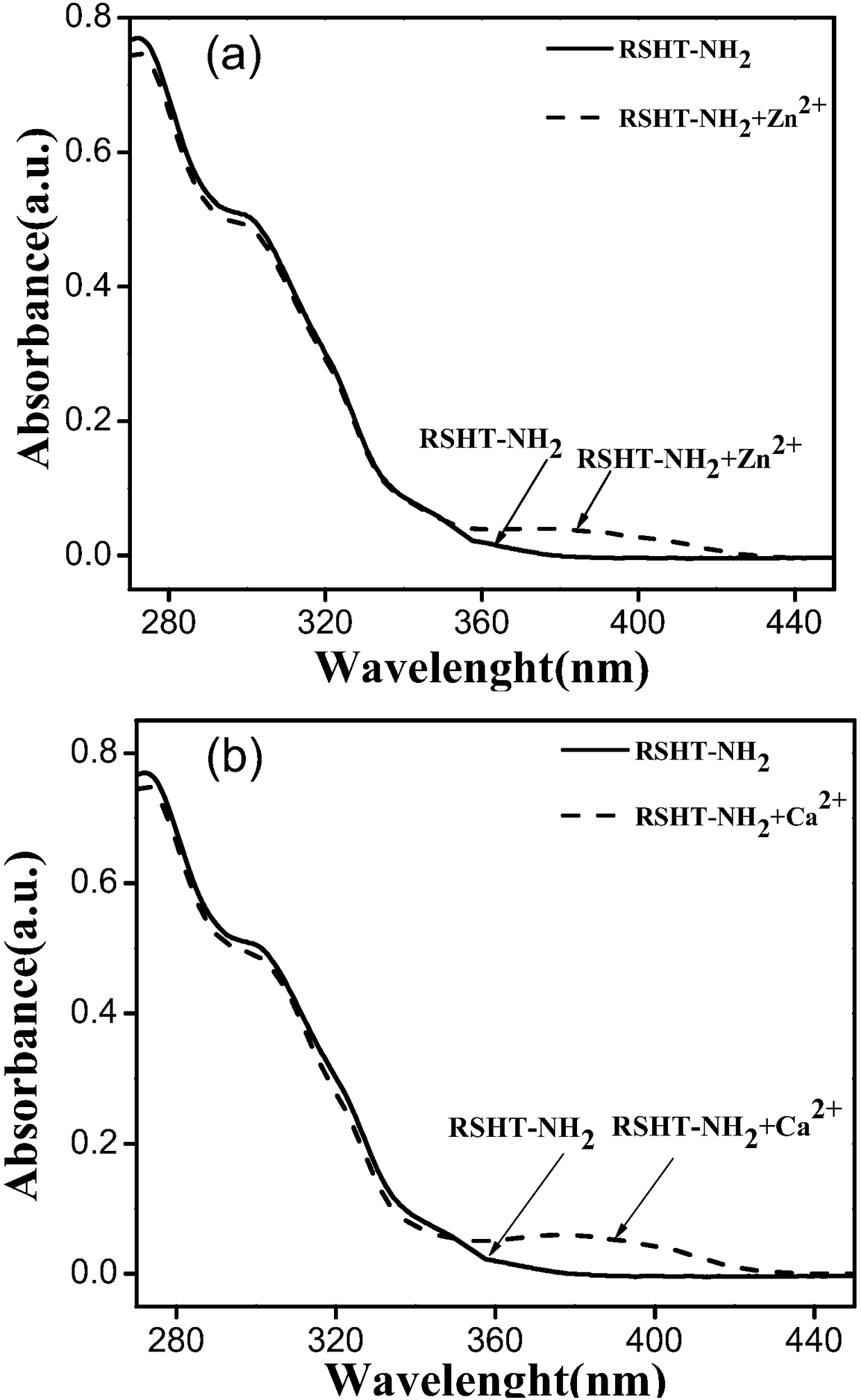
[0059] like figure 1 As shown, the probe molecule RSHT-NH in DMF solution 2 There is no ultraviolet absorption peak at 360-400nm itself, after the probe is complexed with zinc ions, a new ultraviolet absorption peak appears at 370nm ( figure 1 (a) shown); Probe molecule RSHT-NH in DMF solution 2 There is no ultraviolet absorption peak at 360-400nm, but a new ultraviolet absorption peak appears at 380nm after the probe is complexed with calcium ions.
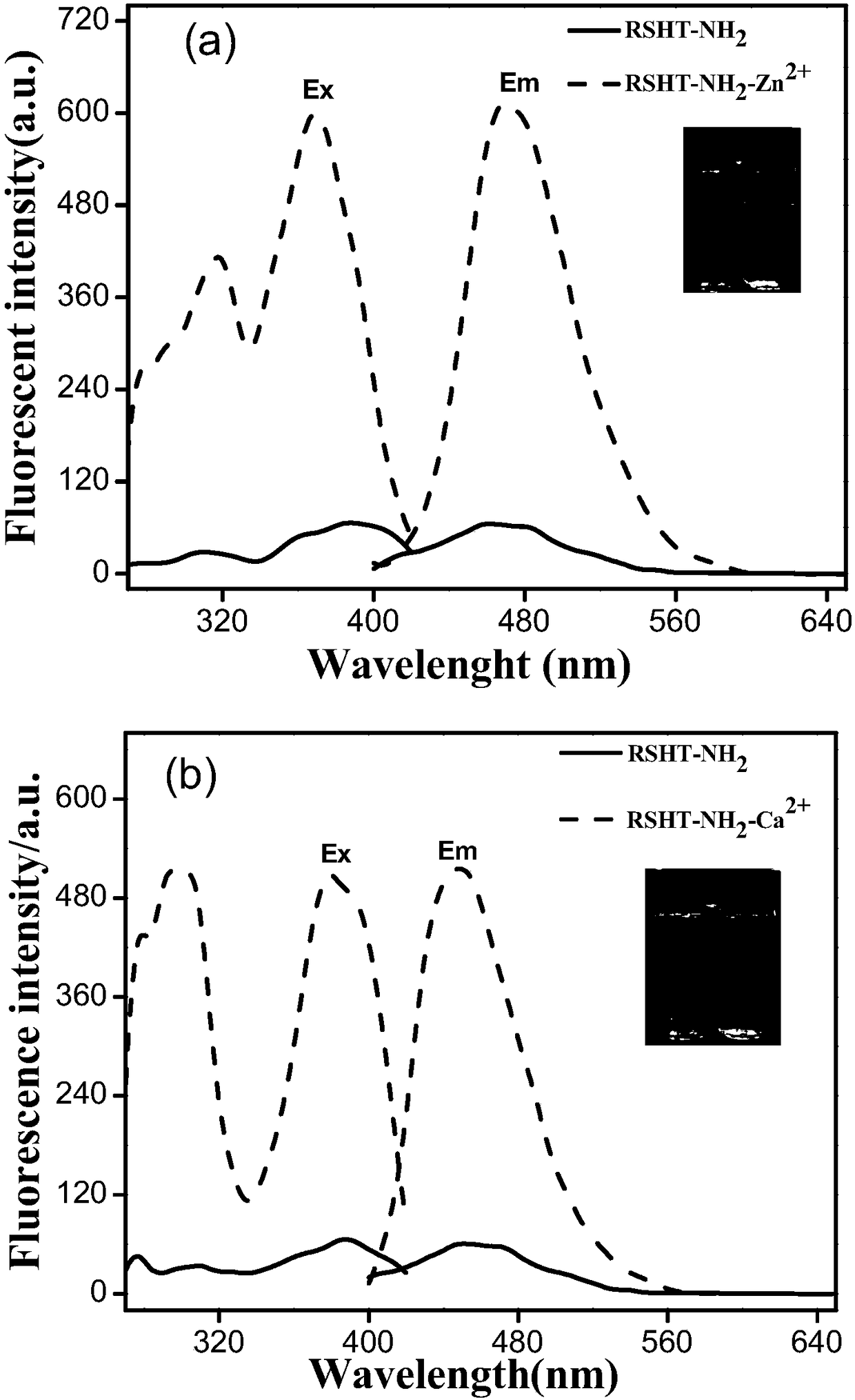
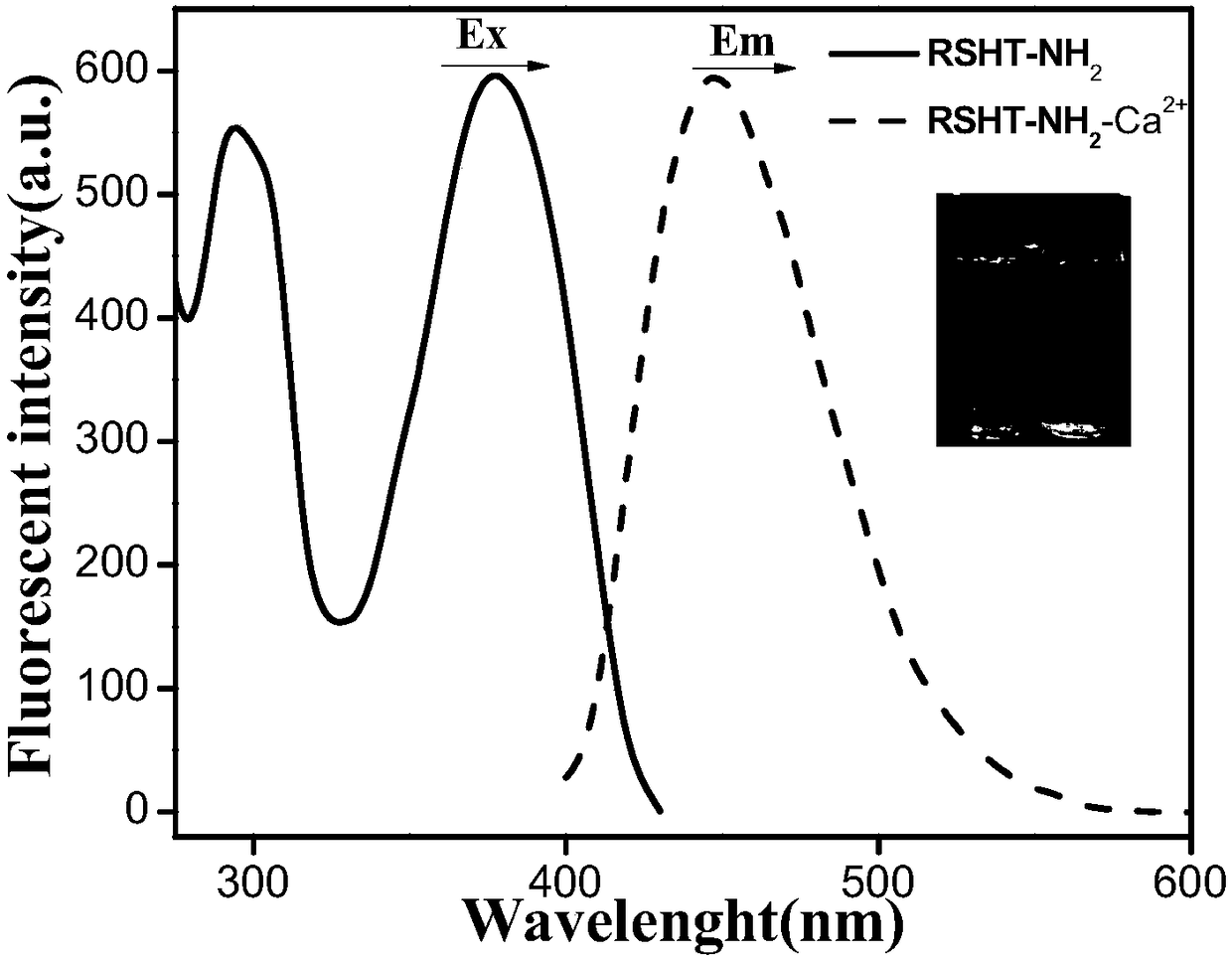
[0060] exist figure 2 It can be found in the DMF solution that after the fluorescent probe is complexed with zinc ions and calcium ions, the fluorescence excitation wavelengths are 370nm and 380nm respectively, and the fluorescence emission wavelengths are 470nm and 450nm respectively, and the colors before and after the solution have changed greatly ( RSHT-NH 2 -Ca 2+ Complexation occurs light green fluorescen...
PUM
 Login to View More
 Abstract
Description
Claims
Application Information
 Login to View More