Energy balanced cluster node selection algorithm

A cluster head node, energy balance technology, applied in digital transmission systems, data exchange networks, electrical components, etc., can solve the problem that the cluster head selection method does not consider the remaining energy of nodes, uneven network energy consumption, and the number and location of nodes are unstable. And other issues

CN108307471AActive Publication Date: 2018-07-20WUHAN UNIV
5 Cites 2 Cited by

Patent Information

Authority / Receiving Office
CN · China
Current Assignee / Owner
Publication Date
2018-07-20

Smart Images

  • Figure 1
    Figure 1
  • Figure 2
    Figure 2
  • Figure 3
    Figure 3
Patent Text Reader

Abstract

The invention discloses an energy balanced cluster node selection algorithm. The algorithm comprises the steps of sending a broadcasting message to each sensor node via a base station, and performingoverall clustering according to an LEACH algorithm; computing a distance between the sensor node and the base station; distributing slots for non-cluster-head nodes in a cluster and computing energy consumed during a process that the cluster head node transmits a data packet by using a cluster head node; computing residual energy when each sensor node becomes the cluster head node; selecting the sensor node with the maximum residual energy to serve as the cluster head and updating the distributed slots for partially clustering once more, and further starting data packet transmission; and performing partial clustering via the residual energy to complete the transmission of all data packets. Compared with the prior art, the algorithm provided by the invention is reduced in change of the cluster structure and prolonged in life cycle of the node, and meanwhile is beneficial to energy balancing.
Need to check novelty before this filing date? Find Prior Art

Description

technical field

[0001] The invention relates to a wireless sensor network routing protocol, in particular to an energy-balanced cluster head node selection algorithm. Background technique

[0002] A wireless sensor network (WSN) consisting of multiple microsensor nodes powered by batteries can form an ad hoc network. As a new mode of information acquisition and processing, it has been widely used in military, environmental, medical, industrial and vehicle ad hoc networks and other fields. In healthcare, the aging of the world's population has forced the design of new, more pervasive, and less costly healthcare systems. Distributed and networked embedded systems such as wireless sensor networks are the most attractive technologies for continuously monitoring the safety of the elderly without affecting their daily activities. Wireless sensor networks have achieved rapid development in real-time remote monitoring and computer-aided rehabilitation emergency response systems. ...

Examples

Embodiment Construction

[0052] In order to facilitate those of ordinary skill in the art to understand and implement the present invention, the present invention will be described in further detail below in conjunction with the accompanying drawings and embodiments. It should be understood that the implementation examples described here are only used to illustrate and explain the present invention, and are not intended to limit this invention.

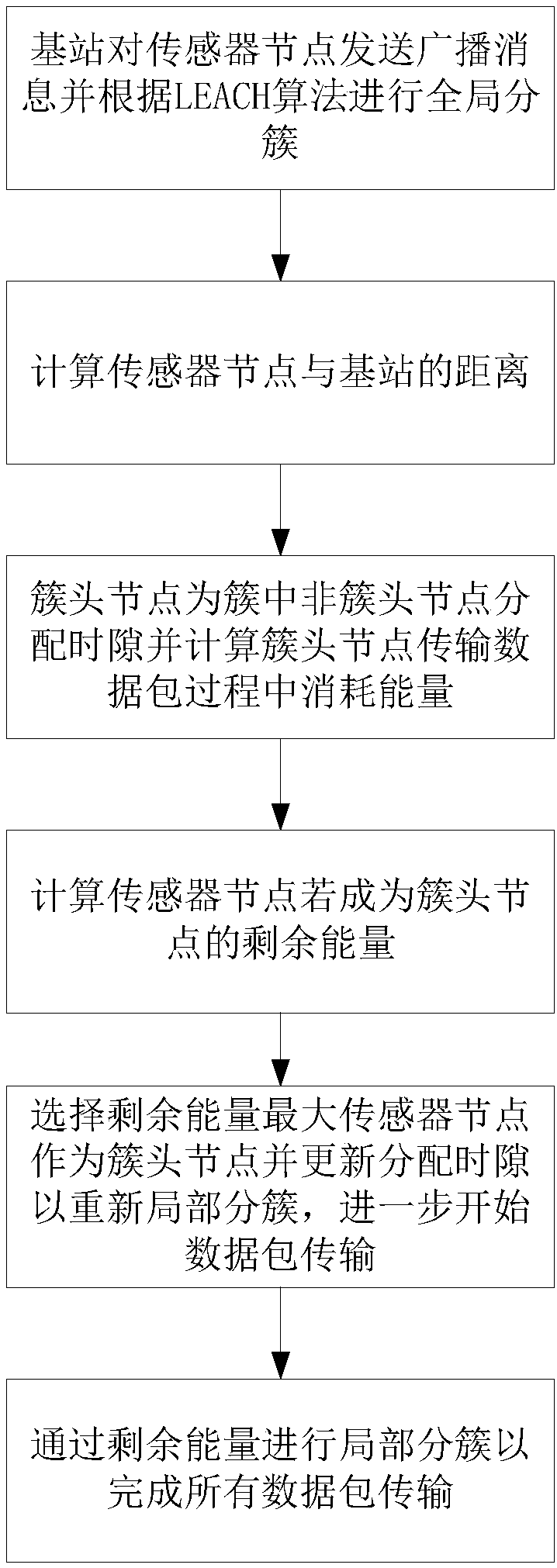
[0053] please see figure 1 , the method flowchart of the embodiment of the present invention, the present invention provides an energy-balanced cluster head node selection algorithm, comprising the following steps:

[0054] Step 1: Deploy N=100 sensor nodes, send broadcast messages to N=100 sensor nodes through the base station, perform global clustering on N sensor nodes according to the LEACH algorithm, and transmit k=5 data packets;

[0055] The base station described in step 1 sends a broadcast message to N=100 sensor nodes:

[0056] messag e info ={c ...