Unlock instant, AI-driven research and patent intelligence for your innovation.
A kind of nucleic acid related to hereditary hearing loss disease and its application
What is Al technical title?
Al technical title is built by PatSnap Al team. It summarizes the technical point description of the patent document.
A hearing loss and hereditary technology, applied in the field of genes, can solve problems that need to be further studied
Active Publication Date: 2022-03-08
BGI GENOMICS CO LTD
View PDF2 Cites 0 Cited by
Summary
Abstract
Description
Claims
Application Information
AI Technical Summary
This helps you quickly interpret patents by identifying the three key elements:
Problems solved by technology
Method used
Benefits of technology
Problems solved by technology
Although some causative genes of hereditary hearing loss have been discovered, there are still a considerable number of unknown causative genes and loci
[0003] Therefore, the current research on hereditary hearing loss still needs to be in-depth
Method used
the structure of the environmentally friendly knitted fabric provided by the present invention; figure 2 Flow chart of the yarn wrapping machine for environmentally friendly knitted fabrics and storage devices; image 3 Is the parameter map of the yarn covering machine
View more
Image
Smart Image Click on the blue labels to locate them in the text.
Viewing Examples
Smart Image
Click on the blue label to locate the original text in one second.
Reading with bidirectional positioning of images and text.
Smart Image
Examples
Experimental program
Comparison scheme
Effect test
Embodiment 1
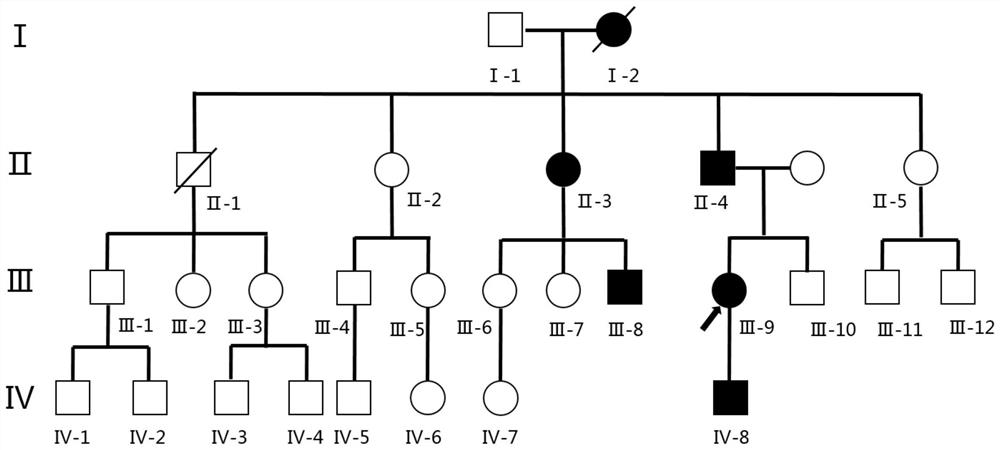
[0032] In this case, a family with hereditary hearing loss was collected, and the family diagram is as follows figure 1 As shown in the figure, □ indicates a normal male, ○ indicates a normal female, ● indicates a female patient, and ■ indicates a male patient; I indicates the first generation, II indicates the second generation, III indicates the third generation, and IV indicates the fourth generation; Ⅱ-1, Ⅱ-2, Ⅱ-3, Ⅱ-4 and Ⅱ-5 are the five members of the second generation; Ⅲ-x, where x is 1-12, respectively represent the twelve members of the third generation . In this case, the peripheral blood of three patients in a family with genetic hearing loss, namely Ⅱ-4, Ⅲ-8, Ⅲ-9, and a normal hearing person Ⅱ-2 were collected for research. Through high-throughputexome Through group sequencing and analysis, a new mutantgene was obtained, that is, the gene generated by the c.3389G>C mutation in the coding region of the wild-type ATP8A2 gene. The details are as follows:
[0033...
Embodiment 2
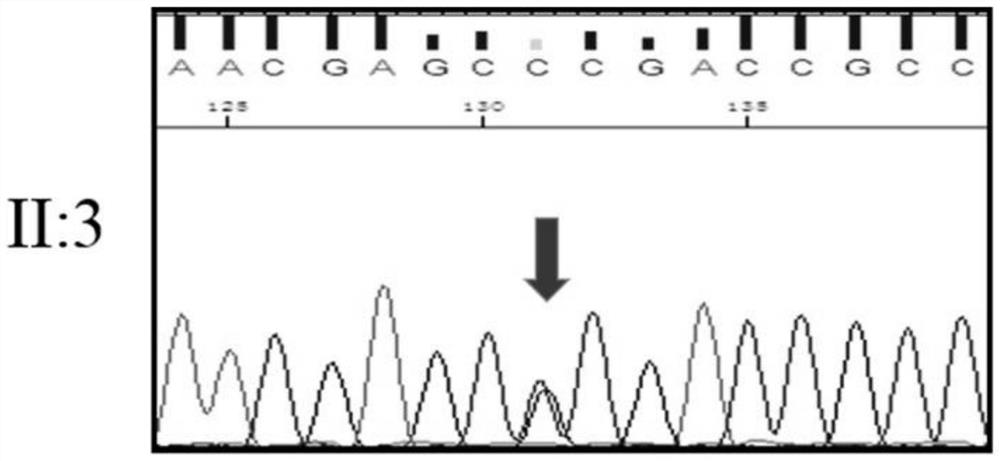
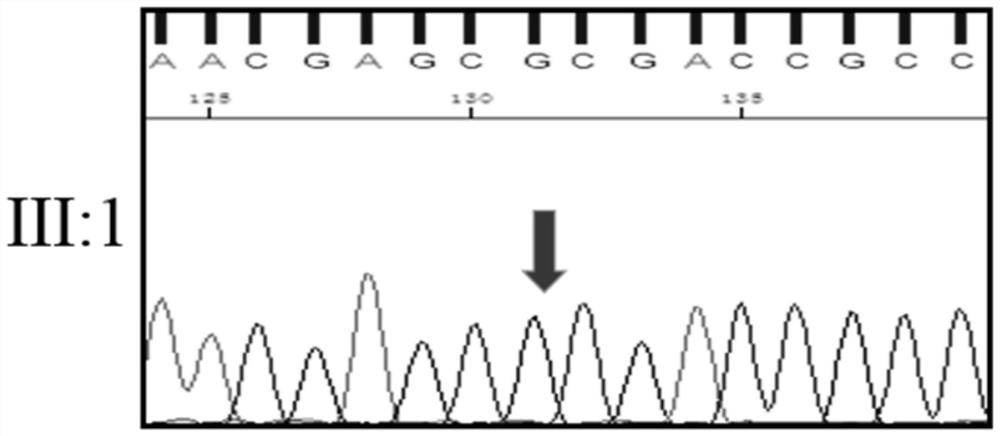
[0057] In this example, Sanger sequencing was used to verify the obtained gene mutation. Specifically, primers were designed for the c.3389G>C mutation sequence of the ATP8A2 gene, and then through PCR amplification, product purification and sequencing, the genetic hearing loss family members II-3, III-1, III-3, III-4 , Ⅲ-7, Ⅳ-2, Ⅳ-3, Ⅳ-8 ATP8A2 genes were detected; according to the sequence determination results, it was determined whether it was a mutant type or a wild type, and combined with its own disease status, it was verified that the ATP8A2 gene c.3389G> Association between C mutations and inherited hearing loss disorders.
[0060] According to the method for extracting DNA in Example 1, the genomes in the peripheral blood of family members II-3, III-1, III-3, III-4, III-7, IV-2, IV-3, and IV-8 were extracted respectively DNA, spare.
[0061] 2. Primer design and PCR reaction
[0062] Re...
the structure of the environmentally friendly knitted fabric provided by the present invention; figure 2 Flow chart of the yarn wrapping machine for environmentally friendly knitted fabrics and storage devices; image 3 Is the parameter map of the yarn covering machine
Login to View More
PUM
Login to View More
Abstract
This application discloses a nucleic acid related to hereditary hearing lossdisease and its application. The nucleic acid related to the hereditary hearing lossdisease of the present application is formed by the c.3389G>C mutation in the coding region of the wild-type ATP8A2 gene. The nucleic acid of the present application is a new related pathogenic nucleic acid of hereditary hearing lossdisease, and the discovery of the nucleic acid or pathogenic mutation site has further expanded and improved the detection and research of hereditary hearing loss disease, and provided a basis for the disease The diagnosis or treatment of the disease provides new detection sites, as well as new detection methods and approaches.
Description
technical field [0001] This application relates to the field of genes, in particular to a nucleic acid related to hereditary hearing loss and its application. Background technique [0002] Hereditary hearing loss diseases can be divided into autosomal dominant inheritance and autosomal recessive inheritance according to their mode of inheritance, and can be divided into congenital hearing loss and delayed hearing loss according to their age of onset. The incidence of hereditary hearing loss is about 1 / 1000 to 3 / 1000. Although some causative genes of hereditary hearing loss have been discovered, there are still a considerable number of unknown causative genes and loci. [0003] Therefore, the current research on hereditary hearing loss still needs to be in-depth. Contents of the invention [0004] The purpose of this application is to provide a new nucleic acid related to hereditary hearing loss disease and its application. [0005] The application adopts the following t...
Claims
the structure of the environmentally friendly knitted fabric provided by the present invention; figure 2 Flow chart of the yarn wrapping machine for environmentally friendly knitted fabrics and storage devices; image 3 Is the parameter map of the yarn covering machine
Login to View More
Application Information
Patent Timeline
Application Date:The date an application was filed.
Publication Date:The date a patent or application was officially published.
First Publication Date:The earliest publication date of a patent with the same application number.
Issue Date:Publication date of the patent grant document.
PCT Entry Date:The Entry date of PCT National Phase.
Estimated Expiry Date:The statutory expiry date of a patent right according to the Patent Law, and it is the longest term of protection that the patent right can achieve without the termination of the patent right due to other reasons(Term extension factor has been taken into account ).
Invalid Date:Actual expiry date is based on effective date or publication date of legal transaction data of invalid patent.

 Login to View More
  Login to View More