
Inertial and magnetometer combination adaptive anti-interference method
A magnetometer and self-adaptive technology, applied in navigation computing tools, measuring devices, instruments, etc., can solve the problems of long calibration time and large amount of data
Patent Information
- Authority / Receiving Office
- CN · China
- Patent Type
- Applications(China)
- Current Assignee / Owner
- Publication Date
- 2019-03-12
Smart Images
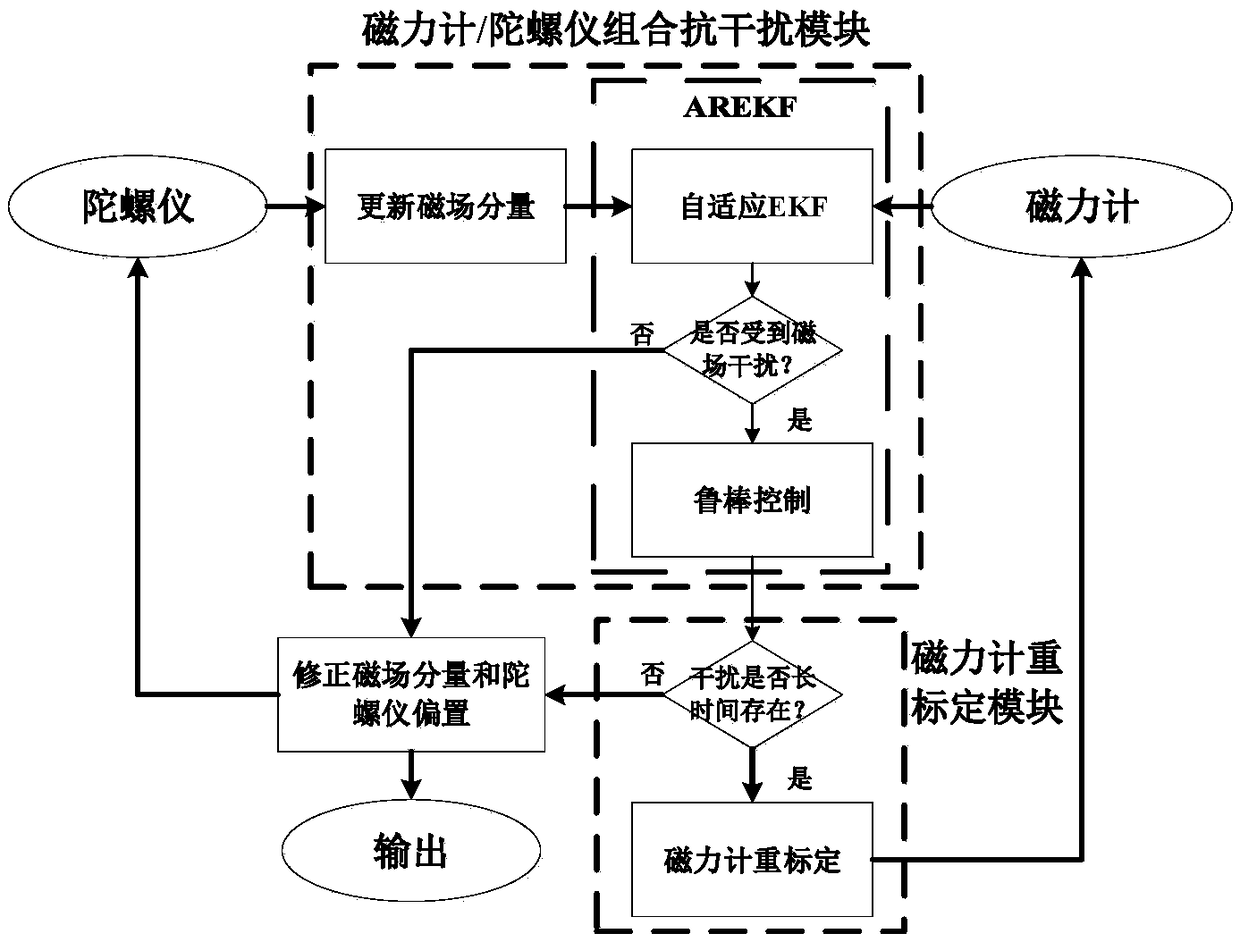
Figure 1 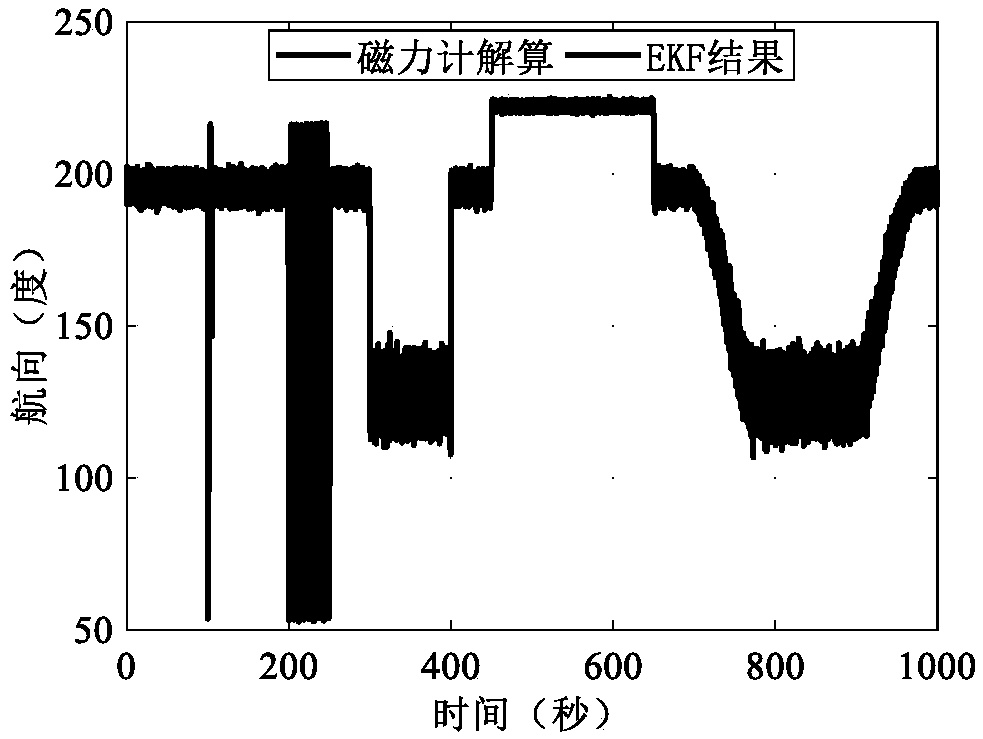
Figure 2 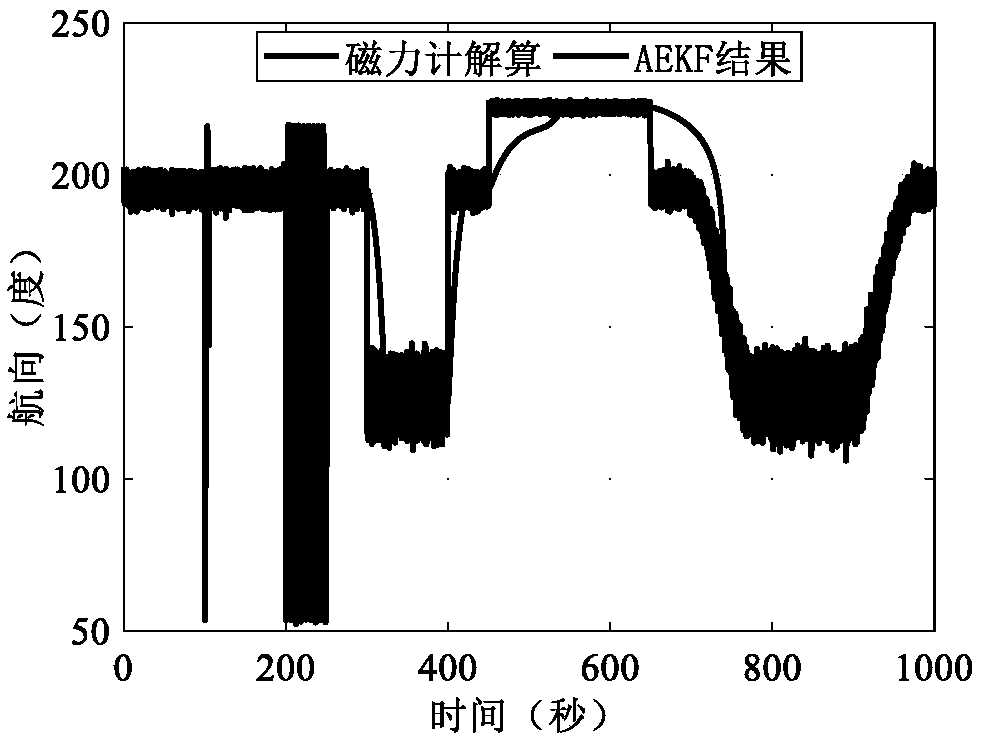
Figure 3
Abstract
Description
technical field
[0001] The invention belongs to the field of data fusion of a magnetometer and an inertial navigation system and the field of adaptive Kalman filtering, and in particular relates to an adaptive anti-jamming method combined with an inertial and magnetometer. Background technique
[0002] With the development of MEMS, low-cost inertial navigation systems are usually integrated into a module or chip, and are widely used in indoor positioning, human motion tracking, unmanned systems, etc. However, as the cost decreases, the accuracy of the MEMS inertial navigation system also decreases, and it cannot be sensitive to the rotation of the earth, so the alignment of the MEMS inertial navigation system can only rely on other sensors. The magnetometer can use the measured magnetic field value to solve the orientation. Therefore, the combination of MEMS magnetometer and inertial navigation system is one of the commonly used integrated navigation systems. Most of the r...
Examples
Embodiment Construction
[0084] The present invention will be further described below in conjunction with the accompanying drawings.
[0085] The purpose of the present invention is to overcome the problem that the magnetometer is disturbed by the changing magnetic field during the use process after calibration, which leads to the decrease of heading accuracy, and proposes a combined anti-jamming technology based on the adaptive robust Kalman filter of the magnetometer and inertial navigation system . The method firstly analyzes the output model of the magnetometer and the output model of the gyroscope, and uses the two models to derive a model that uses the angular rate to update the magnetic field component. Then the model is used as the state transition model of the filter, the magnetic field component is used as the state quantity, and the output of the magnetometer is used as the quantity measurement. Since there is random error interference in the output of the magnetometer, the residual error ...