
A kind of acid-resistant light-controlled fluorescent molecular switch and its synthesis method and application
A technology of fluorescent molecule and synthesis method, which is applied in the field of acid-resistant light-controlled fluorescent molecular switch and its synthesis, can solve the problems of switching interference, performance failure of light-controlled molecular switch, inability of fluorescent probe to be applied to super-resolution fluorescence imaging, etc.
Patent Information
- Authority / Receiving Office
- CN · China
- Patent Type
- Patents(China)
- Current Assignee / Owner
- Publication Date
- 2021-06-04
Smart Images
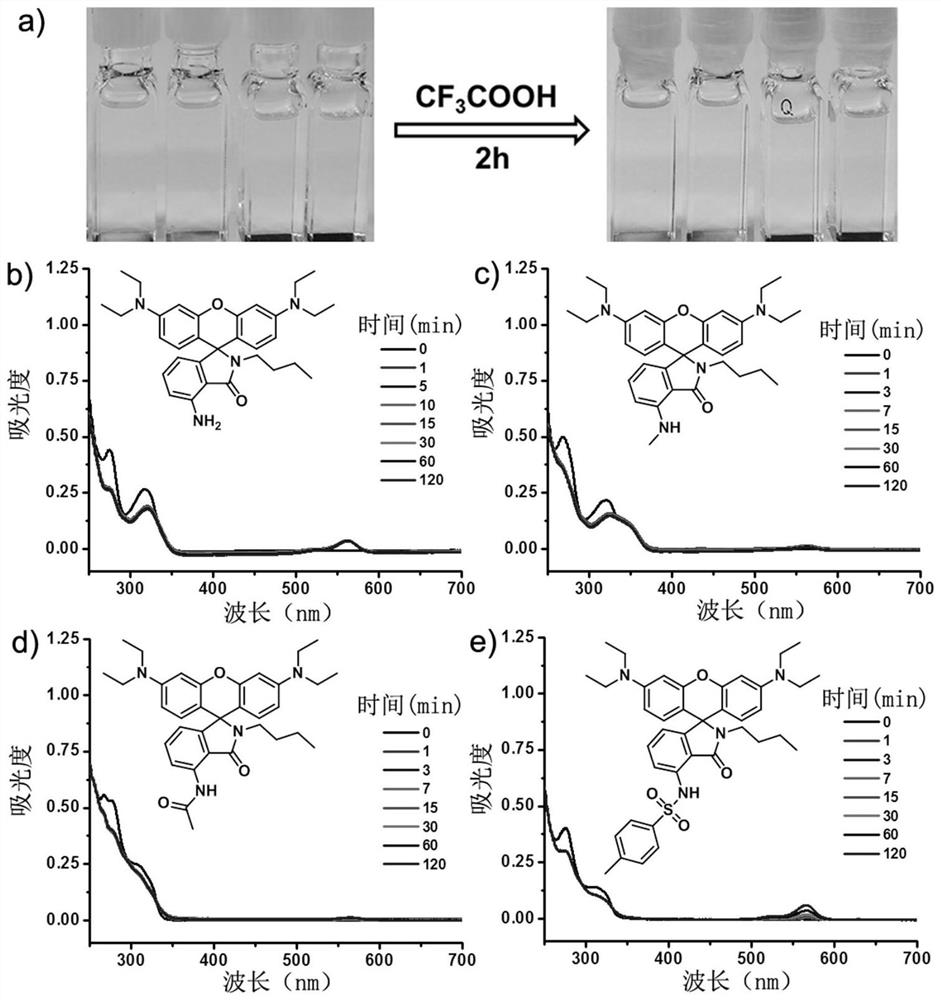
Figure 1 
Figure 2 
Figure 3
Abstract
Description
technical field
[0001] The invention belongs to the field of molecular switches, in particular to an acid-resistant light-controlled fluorescent molecular switch and its synthesis method and application. Background technique
[0002] In recent years, a series of ultra-high-resolution fluorescence imaging techniques have been developed, among which photoactivated localization microscopy (PLAM) and stochastic optical reconstruction microscopy (STORM or dSTORM) based on single-molecule localization have enabled the spatial resolution of optical microscopy to reach Unprecedented height (20nm). At present, super-resolution microscopy imaging technology has been widely used in life science research. However, although super-resolution microscopy imaging technology has made great progress, advancing the spatial resolution of fluorescence microscopy to 20 nanometers, super-resolution fluorescence microscopy imaging The technology still faces many technical problems, one of which is ...
Examples
Embodiment 1
[0033] When R 1 = R 2 = R 3 = R 4 =C 2 h 5 , R 5 =H, X=O, Y=H, Z=C 4 h 9 When, its molecular (P1) synthetic route and product structure are as follows:
[0034]
[0035] Synthesis steps and characterization: 3-Nitrorhodamine (5mmol, 2.4g) and n-butylamine (20mmol, 1.4g) were dissolved in absolute ethanol (50mL). The temperature was raised to 78°C for reflux, and after stirring for 8 hours, the solvent was evaporated under reduced pressure, and the product was separated and purified by silica gel chromatography (petroleum ether / ethyl acetate, 8:1v / v), and the obtained light yellow powder (2.6g, 95% ). Then all the powder was dissolved in methanol / dichloromethane (50mL, 3:1v / v) mixed solvent, under hydrogen atmosphere, by palladium carbon (0.21g, 10%wt) catalytic reduction, the filtrate was taken by suction filtration, and the The final product (2 g, 98%) was obtained as a white powder after removal of the solvent by autoclaving.
[0036] The product was characteri...
Embodiment 2
[0040] When R 1 = R 2 = R 3 = R 4 =C 2 h 5 , R 5 =CH 3 , X=O, Y=H, Z=C 4 h 9 When, its molecular (P2) synthesis route and product structure are as follows:
[0041]
[0042] Synthesis steps and characterization: P1 (0.25g, 0.5mmol), iodomethane (0.28g, 2mmol) and potassium carbonate (0.34g, 2.5mmol) were mixed in acetonitrile (8mL), stirred at reflux for 10 hours, cooled to room temperature and filtered The filtrate was obtained, and the solvent was evaporated under reduced pressure. The crude product was separated and purified by column chromatography (silica gel, petroleum ether / ethyl acetate, 10:1 v / v) to obtain white powder P2 (0.17 g, 65%).
[0043] The product was characterized by NMR and mass spectrometry: 1 H NMR (400MHz, CDCl 3 )δ7.23(t, J=7.9Hz, 1H), 6.75(d, J=4.9Hz, 1H), 6.57(t, J=9.3Hz, 2H), 6.49(d, J=8.1Hz, 1H) ,6.41–6.22(m,5H),3.33(q,J=7.0Hz,8H),3.04(s,2H),2.97(d,J=4.9Hz,3H),1.16(t,J=6.9Hz, 12H), 1.07(s, 4H), 0.67(t, J=6.5Hz, 3H). 13 C NMR (101MH...
Embodiment 3
[0047] When R 1 = R 2 = R 3 = R 4 =C 2 h 5 , R 5 =CH 3 CO, X=O, Y=H, Z=C 4 h 9 When, its molecular (P3) synthesis route and product structure are as follows:
[0048]
[0049] Synthesis steps and characterization: P1 (0.25g, 0.5mmol) and acetyl chloride (58mg, 0.75mmol) were mixed in dichloromethane (5mL), stirred for 2 hours, and the solvent was evaporated under reduced pressure, and the crude product was passed through column chromatography (silica gel, Petroleum ether / ethyl acetate, 8:1 v / v) was separated and purified to obtain white powder P3 (0.26 g, 95%).
[0050] The product was characterized by NMR and mass spectrometry: 1 H NMR (400MHz, CDCl 3 )δ10.60(s,1H),8.43(d,J=8.2Hz,1H),7.39(t,J=7.9Hz,1H),6.74(d,J=7.6Hz,1H),6.46(d, J=8.8Hz, 2H), 6.38(d, J=2.6Hz, 2H), 6.28(dd, J=8.9, 2.6Hz, 2H), 3.34(q, J=7.0Hz, 8H), 3.06(t, J=7.0Hz, 2H), 2.29(s, 3H), 1.17(t, J=7.0Hz, 12H), 1.12–1.02(m, 4H), 0.69(t, J=6.7Hz, 3H). 13 CNMR (101MHz, CDCl 3 )δ169.30,168.85,158.27,15...