Double-frequency orthogonal stripe depth segmentation method based on Fourier transform
What is AI technical title?
AI technical title is built by PatSnap AI team. It summarizes the technical point description of the patent document.
A Fourier transform and depth segmentation technology, applied in the field of computer vision, can solve problems such as reducing computing speed, and achieve the effect of low computing consumption
Inactive Publication Date: 2020-07-17
NORTH CHINA INST OF AEROSPACE ENG
View PDF0 Cites 0 Cited by
Summary
Abstract
Description
Claims
Application Information
AI Technical Summary
This helps you quickly interpret patents by identifying the three key elements:
Problems solved by technology
Method used
Benefits of technology
Problems solved by technology
However, this method needs to project multiple frames of rasters, and the sequence transformation of rasters is required in the data processing stage, which will reduce the calculation speed
Method used
the structure of the environmentally friendly knitted fabric provided by the present invention; figure 2 Flow chart of the yarn wrapping machine for environmentally friendly knitted fabrics and storage devices; image 3 Is the parameter map of the yarn covering machine
View more
Image
Smart Image Click on the blue labels to locate them in the text.
Viewing Examples
Smart Image
Click on the blue label to locate the original text in one second.
Reading with bidirectional positioning of images and text.
Smart Image
Examples
Experimental program
Comparison scheme
Effect test
Embodiment 1
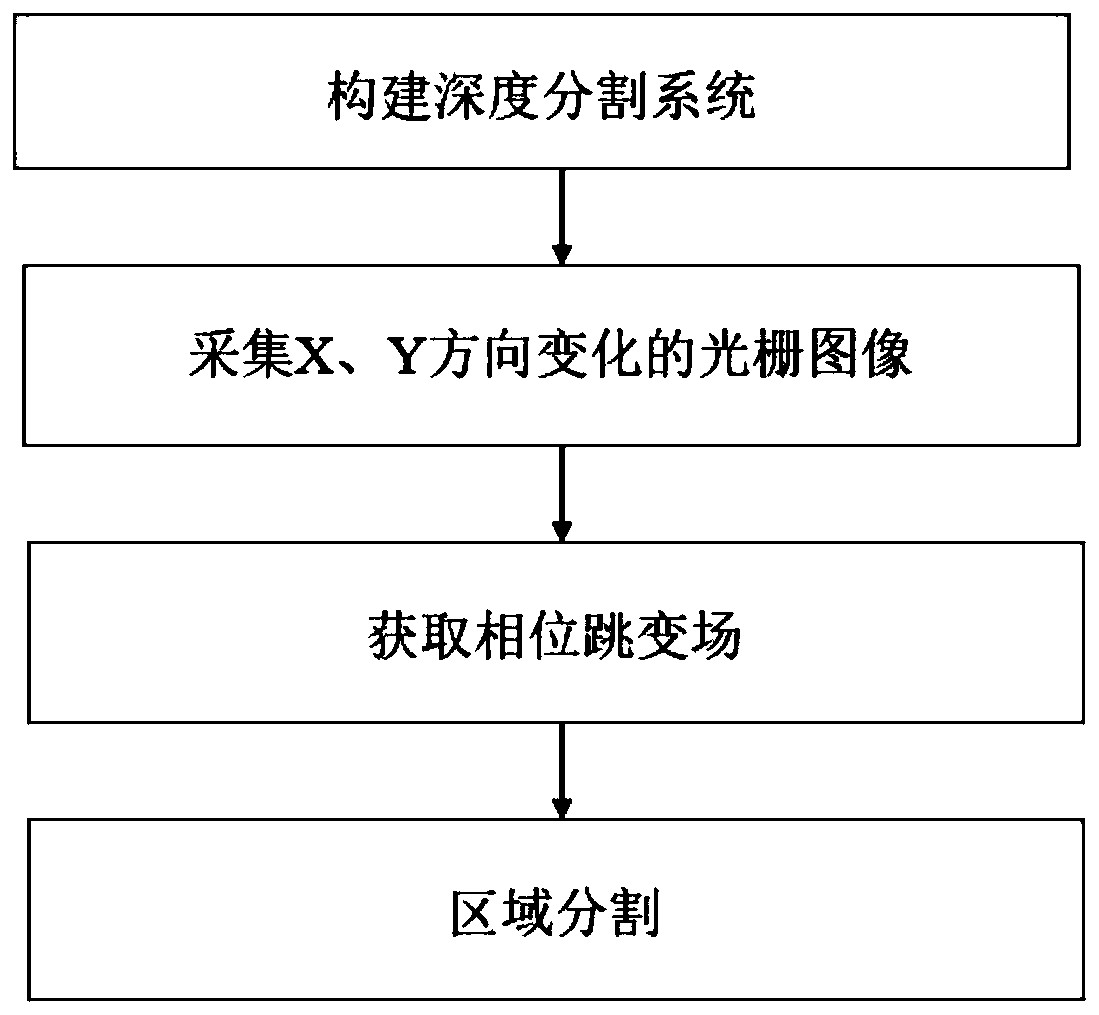
[0049] see Figure 1-Figure 5 , a dual-frequency orthogonal fringe depth segmentation method based on Fourier transform, comprising the following steps:
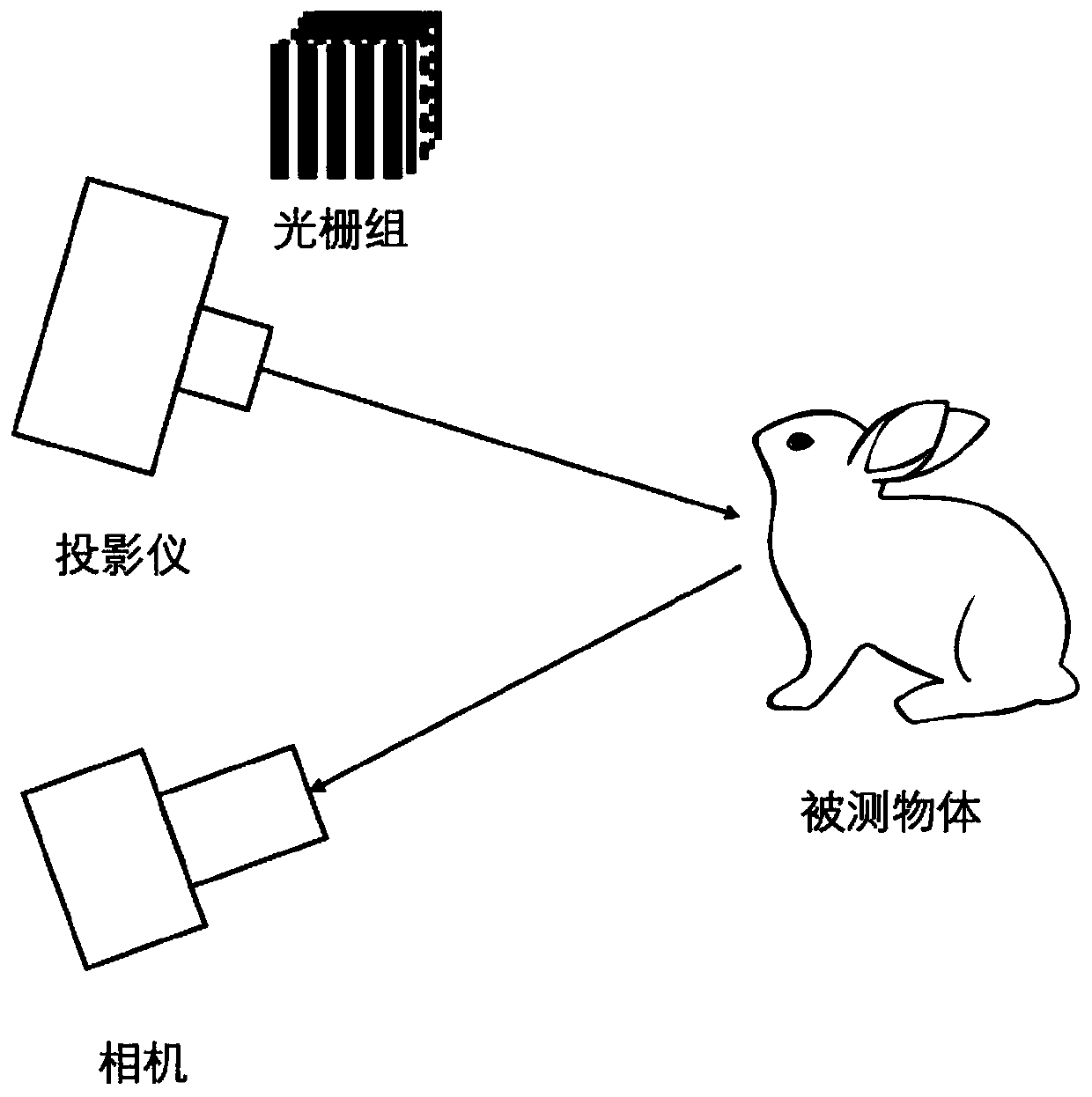
[0051] Wherein, the three points where the projection system, the camera, and the measured object are located are in a triangular relationship, and the specific included angle is only related to the measurement accuracy, which is not limited in this embodiment.
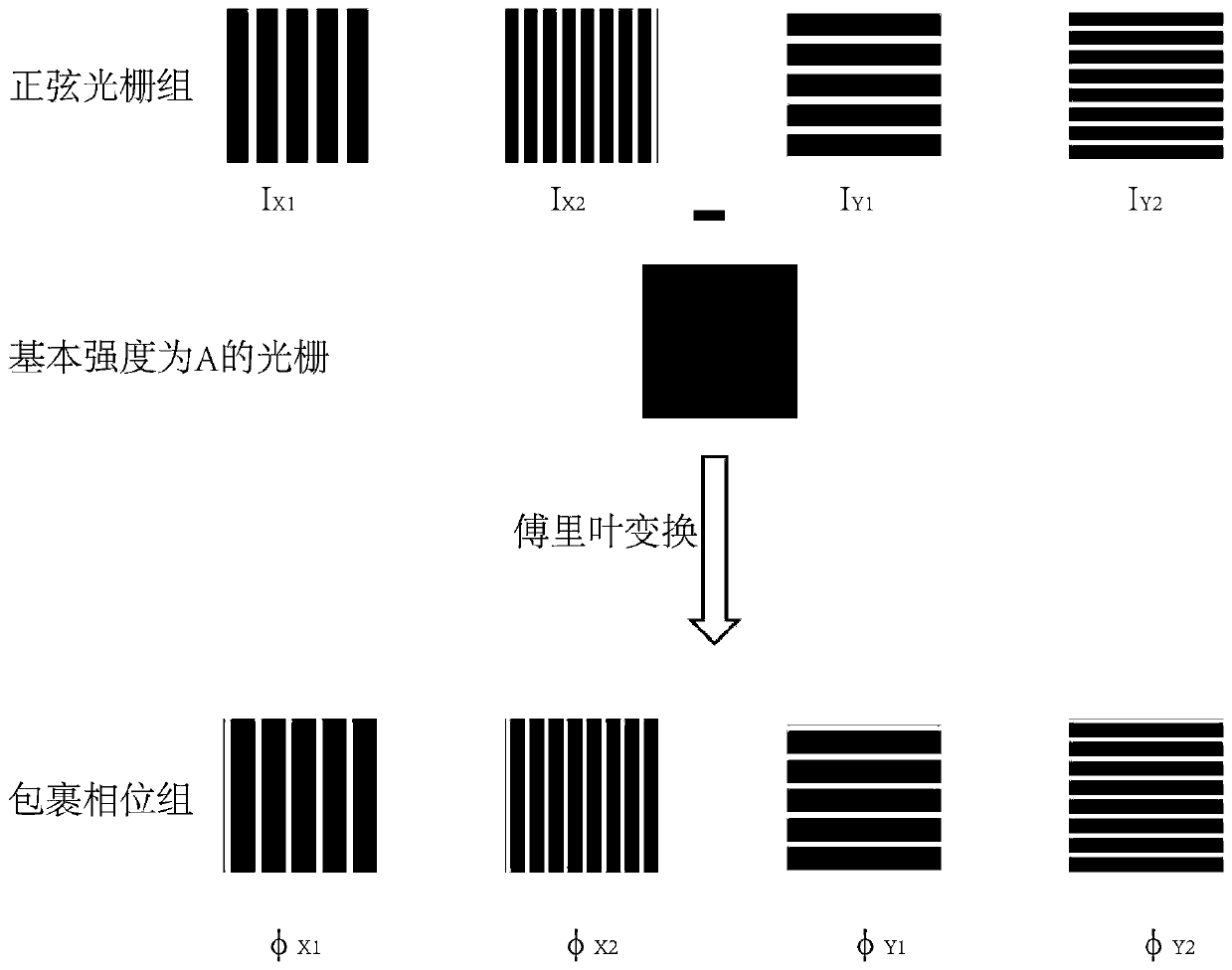
[0052] Step 102: if image 3 As shown, the dual-frequency sinusoidal grating sequence that changes mutually orthogonally along the X and Y directions and a grating with a basic intensity of A are sequentially projected onto the surface of the object; Figure 4 The X and Y direction change stripes shown are the grating images;
[0053] In step 102, assume that the dual-frequency sinusoidal grating sequence IXi and I Yi (i=1,2) al...
Embodiment 2
[0090] The embodiment of the present invention shows the simulation results of segmenting multiple objects, combined below figure 1 , Figure 6 and Figure 7 The scheme in Example 1 is further introduced, see the following description for details:
[0091] Such as figure 1 As shown, in the actual measurement process, the depth segmentation system composed of the projection system, camera, and measured object is assembled and constructed into a triangulation relationship;
[0092] Among them, in the actual experiment process, the included angle between the projection system, the camera, and the object to be measured can be freely adjusted according to the size of the occlusion. The embodiment of the present invention does not limit this, only figure 1 Take the positional relationship and angle in , as an example to illustrate.
[0093] Figure 6 The highly modulated orthogonal grating sequence is shown, and the grating sequence shows that the simulation results contain mu...
the structure of the environmentally friendly knitted fabric provided by the present invention; figure 2 Flow chart of the yarn wrapping machine for environmentally friendly knitted fabrics and storage devices; image 3 Is the parameter map of the yarn covering machine
Login to View More
PUM
Login to View More
Abstract
The invention discloses a double-frequency orthogonal stripe depth segmentation method based on Fourier transform. The method comprises the following steps: constructing a depth segmentation system composed of a projection system, a camera and a measured object; projecting two groups of X and Y double-frequency orthogonal sinusoidal grating sequences and a grating with the basic intensity of A tothe surface of the object, solving corresponding wrapped phases in the X and Y directions by utilizing Fourier transform, and obtaining a phase jump field; extracting corresponding common parts by using the phase jump fields in the X direction and the Y direction respectively, and obtaining coarse segmentation lines respectively; optimizing (such as a morphological expansion method and refining treatment) the segmentation lines to obtain X and Y fine segmentation lines; summing the fine segmentation lines in the X direction and the Y direction to obtain a total segmentation line; and performing negation operation on the total segmentation line to obtain a segmentation result. According to the invention, rapid segmentation of an object is realized; the edge position of the object can be accurately extracted.
Description
technical field [0001] The invention relates to a depth segmentation method, in particular to a depth segmentation method based on fringe projection technology, and belongs to the technical field of computer vision. Background technique [0002] 3D depth segmentation is a technique to divide different depth objects into several specific depth regions with unique properties and propose objects of interest. This technology is widely used in many fields, such as object surface defect detection, robot grasping recognition, particle morphology characterization, etc. [1-3] . [0003] 3D depth segmentation originates from image segmentation, and image segmentation technology has been greatly developed in recent decades. Early image segmentation methods mainly include threshold-based segmentation methods and region-based segmentation methods. The threshold-based segmentation method divides image pixels into several categories by setting different feature thresholds. However, in ...
Claims
the structure of the environmentally friendly knitted fabric provided by the present invention; figure 2 Flow chart of the yarn wrapping machine for environmentally friendly knitted fabrics and storage devices; image 3 Is the parameter map of the yarn covering machine
Login to View More
Application Information
Patent Timeline
Application Date:The date an application was filed.
Publication Date:The date a patent or application was officially published.
First Publication Date:The earliest publication date of a patent with the same application number.
Issue Date:Publication date of the patent grant document.
PCT Entry Date:The Entry date of PCT National Phase.
Estimated Expiry Date:The statutory expiry date of a patent right according to the Patent Law, and it is the longest term of protection that the patent right can achieve without the termination of the patent right due to other reasons(Term extension factor has been taken into account ).
Invalid Date:Actual expiry date is based on effective date or publication date of legal transaction data of invalid patent.



 Login to View More
  Login to View More