Shale gas reservoir fluid-solid coupling multi-scale numerical simulation method

A shale gas reservoir, fluid-solid coupling technology, applied in CAD numerical modeling, complex mathematical operations, electrical digital data processing, etc., can solve problems such as small calculation area, large calculation amount, and difficult grid division

CN111553108AActive Publication Date: 2020-08-18CHINA UNIV OF PETROLEUM (EAST CHINA)
3 Cites 19 Cited by

Patent Information

Authority / Receiving Office
CN · China
Current Assignee / Owner
Publication Date
2020-08-18

Smart Images

  • Figure 1
    Figure 1
  • Figure 2
    Figure 2
  • Figure 3
    Figure 3
Patent Text Reader

Abstract

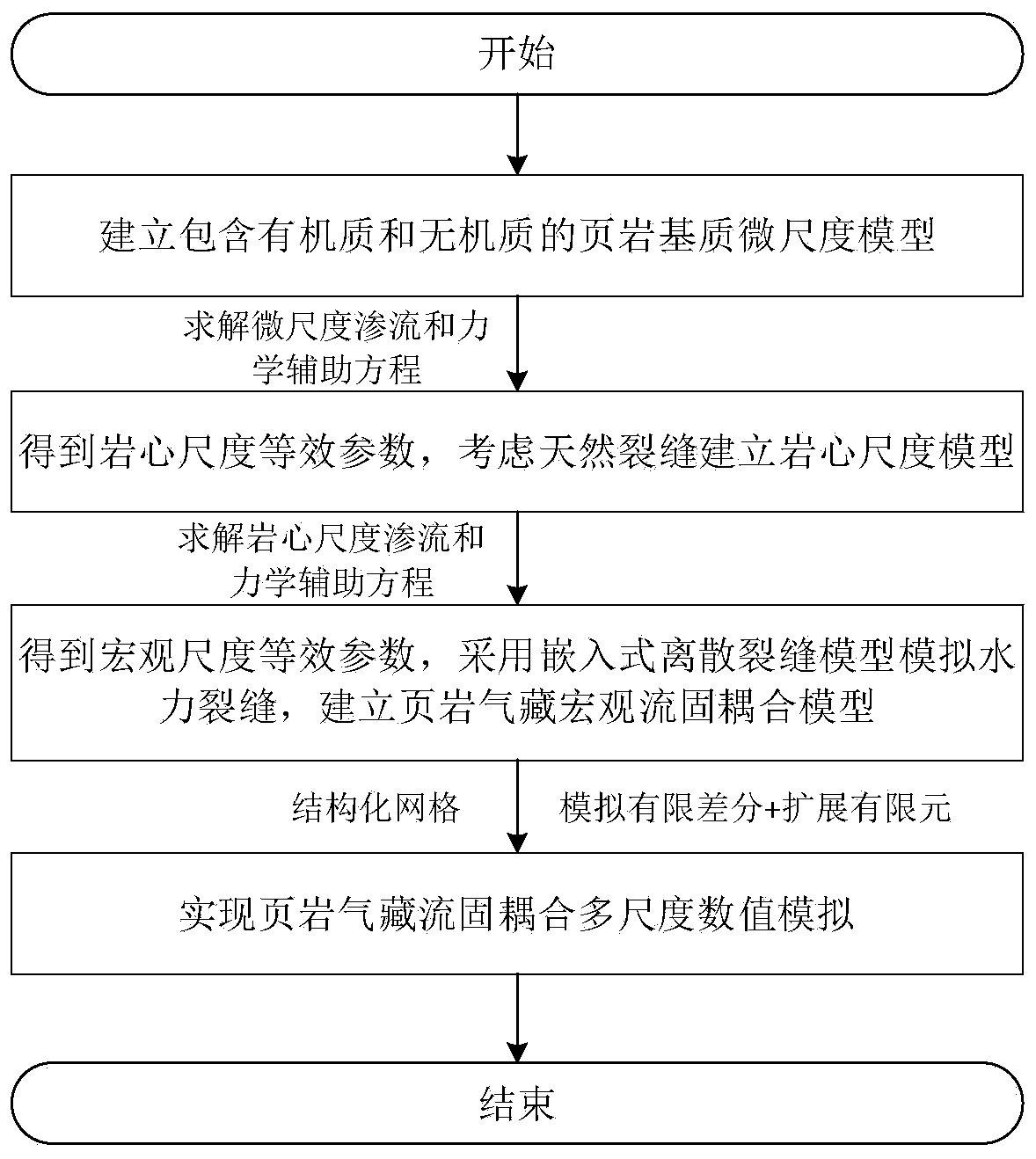
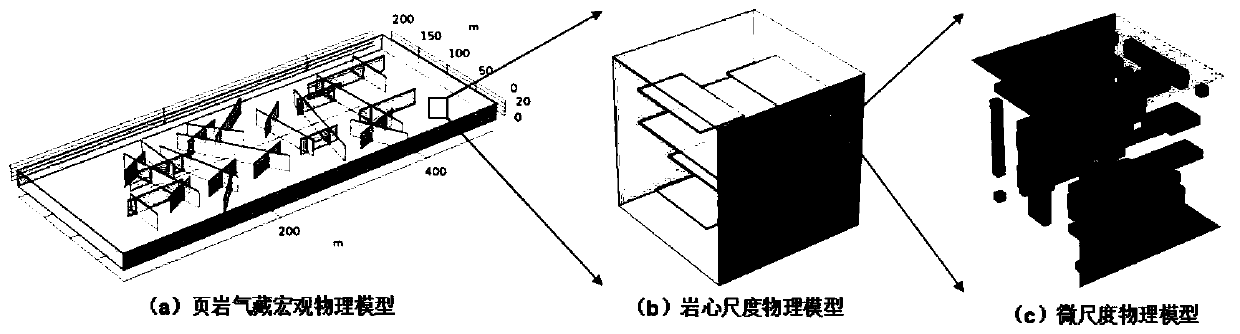
The invention discloses a shale gas reservoir fluid-solid coupling multi-scale numerical simulation method. The method comprises the following steps: obtaining spatial distribution and physical property parameters of organic matters and inorganic matters, constructing a physical model of a micro-scale shale matrix, solving a micro-scale seepage auxiliary equation and a mechanical auxiliary equation, and calculating equivalent seepage and mechanical parameters of the shale matrix core scale; acquiring a natural fracture distribution situation, constructing a rock core scale physical model containing a shale matrix and natural fractures, solving a seepage auxiliary equation and a mechanical auxiliary equation of the rock core scale, and calculating equivalent seepage and mechanical parameters of a shale gas reservoir macro-scale; on the basis, simulating a hydraulic fracture by adopting an embedded discrete fracture model, and establishing a shale gas reservoir macroscopic fluid-solid coupling model; and finally, based on the structured grid, solving the shale gas reservoir fluid-solid coupling model by adopting a mixed numerical discretization method combining simulated finite difference and extended finite elements so as to realize shale gas reservoir fluid-solid coupling numerical simulation with high simulation precision and small calculated amount.
Need to check novelty before this filing date? Find Prior Art

Description

technical field

[0001] The invention relates to the field of reservoir numerical simulation, in particular to a multi-scale numerical simulation method for fluid-solid coupling of shale gas reservoirs Background technique

[0002] Shale gas resources are widely distributed and have large reserves, but the permeability of the reservoir matrix is ​​extremely low, and hydraulic fracturing is usually required for commercial exploitation. After fracturing, shale gas reservoirs develop a large number of fractures and are in a complex in-situ stress field In the joint action of the seepage field and the seepage field, the fluid-solid coupling effect is significant. At the same time, shale gas reservoirs contain multi-scale storage and seepage spaces: micro-scale organic and inorganic pores, core-scale natural fractures, and macro-scale artificial fractures. However, the current macroscopic numerical simulation methods for shale gas reservoirs are difficult to accurately capture th...

Examples

Embodiment Construction

[0060] The following will clearly and completely describe the technical solutions in the embodiments of the present invention with reference to the accompanying drawings in the embodiments of the present invention. Obviously, the described embodiments are only some, not all, embodiments of the present invention. Based on the embodiments of the present invention, all other embodiments obtained by persons of ordinary skill in the art without making creative efforts belong to the protection scope of the present invention.

[0061] In order to make the above objects, features and advantages of the present invention more comprehensible, the present invention will be further described in detail below in conjunction with the accompanying drawings and specific embodiments.

[0062] refer to Figure 1-7 , the invention discloses a shale gas reservoir fluid-solid coupling multi-scale numerical simulation method, comprising the following steps:

[0063] (1) Obtain the spatial distributi...