Unlock instant, AI-driven research and patent intelligence for your innovation.
CFAR detector based on KL divergence unit screening
What is Al technical title?
Al technical title is built by PatSnap Al team. It summarizes the technical point description of the patent document.
A KL divergence and detector technology, applied in the field of CFAR detectors, can solve problems such as ineffective extraction, and achieve the effect of good detection performance
Active Publication Date: 2020-09-22
HARBIN INST OF TECH
View PDF12 Cites 5 Cited by
Summary
Abstract
Description
Claims
Application Information
AI Technical Summary
This helps you quickly interpret patents by identifying the three key elements:
Problems solved by technology
Method used
Benefits of technology
Problems solved by technology
[0003]
The purpose of the present invention is: in view of the priori information of the number of interference targets that the existing detector needs in the multi-target background, the number of large-value deletions in TM-CFAR needs to be artificially set, and the problem that cannot be effectively extracted from the environment is proposed. A CFAR detector based on KL divergence unit screening
Method used
the structure of the environmentally friendly knitted fabric provided by the present invention; figure 2 Flow chart of the yarn wrapping machine for environmentally friendly knitted fabrics and storage devices; image 3 Is the parameter map of the yarn covering machine
View more
Image
Smart Image Click on the blue labels to locate them in the text.
Viewing Examples
Smart Image
Click on the blue label to locate the original text in one second.
Reading with bidirectional positioning of images and text.
Smart Image
Examples
Experimental program
Comparison scheme
Effect test
specific Embodiment approach 1
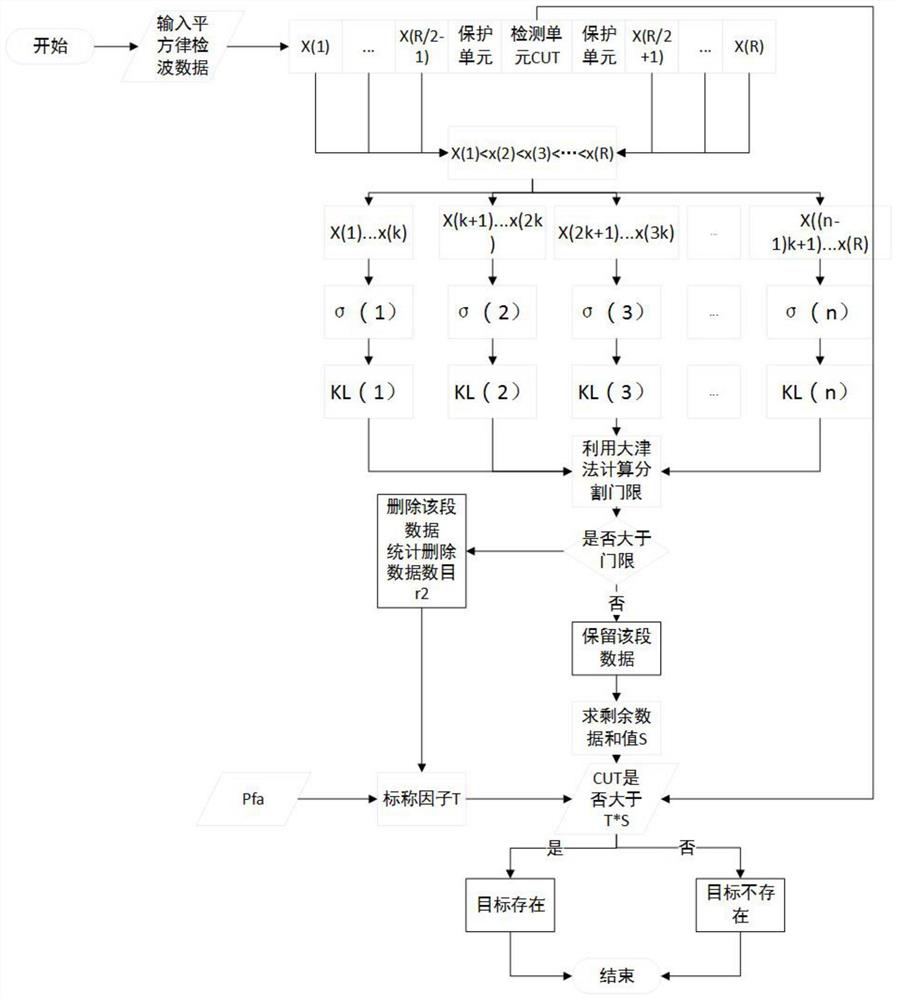
[0056] Specific implementation mode one: refer to figure 1 Specifically illustrate this embodiment, a kind of CFAR detector based on KL divergence unit screening described in this embodiment, comprises the following steps:
[0057] Step 1: Receive radarecho signal data, and process the signal data through square law detection;
[0058] Step 2: Load the signal data after square-law detection into the front and rear sliding windows of the reference unit;
[0059] Step 3: Sort the loaded data of the reference unit from small to large to obtain ordered data
[0060] x(1)≤x(2)≤...≤x(R);
[0061] Step 4: Divide the ordered data into n integer segments x(1)...x(k), x(k+1)...x(2k),...,x((n-1)k +1)...x(R), where n*k=R;
[0062] Step 5: Calculate the standard deviation for each piece of data;
[0063] Step 6: Calculate the statistical distribution difference between each piece of data and the first piece of data, that is, the KL divergence value;
[0064] Step 7: Calculate the se...
Embodiment 1
[0101] In this embodiment, a CFAR detector based on KL divergence data selection is specifically prepared according to the following steps:
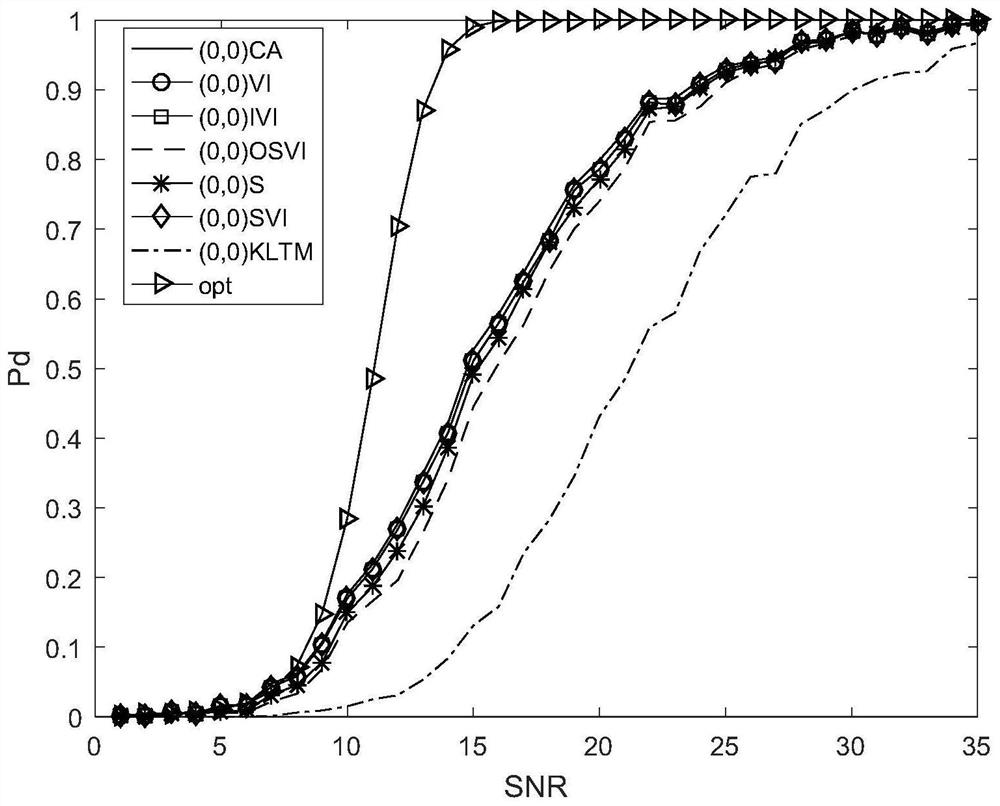
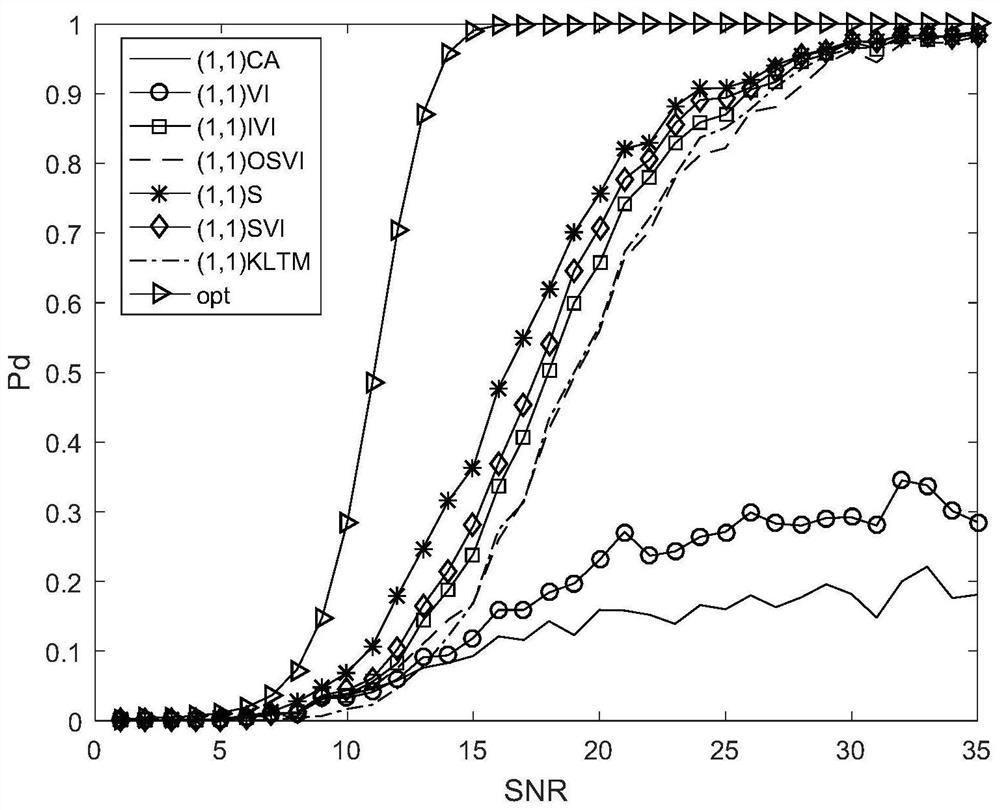
[0102] Simulation experiments are used to verify the effectiveness of the designed algorithm. The number of reference units is R=16, the number of each segment of data is 2, the designed method is recorded as KLTM-CFAR, and the comparison method uses CA-CFAR, VI-CFAR, IVI-CFAR, OSVI-CFAR, SVI-CFAR, S- CFAR, k=3*R / 4=12 in OS-CFAR, k=6 in OS-CFAR in OSGO and OSSO, VI parameter setting: K VI =4.56,K MR = 2.9, the parameters of S-CFAR are set to α = 0.4, β = 24.55, N t =11, false alarm rate setting P fa =10 -6 , the number of Monte Carlo simulations is 1000, respectively set a uniform environment, a multi-target environment with 1 interference target at the front and rear edges, a multi-target environment with 2 interference targets at the rear edge, and a multi-target environment with 3 interference targets at the front and rear edges ...
the structure of the environmentally friendly knitted fabric provided by the present invention; figure 2 Flow chart of the yarn wrapping machine for environmentally friendly knitted fabrics and storage devices; image 3 Is the parameter map of the yarn covering machine
Login to View More
PUM
Login to View More
Abstract
The invention discloses a CFAR detector based on KL divergence unit screening, and relates to the technical field of radar target detection. In allusion to the problems that the existing detector needs the priori information of the number of interference targets under a multi-target background, and the large-number deletion number in TM-CFAR needs to be manually set and cannot be effectively extracted from the environment, the invention designs a novel detector by combining KL divergence and an Otsu method. Abnormal values with relatively high amplitudes can be effectively eliminated on the basis of sequencing the detection units, the large-value deletion number in the TM-CFAR is adaptively and effectively determined according to the change of the environment, the number of the anti-impacttargets is adaptively adjusted according to the condition of a reference unit, prior information of the number of the interference targets is not needed, and the method has good detection performancein a multi-target environment.
Description
technical field [0001] The invention relates to the technical field of radar target detection, in particular to a CFAR detector based on KL divergence unit screening. Background technique [0002] Traditional CFAR detection detectors are mainly designed for exponential distribution (Gaussian distributed clutter becomes exponential distribution after square-law detection), and are divided into mean CFAR detectors and ordered CFAR detectors. Mean CFAR detectors include CA-CFAR, GO-CFAR and SO-CFAR, while the classic ordered CFAR is mainly OS-CFAR, and its improved CMLD-CFAR and TM-CFAR. In the uniform background, CA-CFAR has the best detection performance, but the detection probability deteriorates rapidly in the multi-target environment; GO-CFAR detector can control the false alarm caused by the high clutter background in the clutter edge environment, but Also, the detection probability decreases in the multi-target environment; SO-CFAR improves the performance of CA-CFAR in...
Claims
the structure of the environmentally friendly knitted fabric provided by the present invention; figure 2 Flow chart of the yarn wrapping machine for environmentally friendly knitted fabrics and storage devices; image 3 Is the parameter map of the yarn covering machine
Login to View More
Application Information
Patent Timeline
Application Date:The date an application was filed.
Publication Date:The date a patent or application was officially published.
First Publication Date:The earliest publication date of a patent with the same application number.
Issue Date:Publication date of the patent grant document.
PCT Entry Date:The Entry date of PCT National Phase.
Estimated Expiry Date:The statutory expiry date of a patent right according to the Patent Law, and it is the longest term of protection that the patent right can achieve without the termination of the patent right due to other reasons(Term extension factor has been taken into account ).
Invalid Date:Actual expiry date is based on effective date or publication date of legal transaction data of invalid patent.

 Login to View More
  Login to View More