

Hybrid wireless transceiver architecture that supports multiple antenna arrays
A wireless transceiver and antenna array technology, applied in antenna arrays, individually powered antenna arrays, diversity/multi-antenna systems, etc., can solve the problem of affecting system performance, limiting the space diversity capability or frequency diversity capability of electronic equipment, increasing costs, etc. question
- Summary
- Abstract
- Description
- Claims
- Application Information
AI Technical Summary
Problems solved by technology
Method used
Image



Examples
Embodiment Construction
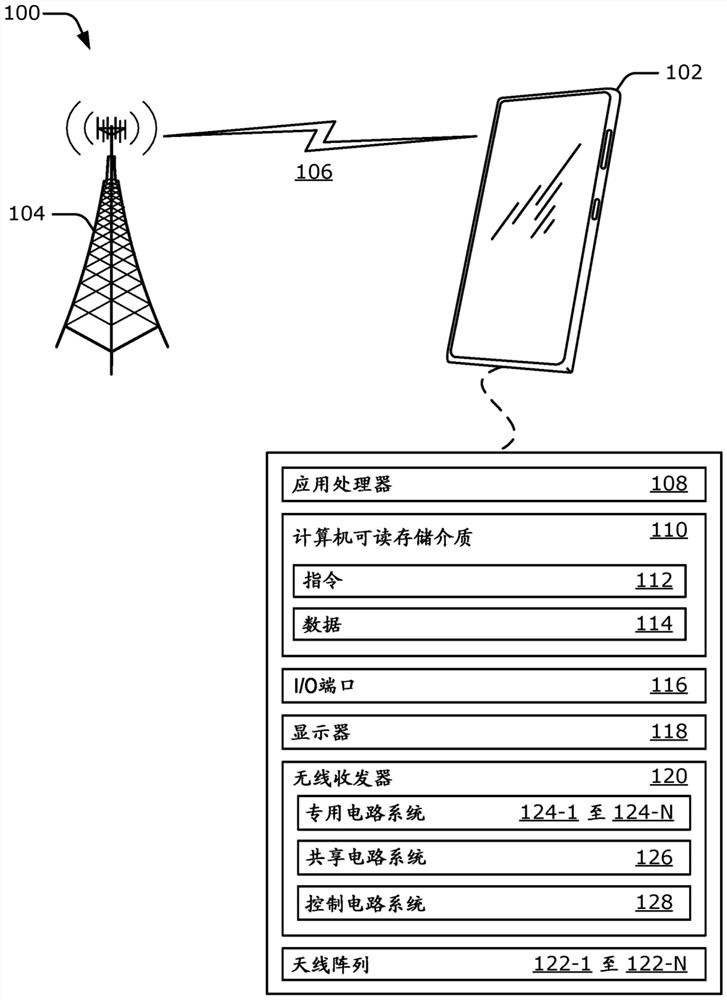
[0021] Although utilizing multiple antenna arrays can increase the spatial coverage of an electronic device or increase the number of frequency bands supported by an electronic device, it can be challenging to design a wireless transceiver to support multiple antenna arrays and fit within the size constraints of the electronic device without Negatively affect system performance or increase cost. Some wireless transceiver architectures include separate or dedicated transceiver chains for each antenna element within multiple antenna arrays. However, these separate transceiver chains take up space and can limit the number of antenna arrays that can be supported within a smaller electronic device. Therefore, this approach may be impractical for electronic devices where small size or low weight are valued.
[0022] Other wireless transceiver architectures may utilize switches to connect a shared transceiver chain to different antenna elements of different antenna arrays. However,...
PUM
 Login to View More
 Abstract
Description
Claims
Application Information
 Login to View More