Novel stator and rotor structure of surface-mounted permanent magnet motor

A permanent magnet motor, surface mount technology, applied in the magnetic circuit shape/style/structure, magnetic circuit rotating parts, magnetic circuit and other directions, can solve the problem of unstable torque output, low power density, cogging torque and The problem of high eddy current loss can reduce the cogging torque ripple, reduce the control temperature rise, and reduce the waveform distortion rate.

CN112838695AInactive Publication Date: 2021-05-25HARBIN UNIV OF SCI & TECH
8 Cites 0 Cited by

Patent Information

Authority / Receiving Office
CN · China
Patent Type
Applications(China)
Current Assignee / Owner
Publication Date
2021-05-25
Estimated Expiration
Not applicable · inactive patent

Smart Images

  • Figure 1
    Figure 1
Patent Text Reader

Abstract

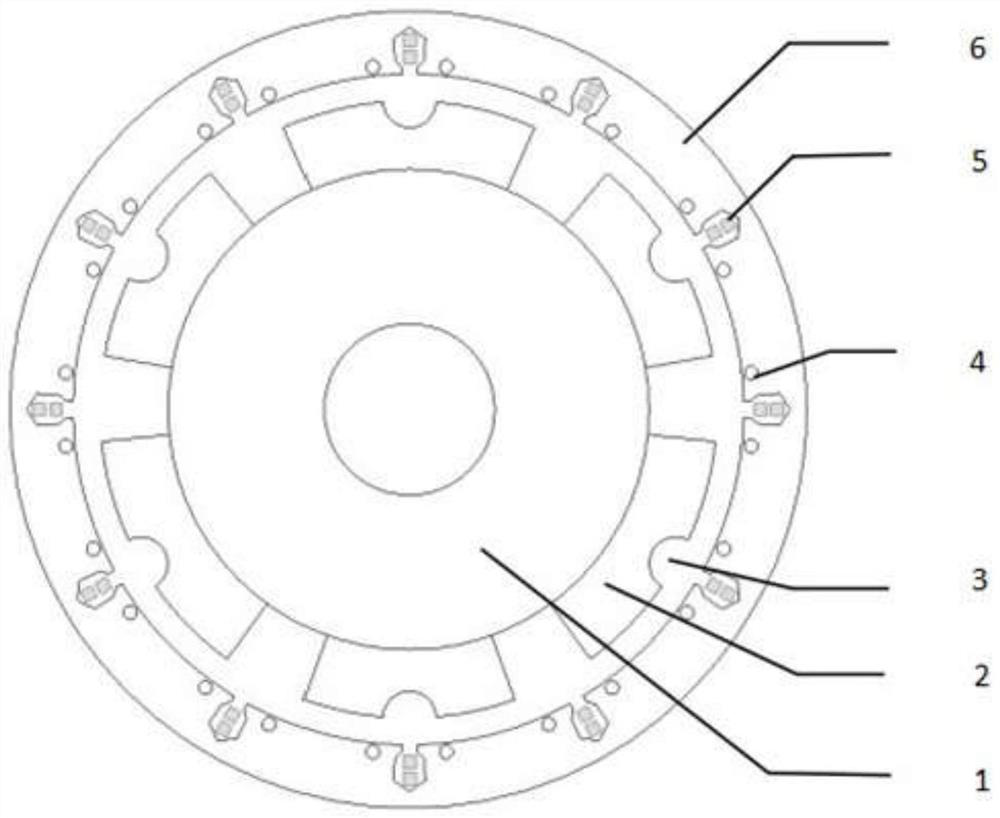
The invention discloses a stator and rotor structure of a surface-mounted permanent magnet motor, which comprises a stator, a rotor, stator water holes, permanent magnets and permanent magnet auxiliary grooves. In order to output high torque and stably operate the motor, the structure adopts an inner rotor and outer stator mechanism, the inner rotor adopts a magnetic pole surface-mounted type, and the magnetic pole adopts two non-uniform permanent magnets, the inner side arc and the outer side arc are located on the same circle with the proportion of 6:5, auxiliary grooves are formed in magnetic poles, excitation windings are placed in inner stator winding grooves, and two round holes are formed in stator teeth to be connected with water pipes to facilitate heat dissipation of the motor. According to the invention, the asymmetric structure of the magnetic poles is used to reduce eddy current loss and optimize the air-gap flux density waveform, reduce magnetic leakage and enhance the sinusoidal property of the air-gap magnetic field; the permanent magnets are used for forming auxiliary slots to reduce cogging torque pulsation; and the purposes of reducing the waveform irregularity and controlling the temperature rise are achieved by using the water holes formed in the stator, so that the motor can operate more safely and stably.
Need to check novelty before this filing date? Find Prior Art

Description

technical field

[0001] The invention relates to the technical field of motor structure, in particular to the stator and rotor structure of a surface-mounted permanent magnet motor. Background technique

[0002] Permanent magnet motors are more and more widely used because of their high efficiency, high output torque and simple structure. Using permanent magnets instead of electric excitation can meet the energy-saving requirements of projects. Permanent magnet motors are more and more widely used in permanent magnet motors. The requirements are higher, but because the permanent magnet surface-mounted motor has lower power density than the permanent magnet built-in motor, the cogging torque and eddy current loss are higher, so the temperature of the motor will rise and the torque output will be unstable, which limits the motor. development of. In order to adapt to the occasions of higher power density and high torque density, the motor needs to be improved. Contents of the...

Examples

Embodiment Construction

[0012] The following will clearly and completely describe the technical solutions in the embodiments of the present invention in conjunction with the accompanying drawings in the embodiments of the present invention. Obviously, the described examples are only some, not all, embodiments of the present invention. Based on the embodiments of the present invention, all other embodiments obtained by persons of ordinary skill in the art without making creative efforts belong to the protection scope of the present invention.

[0013] In the description of the present invention, it should be understood that the orientations or positional relationships indicated by the terms "upper", "lower", "left" and "right" are based on the orientations and positional relationships shown in the drawings, and are only for convenience of description It does not indicate or imply that the referred part must have a specific orientation and operate in a specific orientation, and thus should not be constr...