

Gaze intention recognition method and system based on historical visual behaviors
A visual behavior and recognition method technology, applied in the field of intent recognition, can solve the problem of not considering the impact, etc., to achieve the effect of improving accuracy, high classification accuracy, and improving accuracy
- Summary
- Abstract
- Description
- Claims
- Application Information
AI Technical Summary
Problems solved by technology
Method used
Image

Examples
Embodiment 1
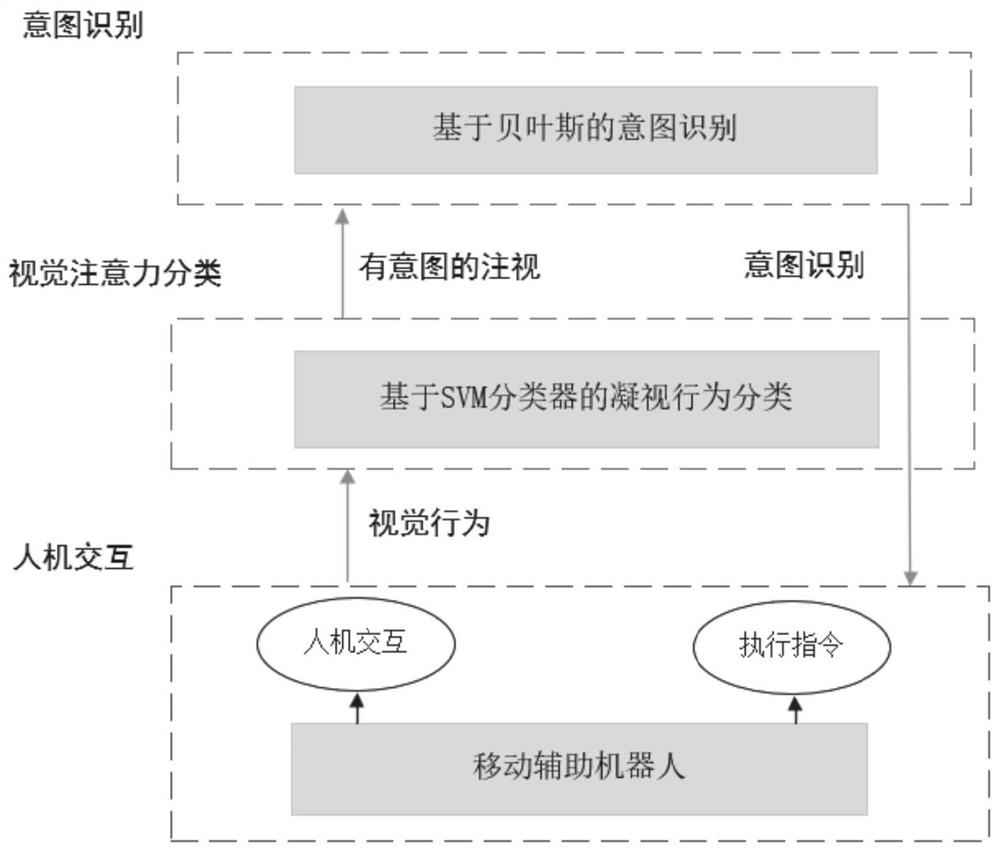
[0044] In the technical solution disclosed in one or more embodiments, a method for gazing intention recognition based on historical visual behavior, the method first extracts eye movement features, including, gazing duration, gazing times, gazing interval and gazing speed; then using The SVM classifier divides the gaze behavior into intentional gaze and unintentional gaze according to the eye movement characteristics; finally, the Naive Bayesian method is used to infer the person's intention according to the historical gaze objects.
[0045] like figure 1 The frame diagram of the fixation intention recognition method based on historical visual behavior is shown. The framework is mainly composed of three parts: first, use Tobii eye tracker 5 to extract eye movement features, namely fixation duration, fixation times, fixation interval and fixation speed; Then, use the support vector machine SVM classifier to divide the gaze behavior into intentional gaze and unintentional gaze ...
Embodiment 2
[0096] The present embodiment provides a system for gazing intention recognition based on historical visual behavior, including:
[0097] The data acquisition module is used to acquire the user's historical visual behavior;
[0098] The eye movement feature extraction module is used to extract the user's eye movement features for each object based on historical visual behavior;
[0099] The SVM classification module is used to input the user's eye movement characteristics to the SVM classifier for each object, and judges whether the user is watching the object with intention, and if so, adds the object to the historical attention object sequence with intention;
[0100] The Naive Bayesian classification module is used to input the intentional historical gaze object sequence to the Naive Bayesian classifier to determine the user's intention.
[0101] The eye movement characteristics include fixation duration, fixation times, fixation interval and fixation speed.
Embodiment 3
[0103] This embodiment provides a computer-readable storage medium, in which a plurality of instructions are stored, and the instructions are suitable for being loaded by a processor of a terminal device and executing the above-mentioned gaze intent recognition method based on historical visual behavior.
PUM
 Login to View More
 Abstract
Description
Claims
Application Information
 Login to View More