
Transformer excitation inrush current identification method based on improved symbolic sequence entropy method
A technology of symbol sequence and excitation inrush current, which is applied in the direction of transformer testing, emergency protection circuit devices, electrical components, etc., can solve the problem of magnetic saturation point reduction, achieve the effect of less number, prevent malfunction, and ensure reliability
- Summary
- Abstract
- Description
- Claims
- Application Information
AI Technical Summary
Problems solved by technology
Method used
Image

Examples
Embodiment Construction
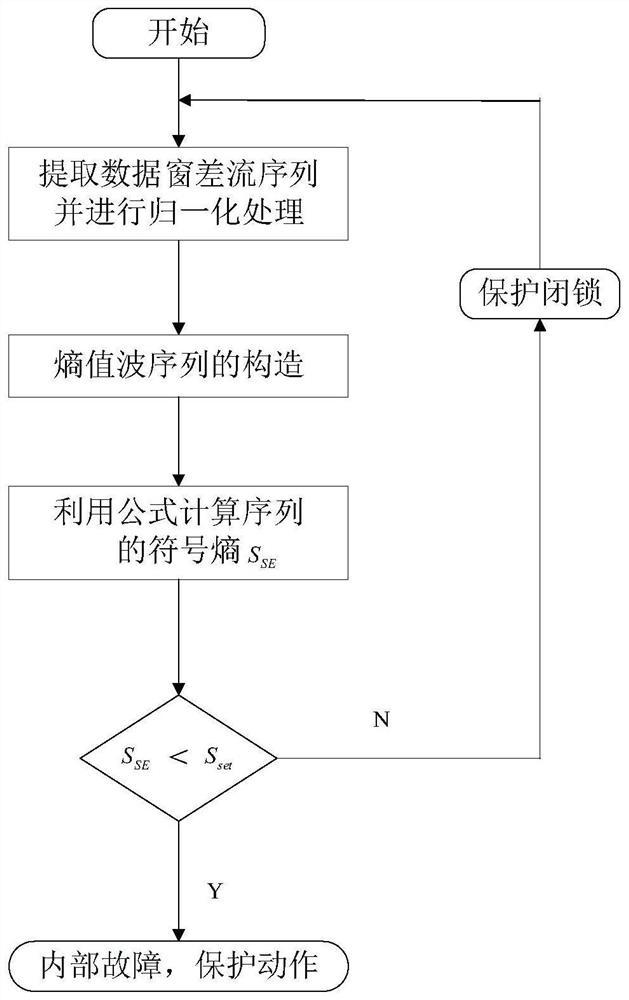
[0057] The transformer excitation inrush current identification method based on the improved symbolic sequence entropy method includes the following steps:
[0058] Step 1: At a certain sampling frequency, according to N points per cycle, collect the secondary current of the current transformers on both sides of the differential protection of the transformer, and form a differential current signal sequence I 1 ={I 1 (1), I 1 (2),...,I 1 (k),...I 1 (N)}, k=1,2,...,N;
[0059] Step 2: Identify the differential current signal sequence I in step 1 1 Whether the value exceeds the setting value of the differential protection starting element, if it exceeds, the starting criterion is used to judge the fault differential current and the excitation inrush current;
[0060] Step 3: Initial signal sequence I for differential flow 1 Perform normalization processing so that all sampling points fall within the [0,1] interval, and obtain the differential flow signal sequence I 2 ={I ...
PUM
 Login to View More
 Abstract
Description
Claims
Application Information
 Login to View More