
A phosphorylated peptide adsorbent and its preparation and application
A phosphorylated peptide and adsorbent technology, applied in the field of immobilized metal ion affinity chromatography materials, can solve the problems of unfavorable large-scale preparation, harsh reaction conditions, and complicated preparation process, and achieve good application prospects, low cost, and easy raw materials The effect
Patent Information
- Authority / Receiving Office
- CN · China
- Patent Type
- Patents(China)
- Current Assignee / Owner
- Publication Date
- 2022-04-08
Smart Images
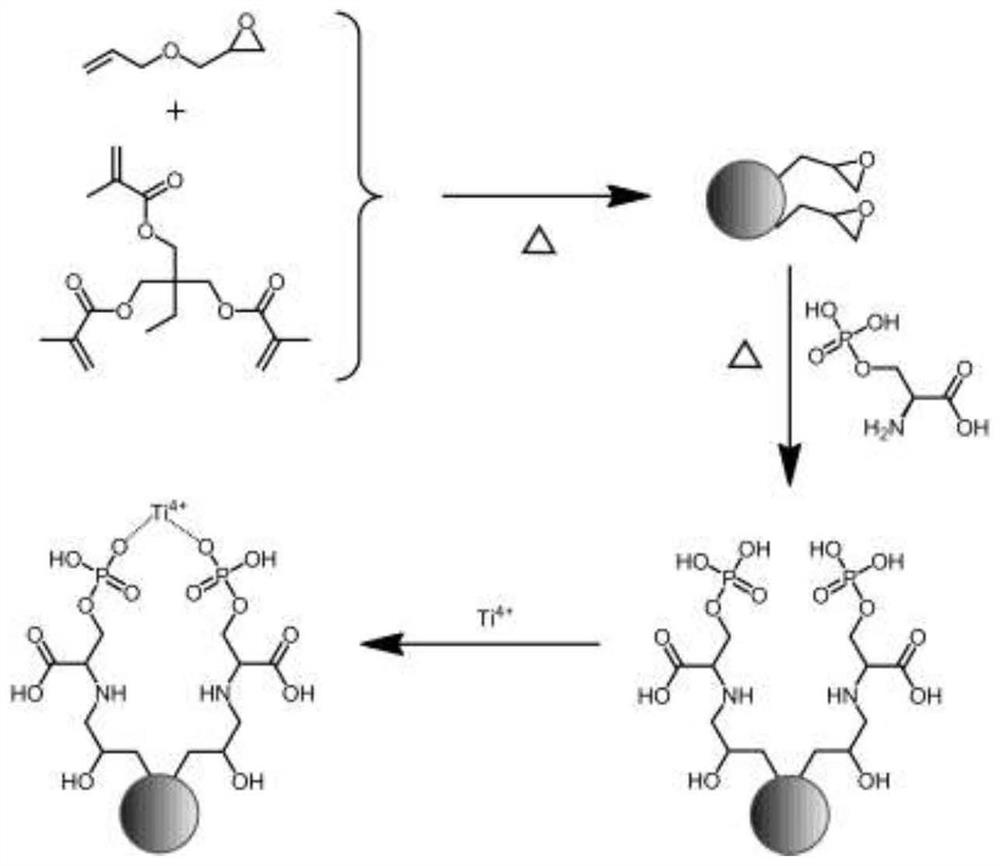
Figure 1 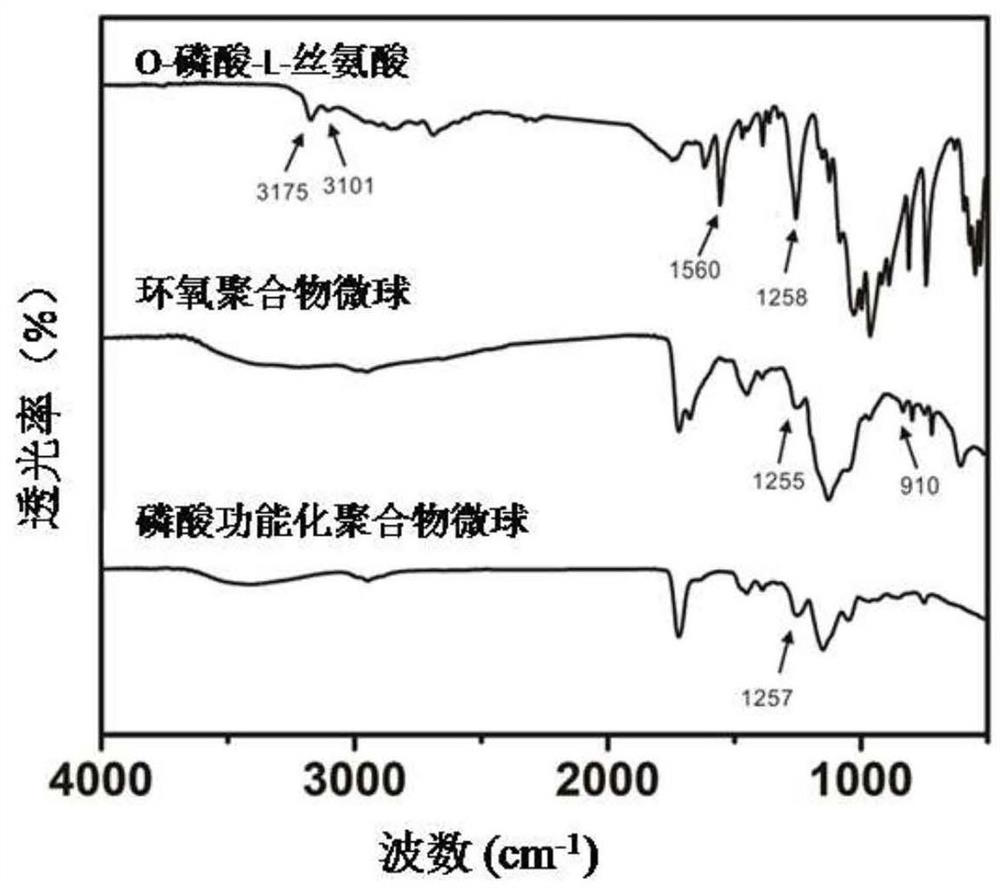
Figure 2 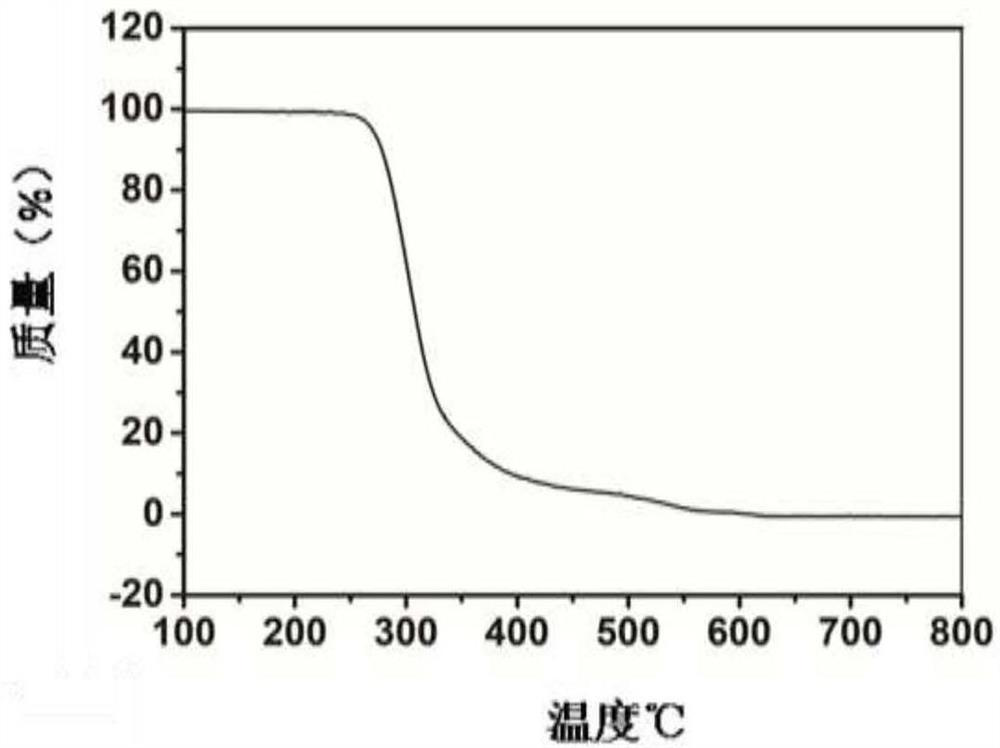
Figure 3
Abstract
Description
technical field
[0001] The invention relates to the preparation and application of a phosphorylated peptide enrichment material. Specifically, polymer microspheres with epoxy groups prepared by a suspension polymerization method are used as a matrix, and O-phospho-L-serine and Ti 4+ Modified to prepare an immobilized metal ion affinity chromatography (IMAC) material that can be used for the enrichment of phosphorylated peptides. Background technique
[0002] Phosphorylation modification is a very important protein post-translational modification. Protein phosphorylation and dephosphorylation almost regulate the entire process of life activities, including cell proliferation, development, differentiation and apoptosis, neural activity, etc. (Reference 1, Steen H.et.al "Phosphorylation Analysis by Mass Spectrometry" Mol.Cell.Proteomecs.2006,5,172-181; Literature 2, Qing G et.al "Hydrogen bond basedsmart polymer for highly selective and tunable capture of multiplyphosphorylated...
Examples
Embodiment 1
[0015] Example 1 Ti prepared based on epoxy polymer microspheres 4+ -IMAC functional materials used in the separation and enrichment of Ti phosphopeptides 4+ - Preparation of IMAC functional materials:
[0016] (1) Preparation of polymer microspheres functionalized with epoxy groups: 0.5 g of polyvinyl alcohol was added to 60 mL of methanol-water mixed solvent (methanol / water=5 / 2, volume ratio), heated to 60° C. It was completely dissolved, then cooled to room temperature (22°C), then 2g of allyl glycidyl ether and 2g of trimethylolpropane trimethacrylate were added dropwise, and then 60mg of azobisisobutyronitrile was added, at 70°C In an oil bath, mechanically stir at a stirring rate of 500rpm, heat up to 85°C after 2h, stop heating after continuing the reaction for 30min, wash the product with methanol and water in turn, remove residual reagents, and vacuum dry at 60°C for 12h to obtain epoxy polymer object microspheres.
[0017] (2) Preparation of polymeric microspheres...
Embodiment 2
[0025] Example 2 Commercial Ti 4+ -IMAC microspheres for separation and enrichment of phosphorylated peptides
[0026] Commercial Ti 4+ - IMAC microspheres were purchased from Bailingwei Reagent Co., Ltd., and the process of enrichment of phosphopeptides and identification by mass spectrometry were the same as in Example 1.
[0027] Material Characterization:
[0028] The epoxy polymer microspheres, phosphoserine-polymer microspheres and O-phospho-L-serine monomer were characterized by Fourier transform attenuated total reflection infrared spectroscopy (ATR-FTIR). Such as figure 2 As shown, the wave number at 910cm appeared in the spectrum of epoxy polymer microspheres -1 and 1255cm -1 The characteristic vibration peak of the epoxy group, while the wave number in the spectrum of phosphoserine-polymer microspheres is at 910cm -1 The absorption peak disappears, and the wavenumber is at 1255cm -1 The intensity of the absorption peak also decreased significantly, indicatin...