
Composite shafting supporting method for two-stage runner of vertical two-stage mixed-flow water turbine
A support method and composite shaft technology, which are applied to reaction engines, hydroelectric power generation, mechanical equipment, etc., can solve the problems of long main shaft length and insufficient shaft system stability, reduce hydraulic vibration, avoid tailwater cross-shaft structure, The effect of increasing stability
Patent Information
- Authority / Receiving Office
- CN · China
- Patent Type
- Applications(China)
- Current Assignee / Owner
- Publication Date
- 2022-04-12
Smart Images
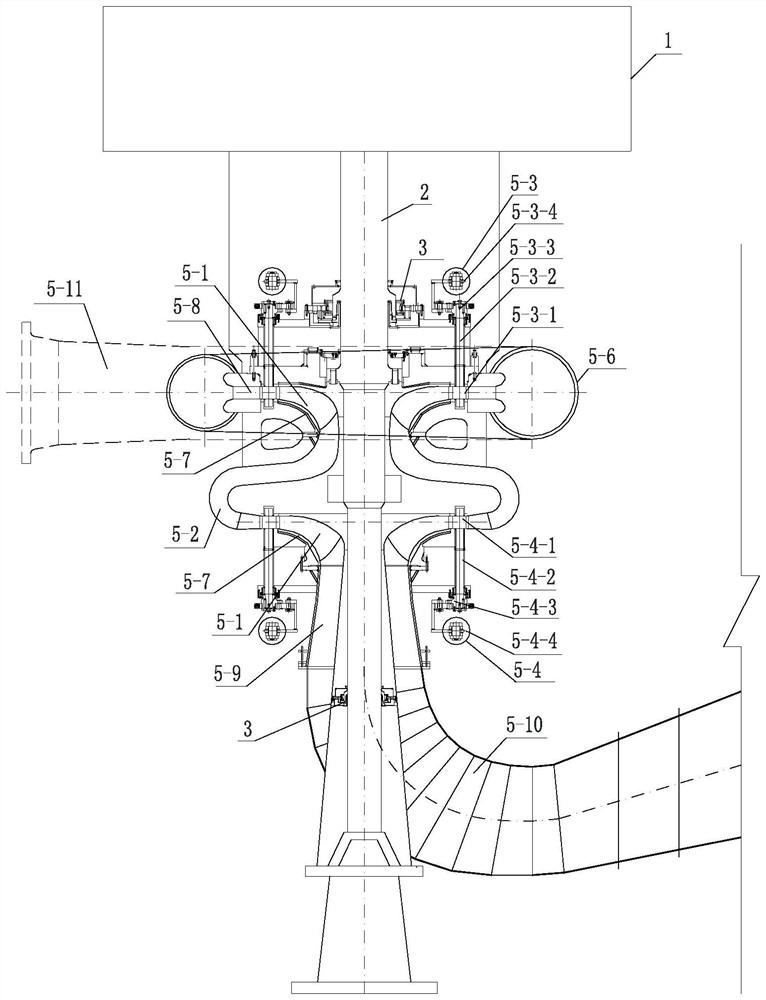
Figure 1 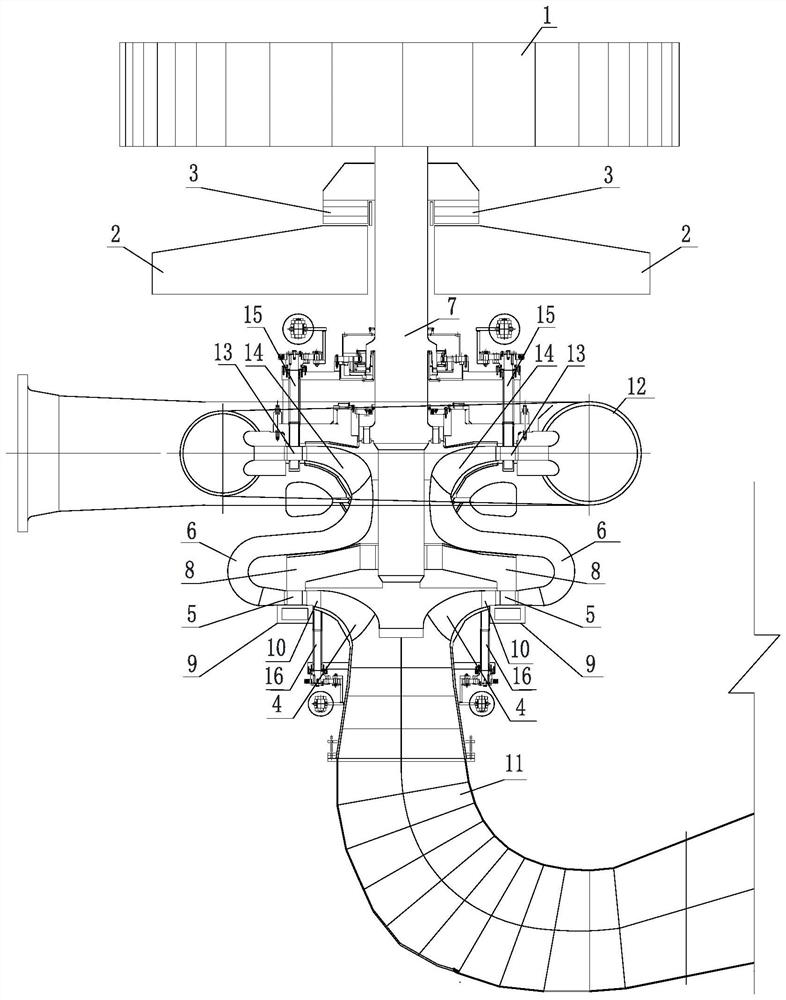
Figure 2 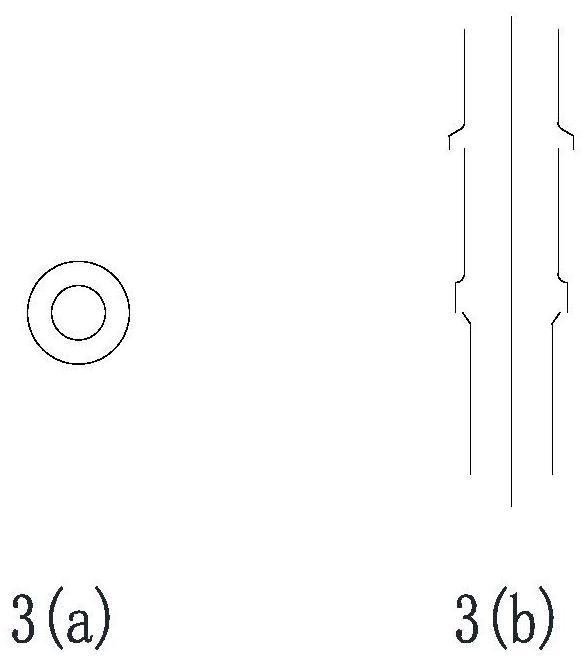
Figure 3
Abstract
Description
technical field
[0001] The invention relates to the technical field of hydroelectric power generation, in particular to a composite shafting support method for a secondary flow channel of a vertical two-stage mixed flow water turbine. Background technique
[0002] The existing Francis turbines all work in the underwater channel, have lower speed and larger unit capacity, and the current maximum unit capacity can reach 1000MW; in addition, compared with the impulse turbine, the Francis turbine has higher efficiency and is resistant Better resistance to sand and sand. The Francis turbine in the prior art includes a main shaft, a generator, a guide bearing, a thrust bearing and a single-stage Francis turbine. The upper and lower ends of the main shaft are respectively erected on the guide bearing and the thrust bearing. Top cover, bottom ring, draft tube, runner and its corresponding water guide mechanism; the water inlet pipe is composed of multi-section pressure steel pipes ...
Examples
Embodiment Construction
[0030] In order to make the purpose, technical solutions and advantages of the embodiments of the present invention clearer, the technical solutions in the embodiments of the present invention will be clearly and completely described below in conjunction with the drawings in the embodiments of the present invention. Obviously, the described embodiments It is a part of embodiments of the present invention, but not all embodiments. Based on the embodiments of the present invention, all other embodiments obtained by persons of ordinary skill in the art without creative efforts fall within the protection scope of the present invention.
[0031] In describing the present invention, it should be understood that the terms "length", "width", "upper", "lower", "front", "rear", "left", "right", "vertical", The orientation or positional relationship indicated by "horizontal", "top", "bottom", "inner", "outer", etc. are based on the orientation or positional relationship shown in the draw...