Equipment switch state detection method based on deep learning

A switching state and detection method technology, applied in forecasting, data processing applications, instruments, etc., can solve the problems of increased computational complexity, inability to perform, parallel computing processing, etc., to achieve good forecasting performance, improve efficiency, and improve accuracy. The effect of equipment switching state prediction results

CN114510992APending Publication Date: 2022-05-17上海梦象智能科技有限公司
6 Cites 0 Cited by

Patent Information

Authority / Receiving Office
CN · China
Current Assignee / Owner
Publication Date
2022-05-17

Smart Images

  • Figure 1
    Figure 1
  • Figure 2
    Figure 2
  • Figure 3
    Figure 3
Patent Text Reader

Abstract

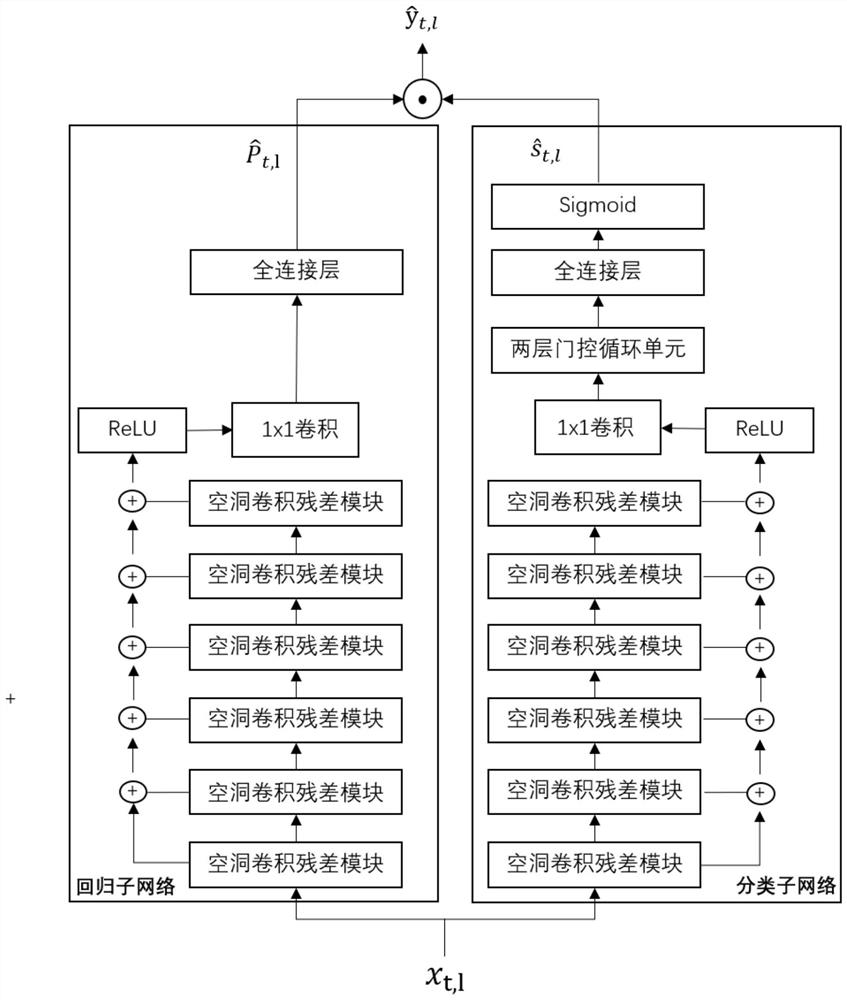
The invention belongs to the technical field of non-intrusive load identification, and particularly relates to an equipment switch state detection method based on deep learning. According to the method, a sequence-point processing mode is improved, that is, prediction of a single point is changed into prediction of a certain target sequence length, the target sequence is closer to a midpoint and a value near the midpoint, and the prediction efficiency is improved on the premise that good prediction performance is guaranteed; meanwhile, a network module used for modeling an original audio signal is introduced, a receiving domain of the network is expanded by adopting stacked cavity convolution, and efficient modeling and prediction output of a long data sequence are realized; the network module comprises a regression network used for performing load decomposition on the aggregated load data to obtain load data of different devices; and the network is classified to obtain the load state of the corresponding equipment, and the information of the two parts is integrally output and integrated to obtain a more accurate equipment on-off state prediction result. The method has remarkable superiority in the aspect of non-intrusive equipment switch state recognition.
Need to check novelty before this filing date? Find Prior Art

Description

technical field

[0001] The invention belongs to the technical field of non-intrusive load identification, and specifically relates to a deep learning-based device switch state detection method. Background technique

[0002] Non-intrusive load identification is to try to identify the current operating state of the equipment by decomposing the power of the corresponding equipment from the total power of the meter. Therefore, how to infer the power load of a specific equipment, and how to decompose and identify the power load is the current stage. The main research objective. At present, deep learning has penetrated into all walks of life. Neural networks are used to solve various problems. How to use deep learning-related methods to improve the accuracy of load identification is a hot topic in current research.

[0003] The total power data is a sequence of data. At present, there are two main processing methods for sequence data: sequence-sequence and sequence-point. Sequenc...

Examples

Embodiment

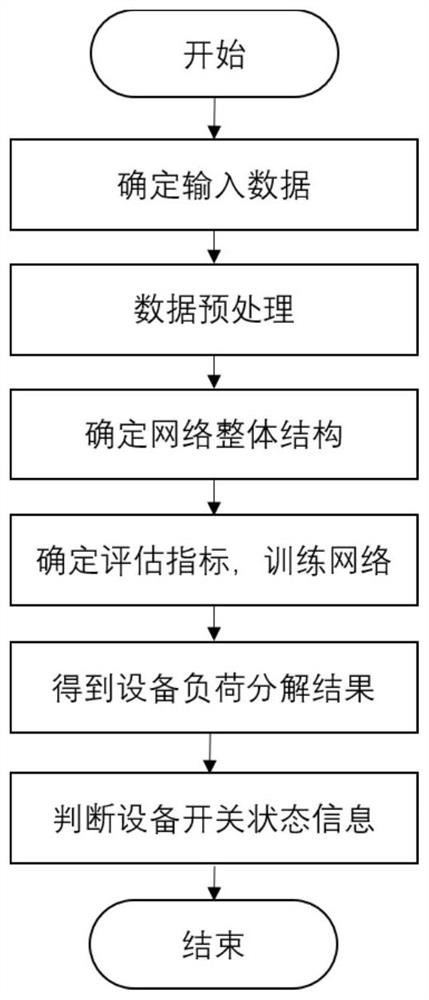
[0031] Embodiment: a kind of equipment switch state detection method based on deep learning, its flow chart is as follows figure 1 As shown, the specific steps are:

[0032] Step 1: Determine the input data;

[0033] Step 2: Data preprocessing;

[0034] Step 3: Determine the network structure;

[0035] Step 4: Determine the evaluation index and train the network model;

[0036] Step 5: Obtain the load decomposition result and judge the switch status of the equipment.

[0037] Each step will be further described in detail below.

[0038] 1. Determine the input data

[0039] The network used in the present invention is aimed at the total power recorded when the equipment is running, which is about low-frequency sampling data, and the data with a lower sampling rate is used to enable the inventive method to perform a long-term load monitoring. Because in real usage scenarios, the use time of most household appliances is very unevenly distributed relative to the total energ...