Check patentability & draft patents in minutes with Patsnap Eureka AI!

Ultrasonic detection method for micro-nano cracks of metal material

A metal material and ultrasonic testing technology, which is applied in the direction of analyzing solids with sound waves/ultrasonic waves/infrasonic waves, analyzing materials, and using sound waves/ultrasonic waves/infrasonic waves for material analysis. Missed detection, false detection and other problems, to achieve the effect of filling technical and theoretical gaps, improving detection efficiency and accuracy, and breaking through application bottlenecks

Pending Publication Date: 2022-05-24
INST OF ACOUSTICS CHINESE ACAD OF SCI
View PDF0 Cites 0 Cited by
  • Summary
  • Abstract
  • Description
  • Claims
  • Application Information

AI Technical Summary

Problems solved by technology

[0007] The ray detection method is more sensitive to volume defects, but not sensitive to area defects, and it is easy to miss or misdetect;
[0008] Penetrant testing methods cannot detect buried defects or closed surface defects;
[0009] Therefore, none of the existing detection methods can detect micro-nano cracks in metal materials, and the detection accuracy is low.

Method used

the structure of the environmentally friendly knitted fabric provided by the present invention; figure 2 Flow chart of the yarn wrapping machine for environmentally friendly knitted fabrics and storage devices; image 3 Is the parameter map of the yarn covering machine
View more

Image

Smart Image Click on the blue labels to locate them in the text.
Viewing Examples
Smart Image
  • Ultrasonic detection method for micro-nano cracks of metal material
  • Ultrasonic detection method for micro-nano cracks of metal material

Examples

Experimental program
Comparison scheme
Effect test

Embodiment Construction

[0054] The present invention will now be further described with reference to the accompanying drawings.

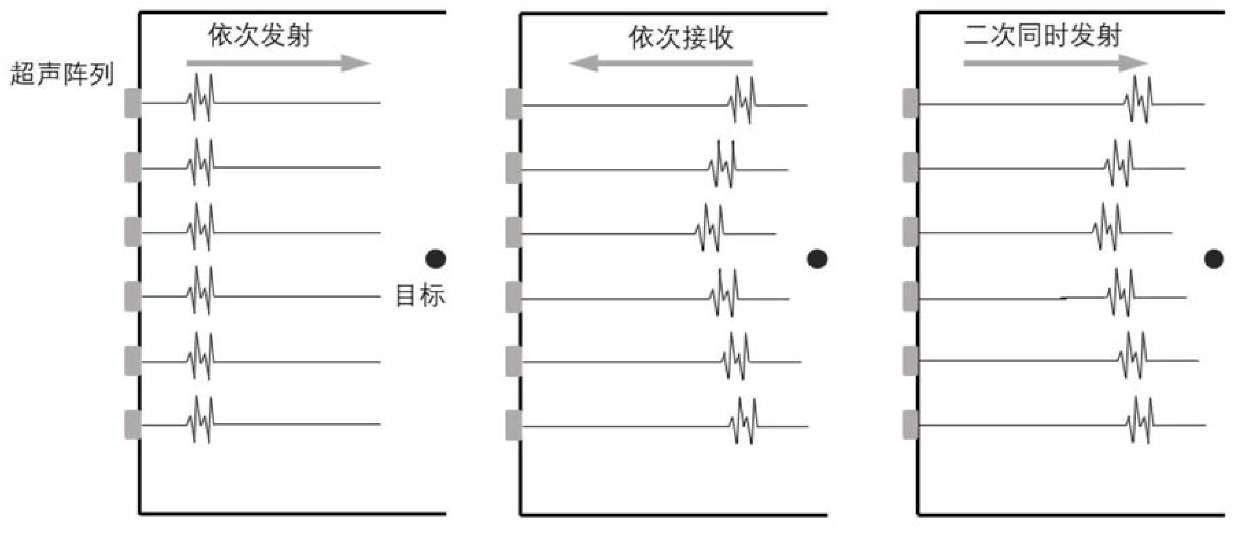
[0055] The invention provides an ultrasonic detection method for micro-nano cracks in metal materials. The method uses a time-reversing mirror method (Time-Reversing Mirror) combined with a linear frequency modulation signal, and does not require prior knowledge to perform adaptive focusing on sound waves , to achieve the adaptive focusing of sound waves in non-uniform media, that is, using the linear frequency modulation signal as the excitation signal, and using the time-reversal mirror technology to realize the adaptive focusing of the sound waves, so as to complete the accurate detection of micro-nano cracks in metal materials.

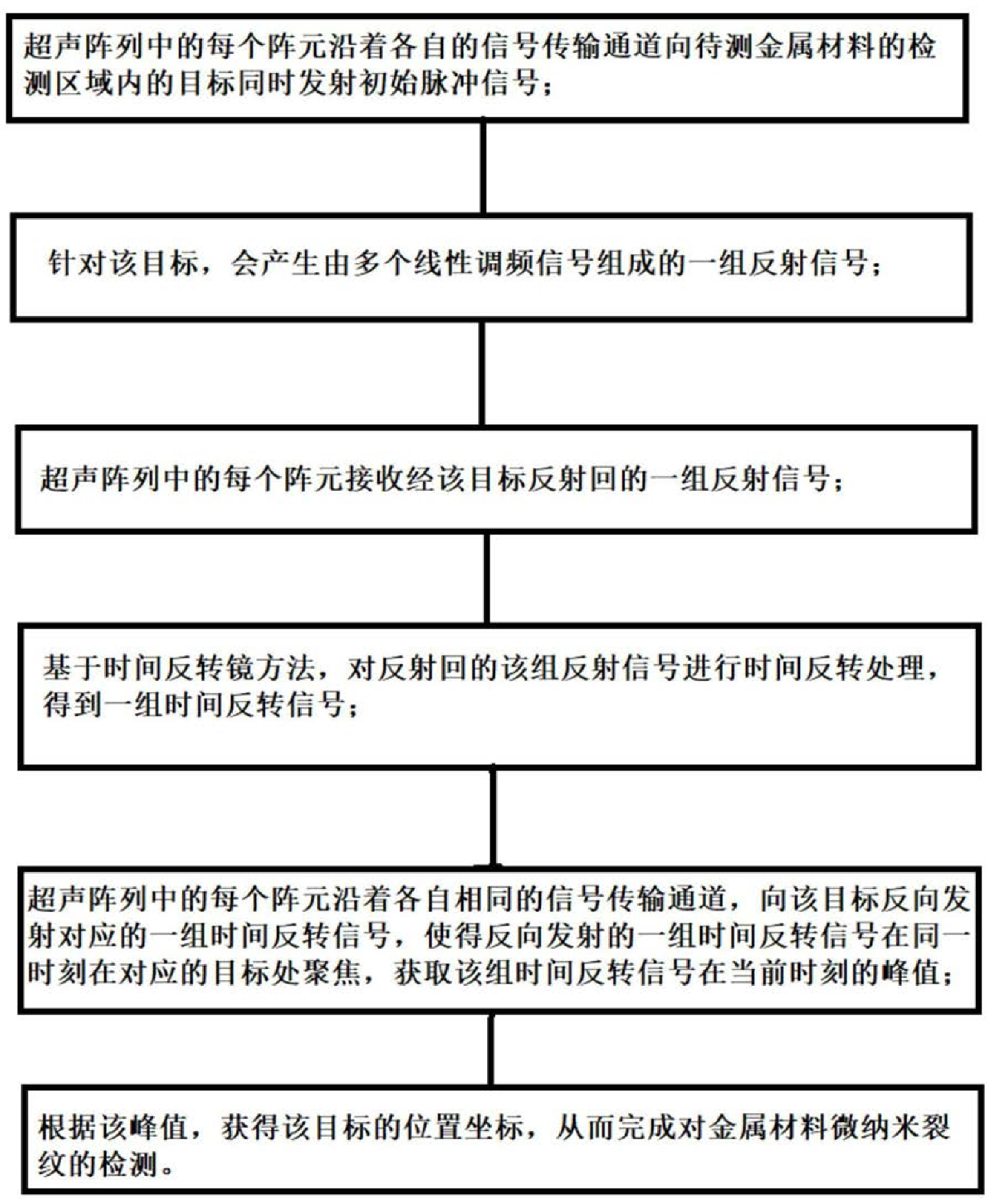
[0056] like figure 1 As shown, the method includes:

[0057] Each array element in the ultrasonic array simultaneously transmits an initial pulse signal to the target in the detection area of ​​the metal material to be tested along its respec...

the structure of the environmentally friendly knitted fabric provided by the present invention; figure 2 Flow chart of the yarn wrapping machine for environmentally friendly knitted fabrics and storage devices; image 3 Is the parameter map of the yarn covering machine
Login to View More

PUM

No PUM Login to View More

Abstract

The invention belongs to the technical field of microscopic detection of metal materials, and particularly relates to an ultrasonic detection method for metal material micro-nano cracks, which comprises the following steps: each array element in an ultrasonic array simultaneously transmits an initial pulse signal to a target in a detection area of a to-be-detected metal material along a respective signal transmission channel; aiming at the target, a group of reflection signals formed by a plurality of linear frequency modulation signals are generated; each array element in the ultrasonic array receives a group of reflected signals reflected by the target; performing time reversal processing on the group of reflected signals based on a time reversal mirror method to obtain a group of time reversal signals; each array element in the ultrasonic array reversely transmits a corresponding group of time reversal signals to the target along the same signal transmission channel, and the peak value of the group of time reversal signals at the current moment is obtained; and obtaining the position coordinate of the target according to the peak value, thereby completing the detection of the micro-nano crack of the metal material.

Description

technical field [0001] The invention belongs to the technical field of microscopic detection of metal materials, and in particular relates to an ultrasonic detection method for micro-nano cracks of metal materials. Background technique [0002] Metal materials are widely used in many fields such as aerospace, military equipment and intelligent manufacturing. Microscopic defect detection of metal materials has always been a research hotspot. Under the application of cyclic load, metal materials will undergo cyclic slip and form extremely non-uniform cyclic slip bands. These cyclic slip bands are usually concentrated in some local weak areas. After a long period of cyclic stress, in these cycles The slip zone region is prone to microcrack initiation. The cracks started as small microscopic short cracks and gradually increased with the increase of loading times. Micro-cracks will lead to catastrophic failure of the material with little warning. The existence of micro-cracks p...

Claims

the structure of the environmentally friendly knitted fabric provided by the present invention; figure 2 Flow chart of the yarn wrapping machine for environmentally friendly knitted fabrics and storage devices; image 3 Is the parameter map of the yarn covering machine
Login to View More

Application Information

Patent Timeline
no application Login to View More
IPC IPC(8): G01N29/04G01N29/22G01N29/44
CPCG01N29/04G01N29/22G01N29/44G01N2291/0234
Inventor 张晗林振源杨军程晓斌
Owner INST OF ACOUSTICS CHINESE ACAD OF SCI
Features
  • R&D
  • Intellectual Property
  • Life Sciences
  • Materials
  • Tech Scout
Why Patsnap Eureka
  • Unparalleled Data Quality
  • Higher Quality Content
  • 60% Fewer Hallucinations
Social media
Patsnap Eureka Blog
Learn More