

Data sharing method and system based on block chain
A data sharing and blockchain technology, applied in the blockchain field, can solve problems such as waste of data resources, restriction of data sharing, data leakage, etc., and achieve the effect of avoiding waste
- Summary
- Abstract
- Description
- Claims
- Application Information
AI Technical Summary
Problems solved by technology
Method used
Image


Examples
Embodiment 1
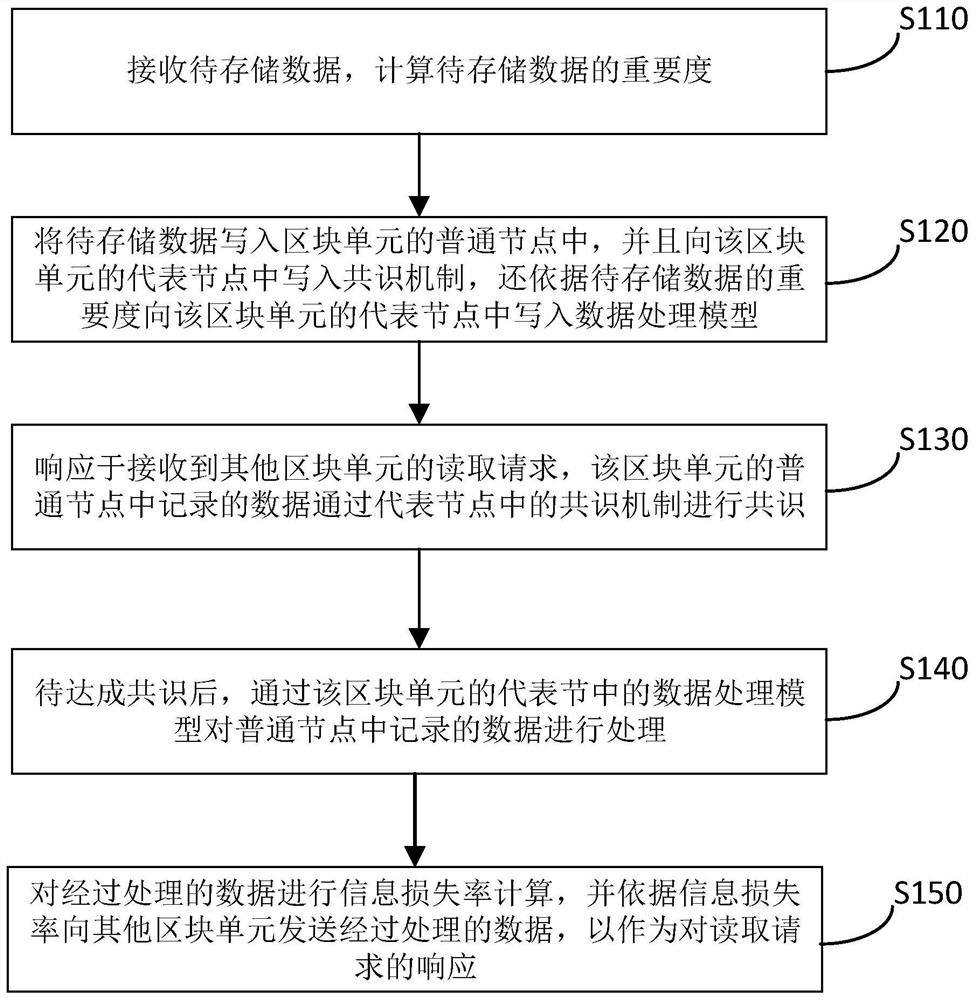
[0023] see figure 1 , figure 1 This is a flowchart of the blockchain-based data sharing method provided by the embodiment of the present application.
[0024] The present application provides a method for data sharing based on blockchain, including the following steps:
[0025] Step S110, receiving the data to be stored, and calculating the importance of the data to be stored;
[0026] The blockchain is a chain composed of one block unit after another, each block unit stores a certain amount of data, and the block units are connected into a chain according to the time sequence of their generation. The blockchain receives the data to be stored, organizes a certain number of nodes according to the data to be stored to construct block units, for example: organizes a certain number of nodes according to the importance of the data to be stored, and then records the previous node in the block header of each node (specifically, it can be the hash value of the previous node, and it...
Embodiment 2
[0043] see figure 2 , figure 2 It is a schematic diagram of the blockchain-based data sharing system provided by the embodiment of the present application.
[0044] The present application also provides a blockchain-based data sharing system 200 , including: a receiving unit 210 , a computing unit 220 , a writing unit 230 , a consensus unit 240 , a processing unit 250 , a loss computing unit 260 and a sending unit 270 .
[0045] The receiving unit 210 receives the data to be stored, and the calculating unit 220 calculates the importance of the data to be stored.
[0046] The blockchain is a chain composed of one block unit after another, each block unit stores a certain amount of data, and the block units are connected into a chain according to the time sequence of their generation. The blockchain receives the data to be stored, organizes a certain number of nodes according to the data to be stored to construct block units, for example: organizes a certain number of nodes ...
PUM
 Login to View More
 Abstract
Description
Claims
Application Information
 Login to View More