
Digestive tract stent with anti-cancer medicinal particles
An anticancer drug and digestive tract technology, which is applied in the field of components in the field of medicine and medical equipment technology, can solve problems such as the influence of drug loading, large toxic and side effects of anticancer drugs, and slow drug release, so as to increase drug loading and improve Dissolution behavior, effect of improving transmembrane absorption
- Summary
- Abstract
- Description
- Claims
- Application Information
AI Technical Summary
Problems solved by technology
Method used
Image

Examples
Embodiment 1
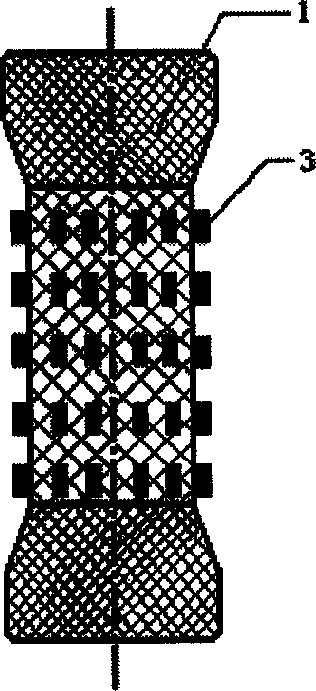
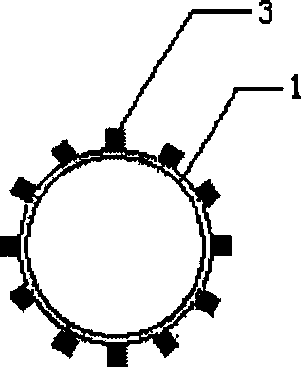
[0045]Such as figure 1 and figure 2 As shown, the present invention includes: a stent 1 , anticancer drug particles 3 , and the anticancer drug particles 3 are directly carried on the stent 1 .
[0046] The anticancer drug particles 3 are implanted dosage forms, the carrier material used is glycolide / lactide copolymer, and the anticancer drug is 5-fluorouracil. The anticancer drug particles 3 are tied to the alloy wire of the stent 1 through surgical sutures.
[0047] The stent prepared by the present invention is used for the treatment of stenosis caused by malignant esophageal tumors. It not only has a mechanical expansion effect, but also can directly act on the diseased tissue or its vicinity with the released drug, so as to perform local slow and long-term administration. Treatment of strictures caused by malignancy of the esophagus.
Embodiment 2
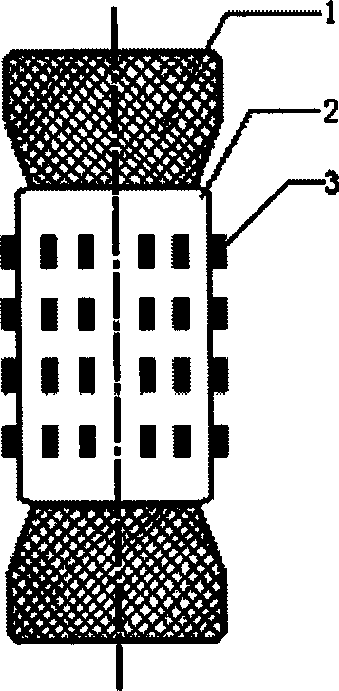
[0049] Such as image 3 and Figure 4 As shown, the present invention includes: a stent 1, a coating 2 and anticancer drug particles 3, the coating 2 is wrapped on the surface of the stent 1, the coating 2 is close to the stent 1, and the anticancer drug particles 3 are carried on the coating 2 Above, the protective layer 4 is set on the anticancer drug particle 3 layer.
[0050] The material of the envelope 2 is polyurethane.
[0051] The anticancer drug particles 3 are microspheres, the carrier material is starch, and the antitumor drug is cisplatin. Anticancer drug particles adhere to the envelope 2 through acrylic pressure-sensitive adhesive.
[0052] The stent prepared by the present invention is used for the treatment of stenosis caused by malignant esophageal tumors. It not only has a mechanical expansion effect, but also can directly act on the diseased tissue or its vicinity with the released drug, so as to perform local slow and long-term administration. Treatmen...
Embodiment 3
[0054] Such as Figure 5 and Figure 6 As shown, the present invention includes: a stent 1 , anticancer drug particles 3 , and a protective layer 4 , and the anticancer drug particles 3 are directly carried on the stent 1 . The protective layer 4 is set on the anticancer drug particle 3 layer.
[0055] The anticancer drug particles 3 are nanospheres, the carrier material is albumin, and the antitumor drug is hydroxycamptothecin. The anticancer drug particles 3 are directly bonded to the wire of the stent 1 through a medical adhesive.
[0056] The protective layer 4 is a water-soluble film of polyvinylpyrrolidone.
[0057] The stent prepared by the present invention is used for the treatment of stenosis caused by malignant tumors of the biliary tract. It not only has a mechanical expansion effect, but also can directly act on the diseased tissue or its vicinity with the released drug, so as to perform local slow and long-term administration. Treatment of strictures caused b...
PUM
 Login to View More
 Abstract
Description
Claims
Application Information
 Login to View More