

Phosphorus-containing resin composition and article made therefrom
a technology of phosphorus-containing resin and composition, which is applied in the field of phosphorus-containing resin composition, can solve the problems of inability to meet the requirements of phosphorus-containing flame retardants, affecting the mechanical properties and electrical properties of copper-clad laminates, and conventional reactive flame retardants such as allyl-containing phosphazene compounds, and achieving poor thermal resistan
- Summary
- Abstract
- Description
- Claims
- Application Information
AI Technical Summary
Benefits of technology
Problems solved by technology
Method used
Image

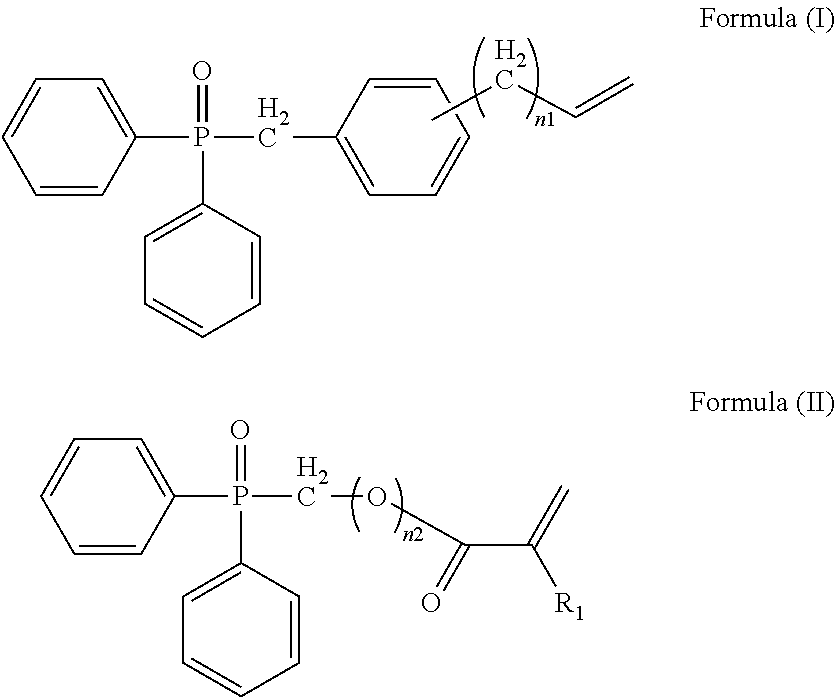
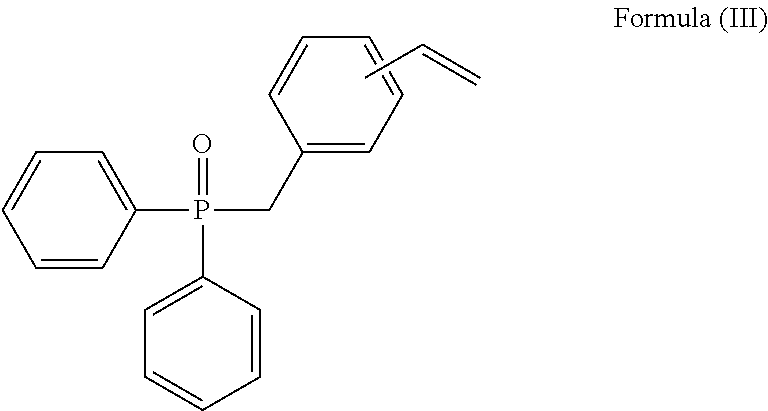
Examples
preparation example 1
[0115]202.19 g of diphenylphosphine oxide, 126.1 g of formaldehyde, 25.8 g of potassium carbonate and 2.0 L of methanol were added to a 3-liter three-necked flask, heated at 40° C. and stirred for 3 hours. Then the reaction solution was concentrated to obtain 575.3 g of colorless transparent viscous liquid. Then 204.5 g of vinylbenzyl chloride was added and fully stirred, followed by increasing the temperature to 80° C. and carrying out the reaction for 8 hours to obtain the product. The product thus obtained was then purified to obtain white powder solid.
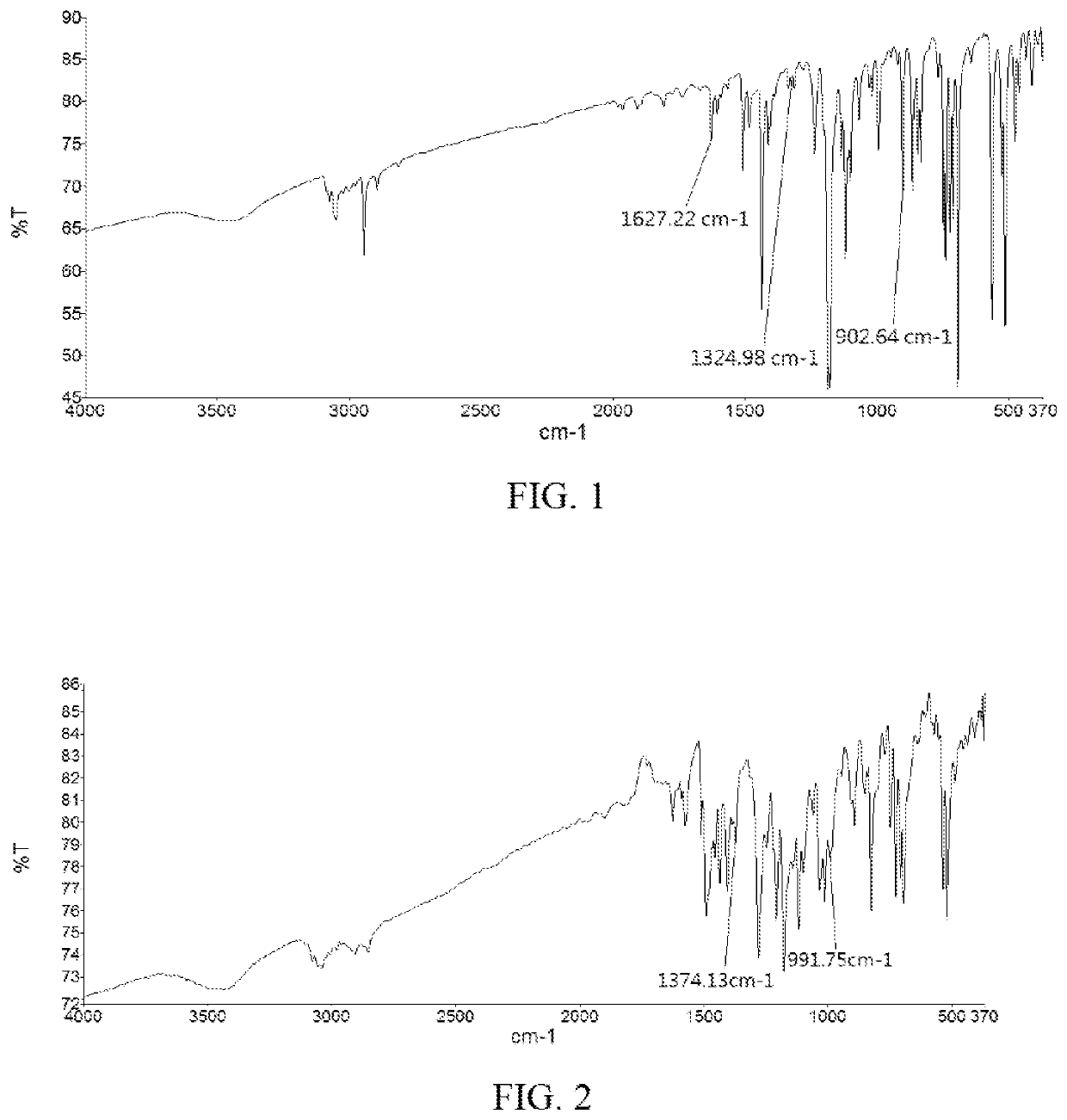
[0116]The white powder solid was analyzed by using Fourier transform infrared spectroscopy (FTIR), and the result is shown in FIG. 1. From the measurement result, peaks at 902.64 cm−1 and 1627.22 cm−1 represent the absorptions of vinyl group (C═C, belonging to the vinylbenzyl group), and peak at 1324.98 cm−1 represents the absorption of P═O double bond, indicating that the product synthesized is a vinylbenzyl diphenylphosphine oxid...
preparation example 2
[0118]202.19 g of diphenylphosphine oxide, 126.1 g of formaldehyde, 25.8 g of potassium carbonate and 2.0 L of methanol were added to a 3-liter three-necked flask, heated at 40° C. and stirred for 3 hours. Then the reaction solution was concentrated to obtain 575.3 g of colorless transparent viscous liquid. Then 104.5 g of methacryloyl chloride was added and fully stirred, followed by increasing the temperature to 50° C. and carrying out the reaction for 20 hours to obtain the product. The product thus obtained was then purified to obtain white powder solid.
[0119]The white powder solid was analyzed by using Fourier transform infrared spectroscopy (FTIR), and the result is shown in FIG. 2. From the measurement result, peak at 991.75 cm−1 represents the absorption of vinyl group (C═C, belonging to the methacrylate group), and peak at 1374.13 cm−1 represents the absorption of P═O double bond, indicating that the product synthesized is a methacrylate diphenylphosphine oxide compound (me...
preparation example 3
[0121]310 g of diphenylphosphinyl hydroquinone (PPQ), 25.8 g of potassium carbonate and 2.0 L of toluene were added to a 3-liter three-necked flask. Then 404.5 g of vinylbenzyl chloride was added and fully stirred, followed by increasing the temperature to 80° C. and carrying out the reaction for 8 hours to obtain the product. The product thus obtained was then purified to obtain white powder solid, which was subject to analysis and confirmed to be di-vinylbenzyl DPPO-HQ.
[0122]In addition, samples (specimens) were prepared as described below and tested and analyzed under specified conditions.
[0123]Varnish
[0124]Resin compositions from different Examples (E1 to E17) and Comparative Examples (C1 to C9) listed in Tables below were respectively added to a stirred tank, well mixed and fully dissolved as varnishes.
[0125]Semi-Cured Resin Film (a.k.a. Resin Film)
[0126]Each varnish was coated by using a slot die coater (brand name Hirano) on a 38 μm polyethylene terephthalate film (PET film),...
PUM
| Property | Measurement | Unit |
|---|---|---|
| elongation percentage | aaaaa | aaaaa |
| elongation rate | aaaaa | aaaaa |
| temperature | aaaaa | aaaaa |
Abstract
Description
Claims
Application Information
 Login to View More