
Clean room and method for regulating airflow of clean room
a technology for cleaning rooms and clean rooms, applied in ventilation systems, lighting and heating apparatus, heating types, etc., can solve the problems of reducing the cleanliness class of the clean room of the main process, affecting the efficiency of the clean room, and unable to achieve good regulation effect after regulation
- Summary
- Abstract
- Description
- Claims
- Application Information
AI Technical Summary
Benefits of technology
Problems solved by technology
Method used
Image

Examples
Embodiment Construction
[0039]In order to make the objects, technical solutions, and advantages of the present application more clear, the present application will be further described in detail hereinbelow with reference to the accompanying drawings and embodiments. It should be understood that the specific embodiments described herein are merely intended to explain the application rather than to limit the present application.
[0040]It should be noted that when an element is referred to as being “fixed” or “arranged” at / in / on another element, it can be directly or indirectly at / in / on the other element. When an element is referred to as being “connected” to / with another element, it can be directly or indirectly connected to / with the other element.
[0041]It should also be noted that the terms of the left, right, upper, and lower orientations in these embodiments are merely relative concepts or reference to the normal use state of the product, and should not be considered as limitation.
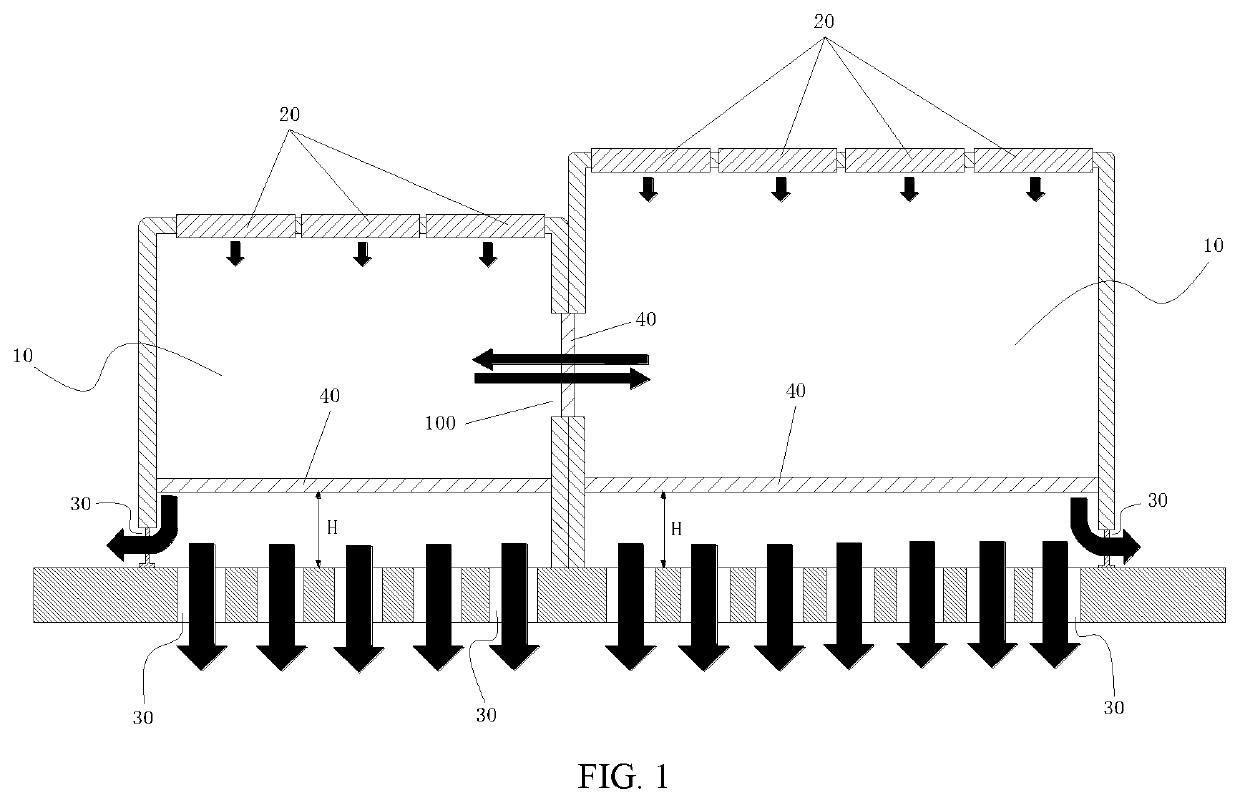
[0042]As shown in FIG. 1...
PUM
 Login to View More
 Abstract
Description
Claims
Application Information
 Login to View More