[0003] Many students of the bowling art have recognized that the middle two fingers, which occupy adjacent holes in the ball, should be the source of the desired roll. These fingers should rotate the underside of the ball upward, an effect called lift as they leave the ball upon its release from the bowler's middle fingers. One or more of the bowler's middle fingers are used to lift the ball giving it this complex rotation about two axes and also to grip the ball with sufficient control at its delivery and release to prevent or reduce slippage and to enable the bowler to achieve lift with the most revolutions on the ball the bowler is capable of delivering, which is important to scattering the pins and achieving a strike. Attempts to achieve a better grip generally use a surface between the finger and the ball which increases the
surface friction and the surface counter force to the force developed when lifting and releasing the ball in a direction to displace the finger placement relative to the ball. A device of this kind is shown in published
patent application No. 20030045367, published Mar. 6, 2003, describing a polymeric material being substantially resilient and elastic which fits onto the finger end and with projections which may be hemispherical for contacting the surface of the ball. Depending upon the pressure exerted by the finger, the projections will flatten, forming a
circular face onto the bowling ball and assisting in the bowler's grip of the bowling ball enabling the bowler to better initiate rotation as the bowling ball is released.
[0005] In an attempt to improve a bowler's control over the delivery of the ball, bowling ball finger hole inserts are used, for example as described in U.S. Pat. No. 4,892,308, of Gaunt, and the patents cited therein. Inserts, as shown and described in these patents, are used to better fit the finger hole to the bowler's finger or provide structural or dimensional changes into the finger hole to relieve stress on the finger and provide better ball control.
[0008] The
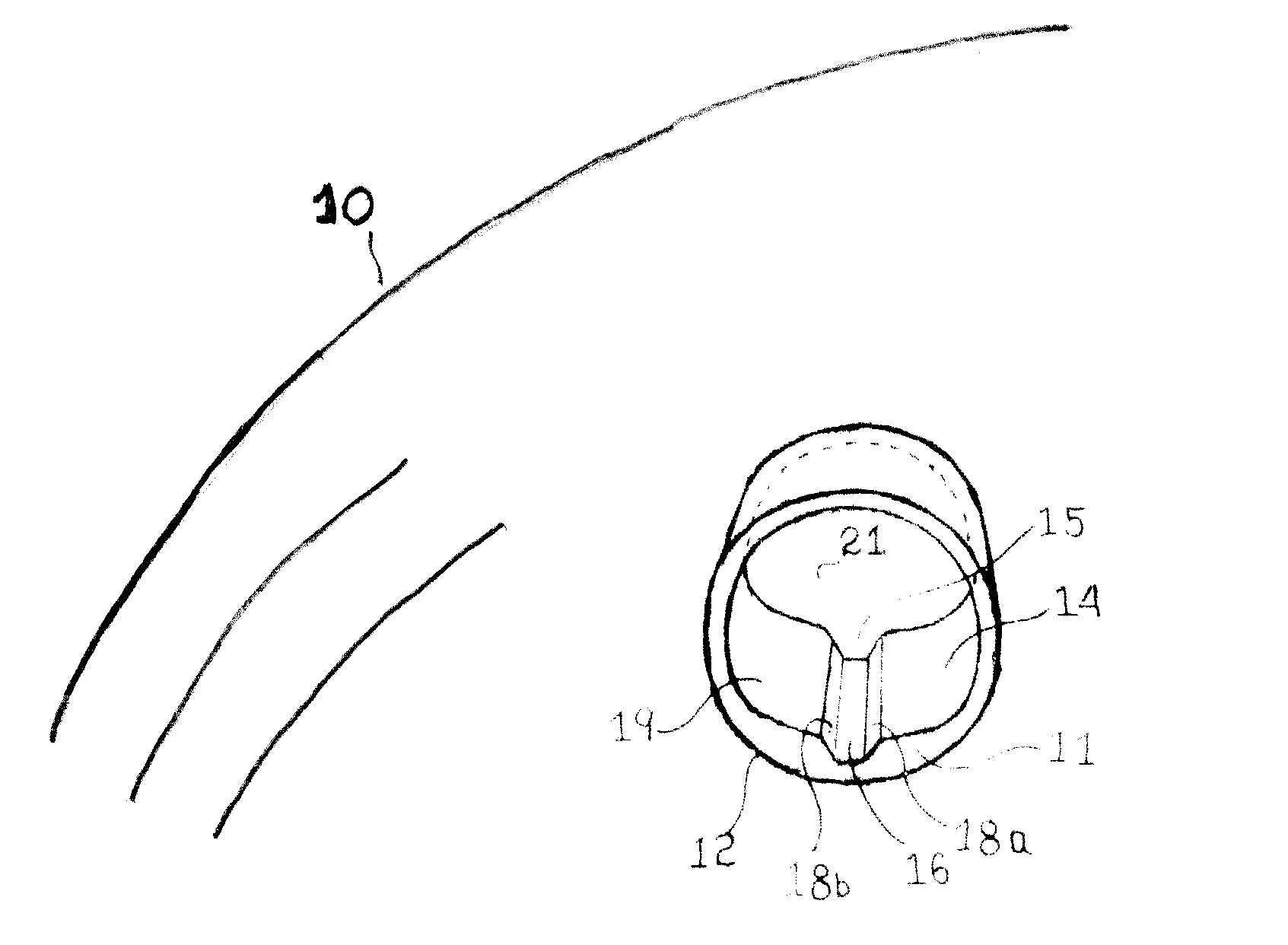
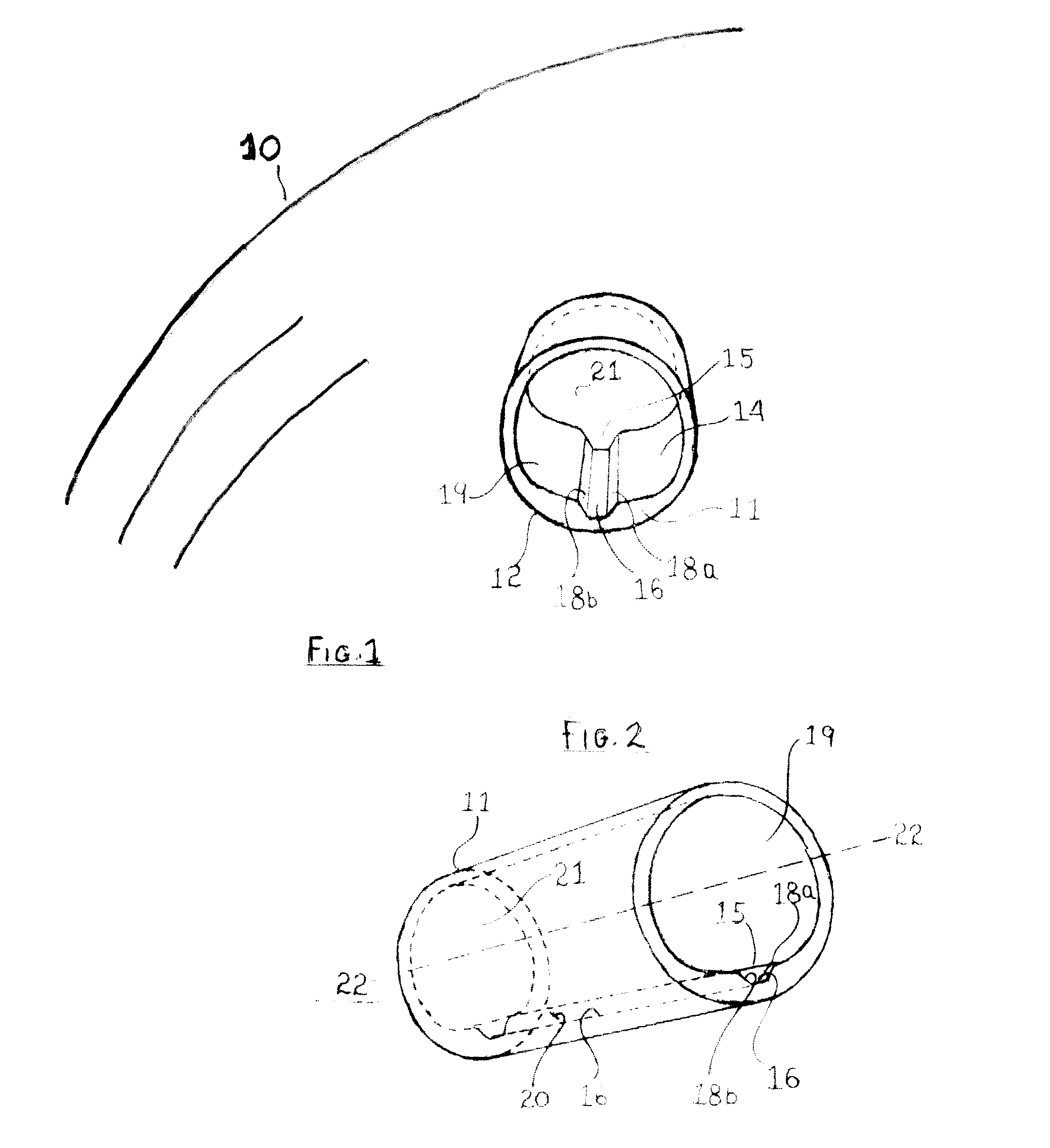
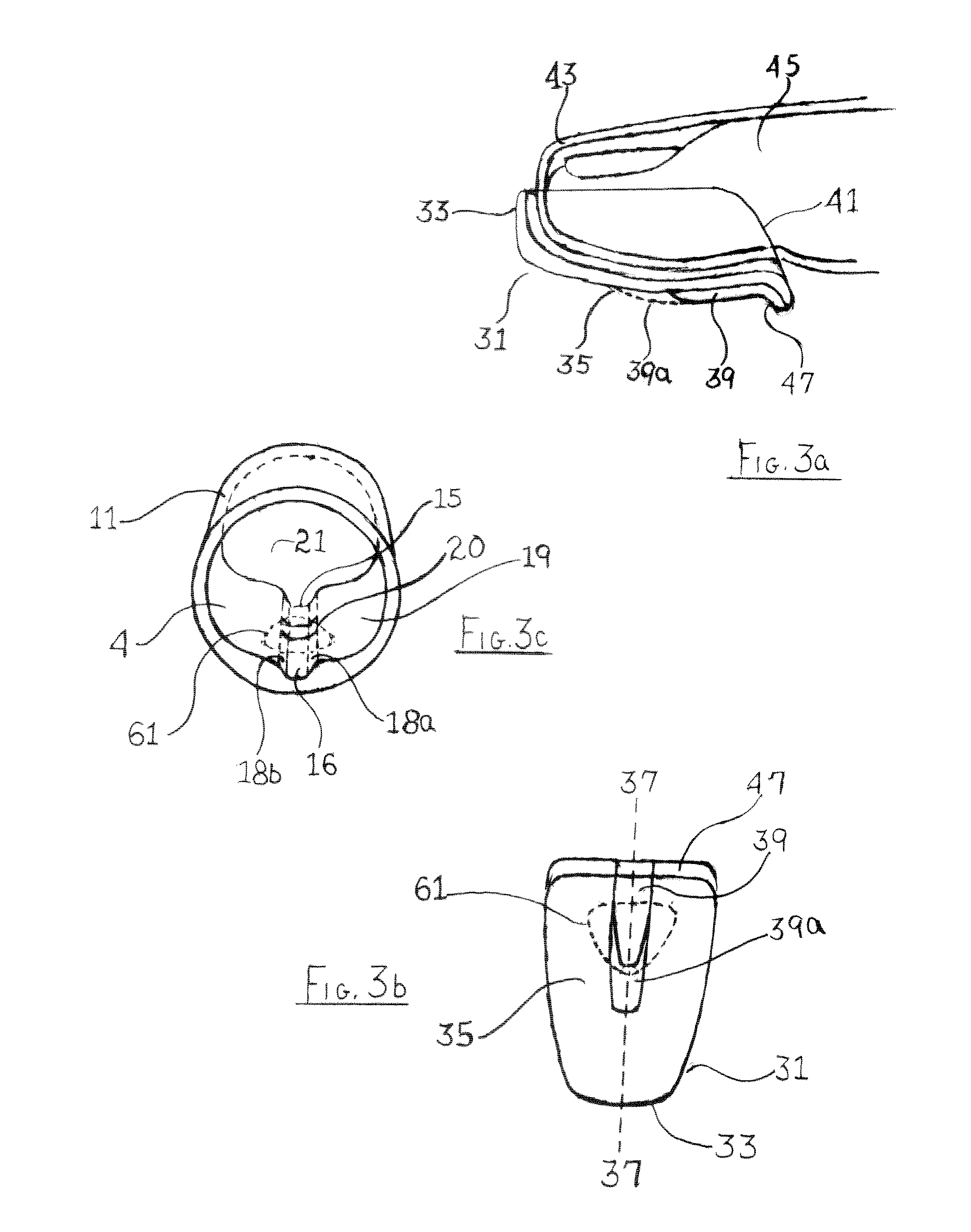
mating interlocking opposed surfaces on the finger pad cover and the interior surface of the finger hole, or insert, may be arranged to provide a counter force to any movement of the finger pad cover relative to the bowling ball finger hole, in a direction at any angle to the direction in the release of the ball, for example as shown in preferred embodiment, at an angle to the primary axis along the finger pad or the matching primary axis of the finger hole or finger hole insert. Where, in a preferred embodiment for example, a counter force is established by
mating surfaces on the finger pad cover and the finger hole interior surface that opposes
relative displacement in the direction of the matching primary axis and primary axis or in the direction of the release of the ball from the finger pad cover, the bowler's delivery can be adjusted for any loss in
kinetic energy caused by overcoming this counter force opposing release of the ball.
[0009] In a preferred embodiment, the use of the disclosed
system of
mating surfaces preventing a shift in
relative displacement of the finger pad cover and the finger hole surface, gives the bowler a
positive control over the alignment of the ball with the
middle finger which is not available with a single gripping surface on the finger or in the finger hole, for example by an insert in the finger hole or by a gripping device on the finger of the bowler.
[0015] As would be understood by those skilled in the art, the
interlocking surface may be in a finger hole insert or on the wall of the ball's finger hole, without departing from the principles of the invention. By primary axis and matching primary axis is meant an axis substantially aligned with the direction of the bowling ball at its release. However, as would be known to those skilled in the art, the
interlocking three dimensional surfaces may be aligned at an angle with these axes to the extent the smooth separation of the ball from the finger at its release is not substantially impeded.



 Login to View More
  Login to View More