Cemented artificial disc replacements

a technology of artificial discs and implants, applied in the field of artificial disc replacements, can solve problems such as dislocation and other problems
US20050049707A1Inactive Publication Date: 2005-03-03ANOVA

Patent Information

Authority / Receiving Office
US · United States
Current Assignee / Owner
ANOVA
Publication Date
2005-03-03
Estimated Expiration
Not applicable · inactive patent

Smart Images

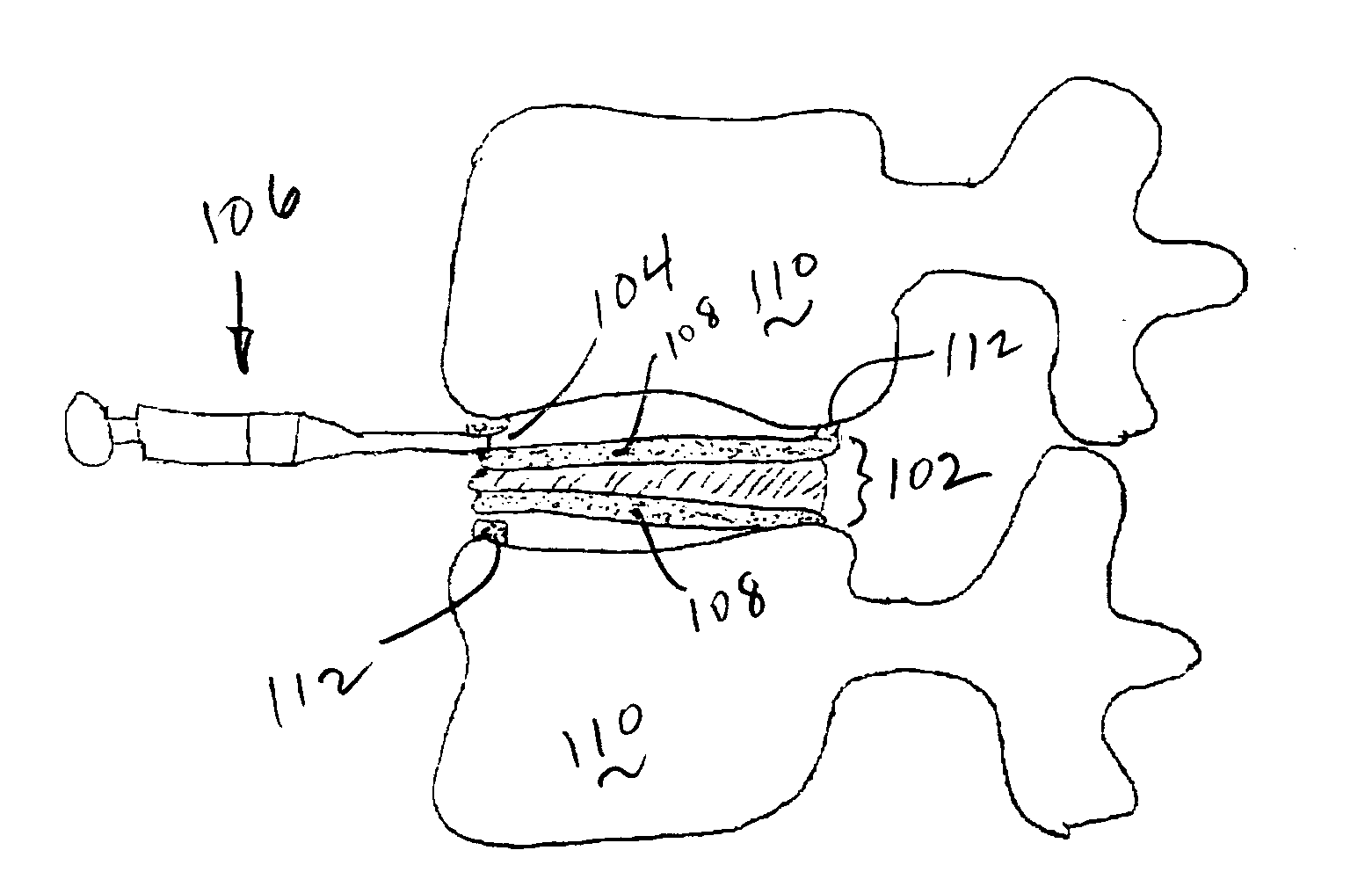
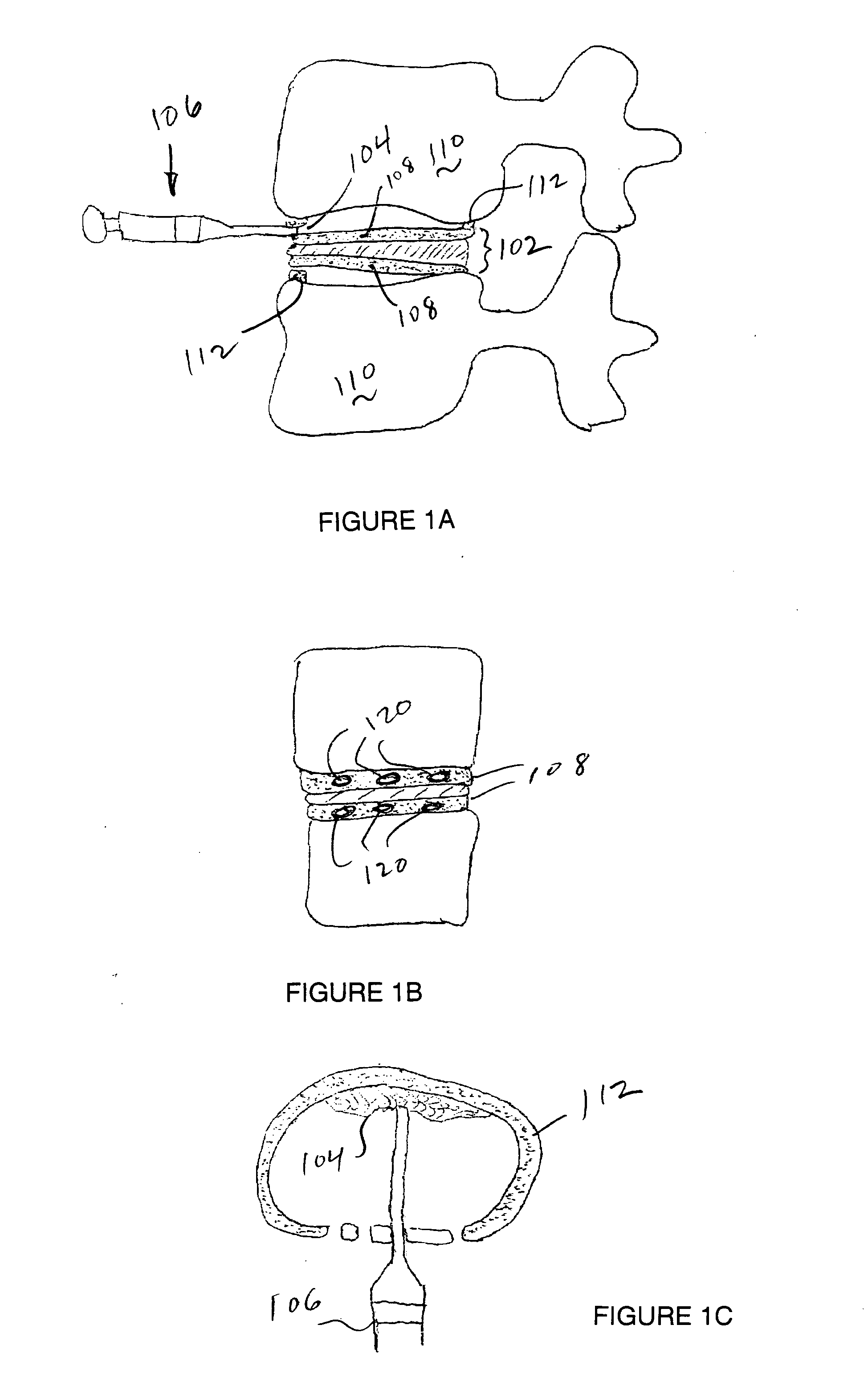
  • Figure 1
    Figure 1
  • Figure 2
    Figure 2
  • Figure 3
    Figure 3
Patent Text Reader

Abstract

Cementation in place of, or in conjunction with, artificial disc replacements (ADRs) to provide numerous advantages over existing techniques. Methods, instruments, and systems are disclosed. A preferred method of fixing an artificial disc replacement (ADR) to a vertebral endplate according to the invention includes locating a component of the ADR in spaced-apart relation to the vertebral endplate and introducing cement between the component and the vertebral endplate. The “introduction” may be carried out through manual packing or forced injection using inventive instrumentation. The component of the ADR may be a rigid endplate, or it may be constructed of polyethylene or other suitable polymeric material. The component may further articulate with a second component. A system according to the invention involving an artificial disc replacement (ADR) configured for placement between opposing vertebral endplates would comprise a component forming a cavity between the component and one of the vertebral endplates, and a path to fill the cavity with cement. Again, the path may be formed in the component with a channel or groove, with or without a peripheral rim, or the path may be formed through a vertebral body. The system may further include various instruments, including an instrument for urging the component against the vertebral endplate until the cement cures, for injecting the cement prior to insertion of the component, for pressurizing the cement following introduction, or for removing excess, cured cement prior to placement of the ADR.
Need to check novelty before this filing date? Find Prior Art

Description

FIELD OF THE INVENTION

[0001] This invention relates generally to artificial disc replacements (ADRs) and, in particular, to cemented ADRs and instrumentation for use in conjunction therewith. BACKGROUND OF THE INVENTION

[0002] Current artificial disc replacements (ADRs) are not cemented to the vertebrae. Instead, they rely on the ingrowth of bone or fibrous tissue to stabilize the implant, which is press-fit into place. Press fitting, however, can lead to dislocation and other problems.

[0003] U.S. Pat. No. 5,171,281 mentions, in passing, the potential use of cementing agents such as polymethyl methylacrylate “bone cement” for attachment of endplates to adjacent bony vertebral bodies. Rather, the point of novelty resides in disc spacers that possess mechanical properties akin to those of a normal disc to preserve normal functions of the spinal motion segment. A spacer is used having a central core of a soft, biocompatible elastomer shaped and sized so as to approximate the shape an...

Claims

the structure of the environmentally friendly knitted fabric provided by the present invention; figure 2 Flow chart of the yarn wrapping machine for environmentally friendly knitted fabrics and storage devices; image 3 Is the parameter map of the yarn covering machine
Login to View More