
Generalized parity stripe data storage array
a data storage array and generalized parity strip technology, applied in the field of storage systems, can solve the problems of reducing the failure tolerance of nested array implementation, failure combinations that product codes cannot correct, and particular set of disk failures that are not correctable, so as to increase the hamming distance of the array
- Summary
- Abstract
- Description
- Claims
- Application Information
AI Technical Summary
Benefits of technology
Problems solved by technology
Method used
Image

Examples
Embodiment Construction
[0025] The present invention significantly increases the failure tolerance of HDD arrays with only a minimal impact of additional I / O operations that are required for updating. Consequently, the present invention allows for a higher failure tolerance to be achieved at a reasonable efficiency using a fewer number of HDDs than are used by conventional product code arrangements.
[0026] The present invention modifies a parity check matrix by using roots of unity such that the constraint equations for certain error patterns become independent. As a result, the number of minimal weight error patterns can be reduced at no additional overhead cost, but with a slight increase in arithmetic complexity of the encoder / decoder in comparison to conventional XOR-arithmetic.
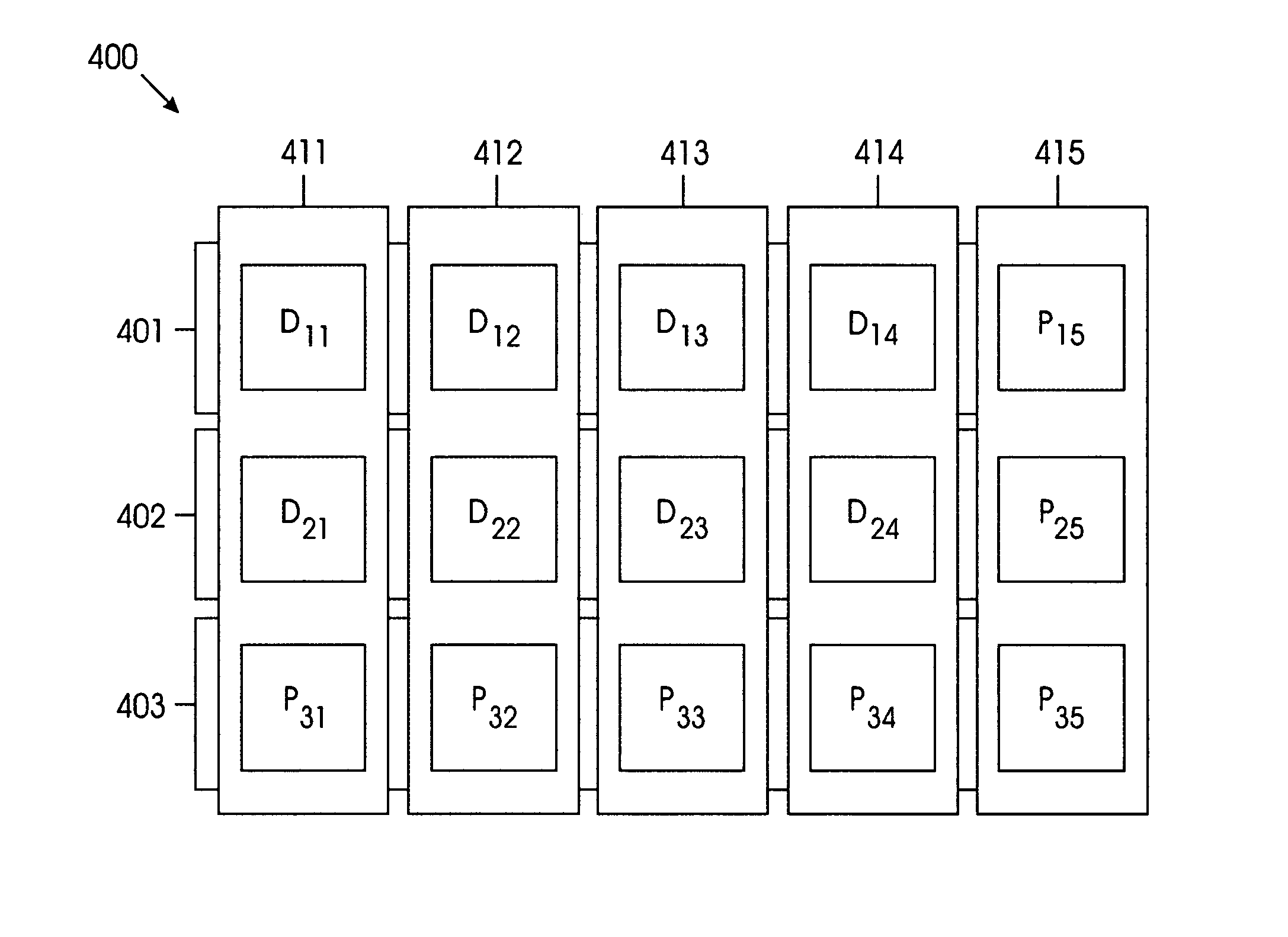
[0027]FIG. 4 shows an exemplary 3×5 array 400 of HDDs for illustrating the basic concept of the present invention. If array 400 is arranged as the product of two parity codes, the product-check matrix would be of rank 5 and arr...
PUM
 Login to View More
 Abstract
Description
Claims
Application Information
 Login to View More