Portable-terminal holder and radio communication system
a terminal holder and radio communication technology, applied in the field of terminal holder and radio communication system, can solve the problems of reducing working efficiency, needing to recharge, and wasting the battery of scanner units,
- Summary
- Abstract
- Description
- Claims
- Application Information
AI Technical Summary
Benefits of technology
Problems solved by technology
Method used
Image

Examples
first embodiment
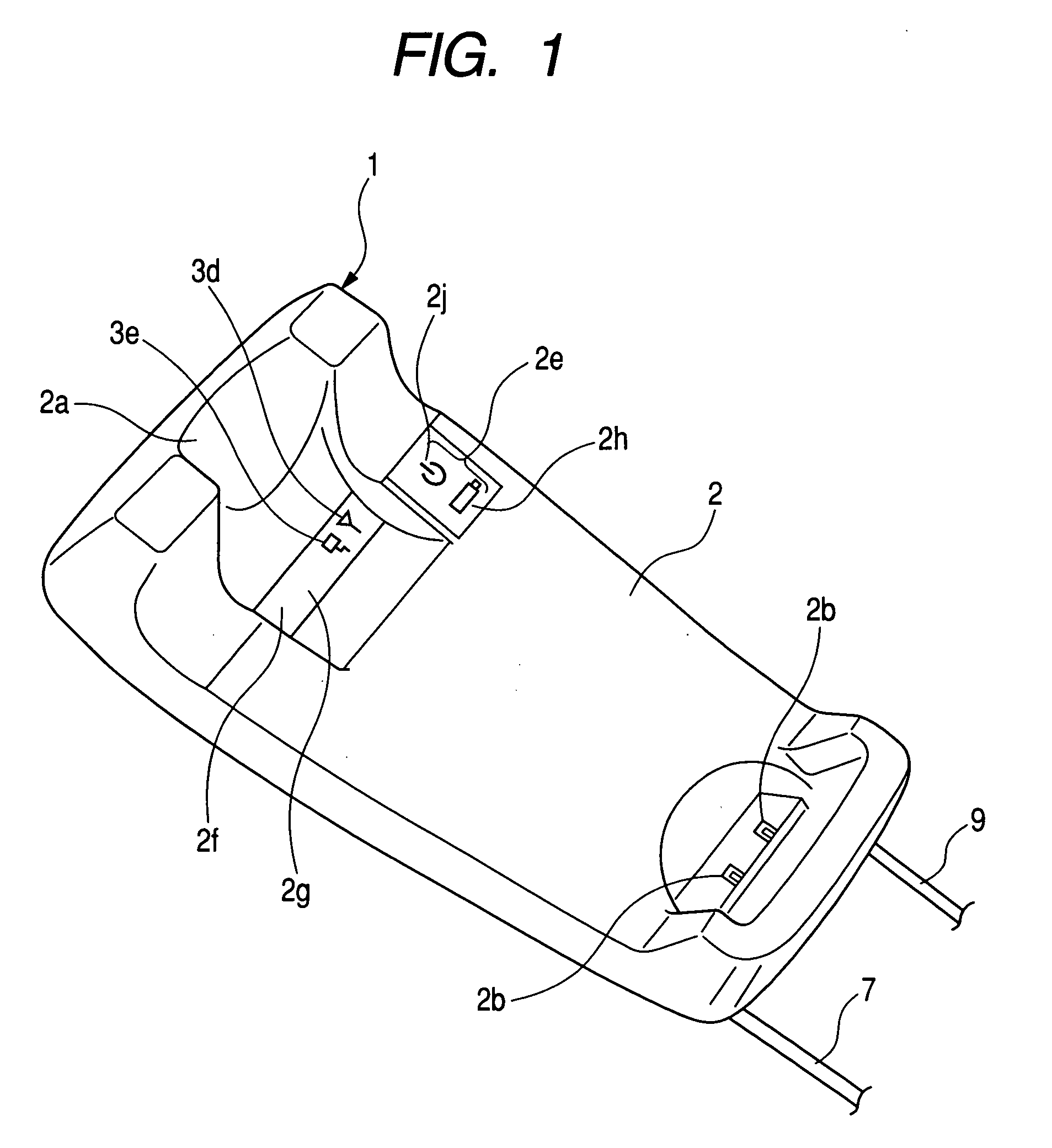
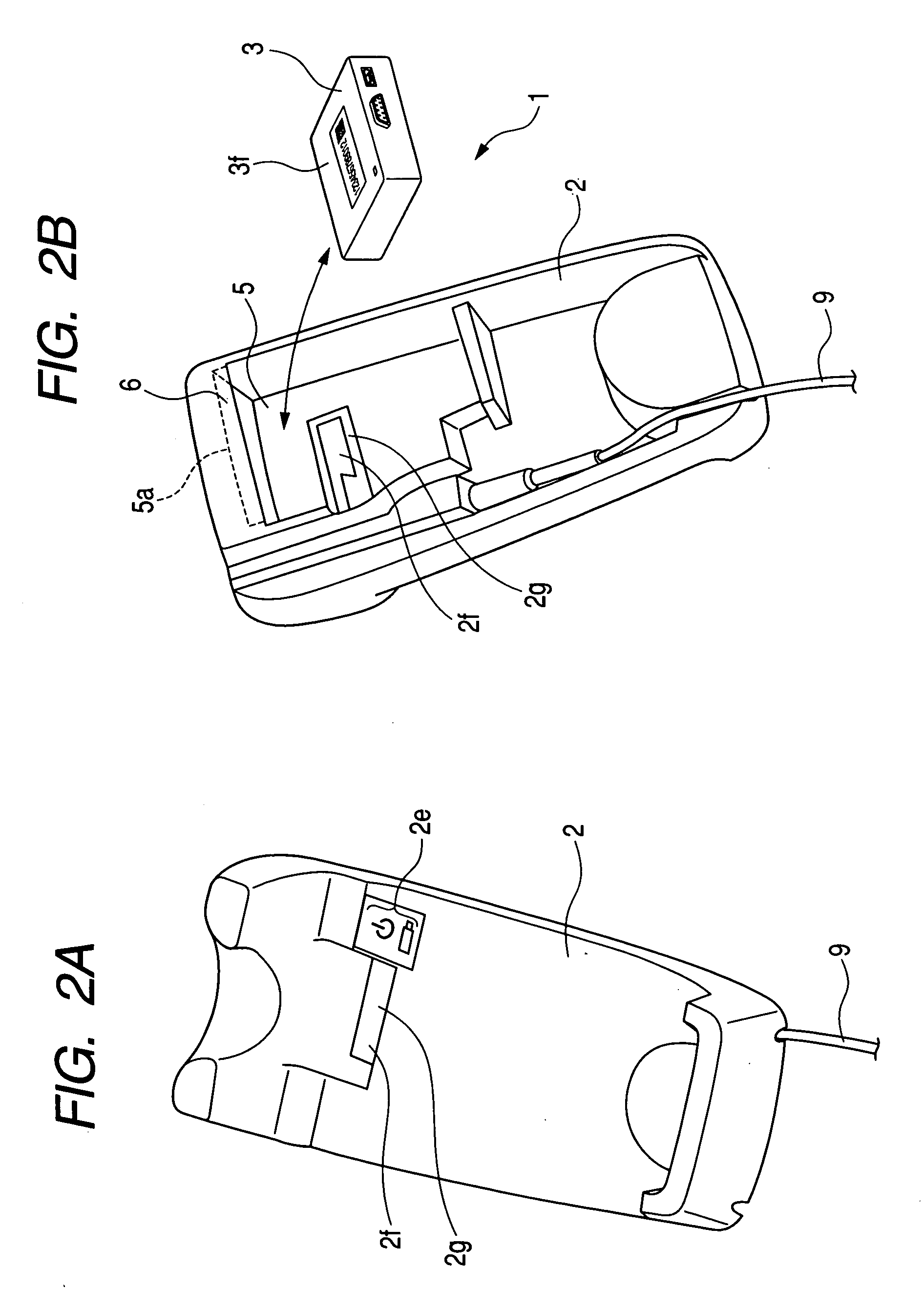
[0081] A portable-terminal holder according to an embodiment of the invention has a base for receiving thereon a portable terminal and a communication module. FIG. 1 is a diagram showing the portable-terminal holder 1 (referred to as simply holder 1 hereinafter) fitted with the communication module 3 when viewed from above. FIG. 2A is a diagram showing the holder 1 separated from the communication module 3 when viewed from above, and FIG. 2B is a diagram showing the holder 1 separated from the communication module 3 when viewed from below.
[0082] As shown in FIG. 2B, the communication module 3 has a box shape, and the base 2 has a hollow portion 5 at its bottom for housing therein the communication module 3. The base 2 has also a protruding plate 6 at its bottom inwardly protruding from an outer end 5a of the hollow portion 5 so as to cover a part of the hollow portion 5. This protruding plate 6 enables the communication module 3 to be snapped into the hollow portion 5.
[0083]FIGS. ...
second embodiment
[0105]FIG. 9 is a diagram showing a schematic structure of a radio communication system S used for reading information codes according to a second embodiment of the invention. As shown in this figure, the radio communication system S includes a host computer P, a plurality of portable scanner units B1 to B6 (collectively represented by B hereinafter) having the same structure, and one or more relay units A1 to A3 (collectively represented by A hereinafter) having the same structure. The scanner units B and the relay units A constitute a local area network N.
[0106] The relay units A are cable-connected to the host computer P through a hub H such as a USB (Universal Serial Bus). The scanner units B are radio-connected to the relay units A which serve also as holders of the scanner units A.
[0107]FIG. 10A is a block diagram showing an electrical configuration of the scanner units B. The scanner units B include a control circuit 111, a lighting device drive circuit 112, a lighting devi...
third embodiment
[0136]FIG. 16 is a sequence diagram explaining an operation of the radio communication system according to a third embodiment of the invention. The third embodiment is different from the second embodiment in that the third embodiment uses an auxiliary local ID for establishing communication in an emergency mode or a test mode, and that the scanner units has a receiving-only mode.
[0137] The auxiliary local ID is prestored in the nonvolatile memory of the memory device 110 or 130. The auxiliary local ID is used instead of the regular local ID explained in the second embodiment when the radio communication system is in fault condition, or when fault diagnosis is performed, or when the radio communication system is in an auxiliary mode (test mode or emergency mode). The auxiliary local ID is assigned in common to all the relay units A1 to A3 and the scanner units B1 to B6 constituting the local network N. The auxiliary local ID may be used for validating received local IDs when the rad...
PUM
 Login to View More
 Abstract
Description
Claims
Application Information
 Login to View More
 - R&D
- Intellectual Property
- Life Sciences
- Materials
- Tech Scout
- Unparalleled Data Quality
- Higher Quality Content
- 60% Fewer Hallucinations
Browse by: Latest US Patents, China's latest patents, Technical Efficacy Thesaurus, Application Domain, Technology Topic, Popular Technical Reports.
© 2025 PatSnap. All rights reserved.Legal|Privacy policy|Modern Slavery Act Transparency Statement|Sitemap|About US| Contact US: help@patsnap.com