Assessment of sleep quality and sleep disordered breathing based on cardiopulmonary coupling

a cardiopulmonary coupling and sleep quality technology, applied in the field of physiologic data analysis, can solve the problems of significant expense and patient discomfort, conventional sleep diagnostic system dependence on tedious manual scoring of “events” based on physiologically arbitrary, and leave a significant amount of unexplained effect varian

US20050267362A1Active Publication Date: 2005-12-01BETH ISRAEL DEACONESS MEDICAL CENT INC
7 Cites 62 Cited by

Patent Information

Authority / Receiving Office
US · United States
Patent Type
Applications(United States)
Current Assignee / Owner
Publication Date
2005-12-01

Smart Images

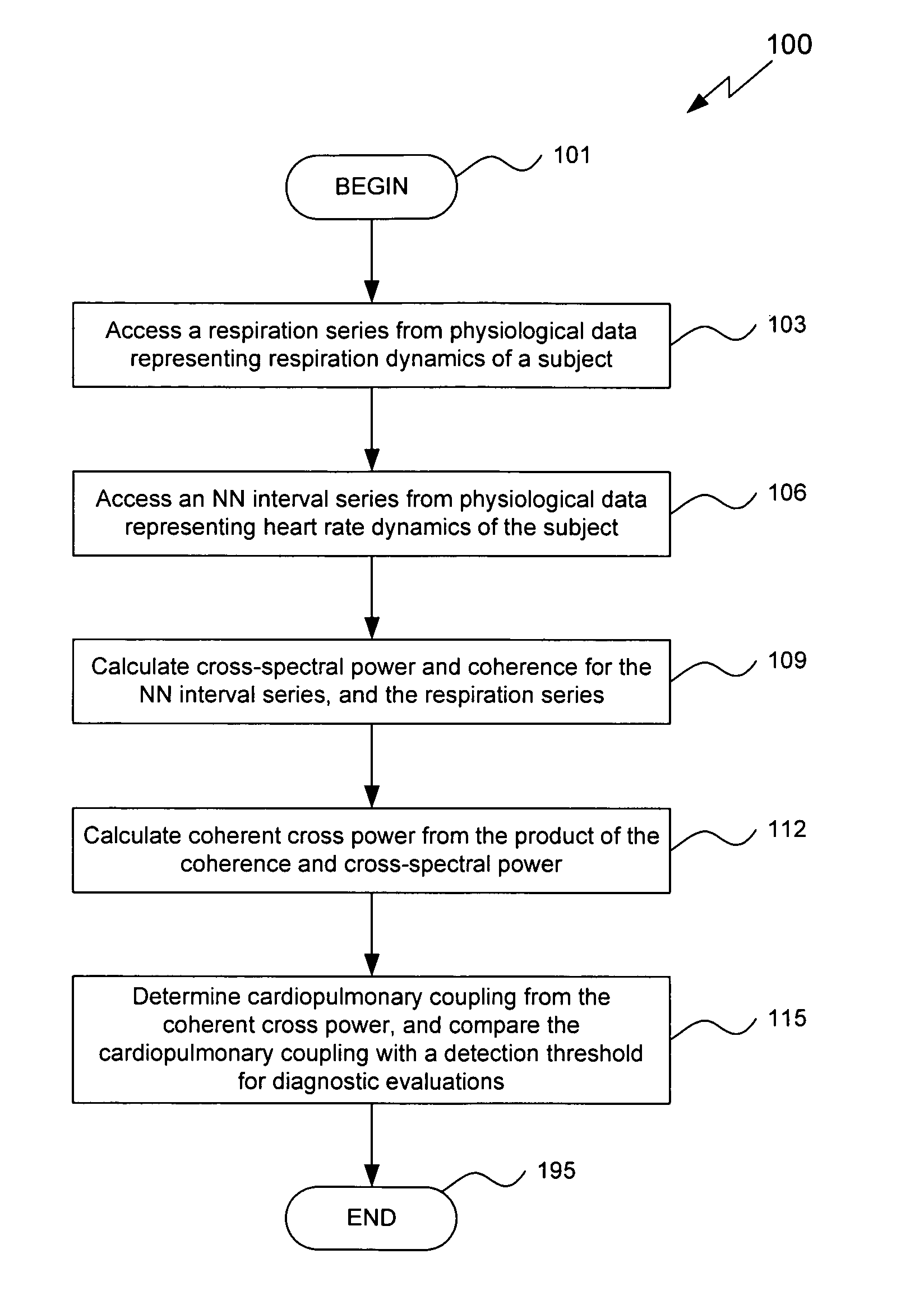
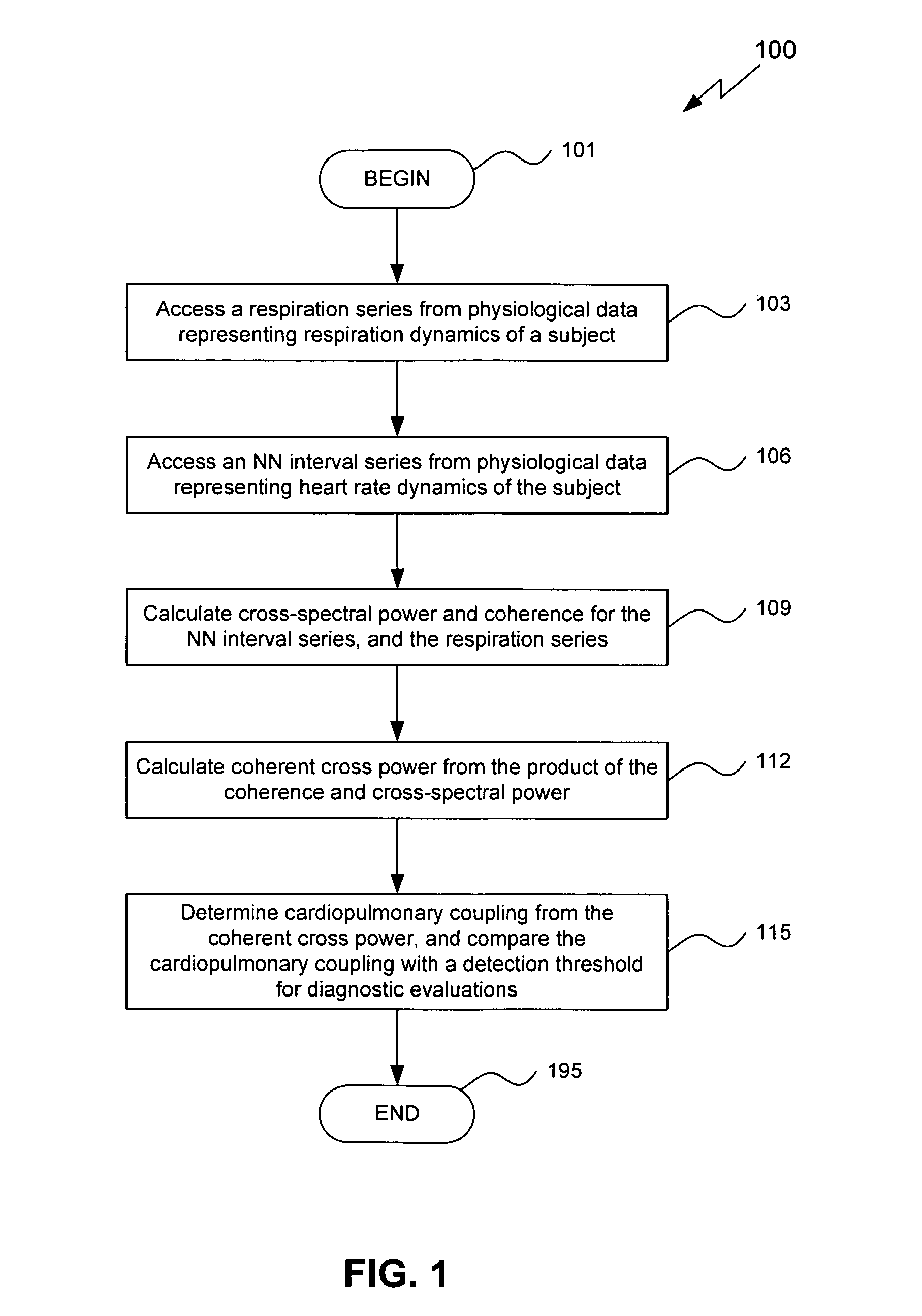
  • Figure 1
    Figure 1
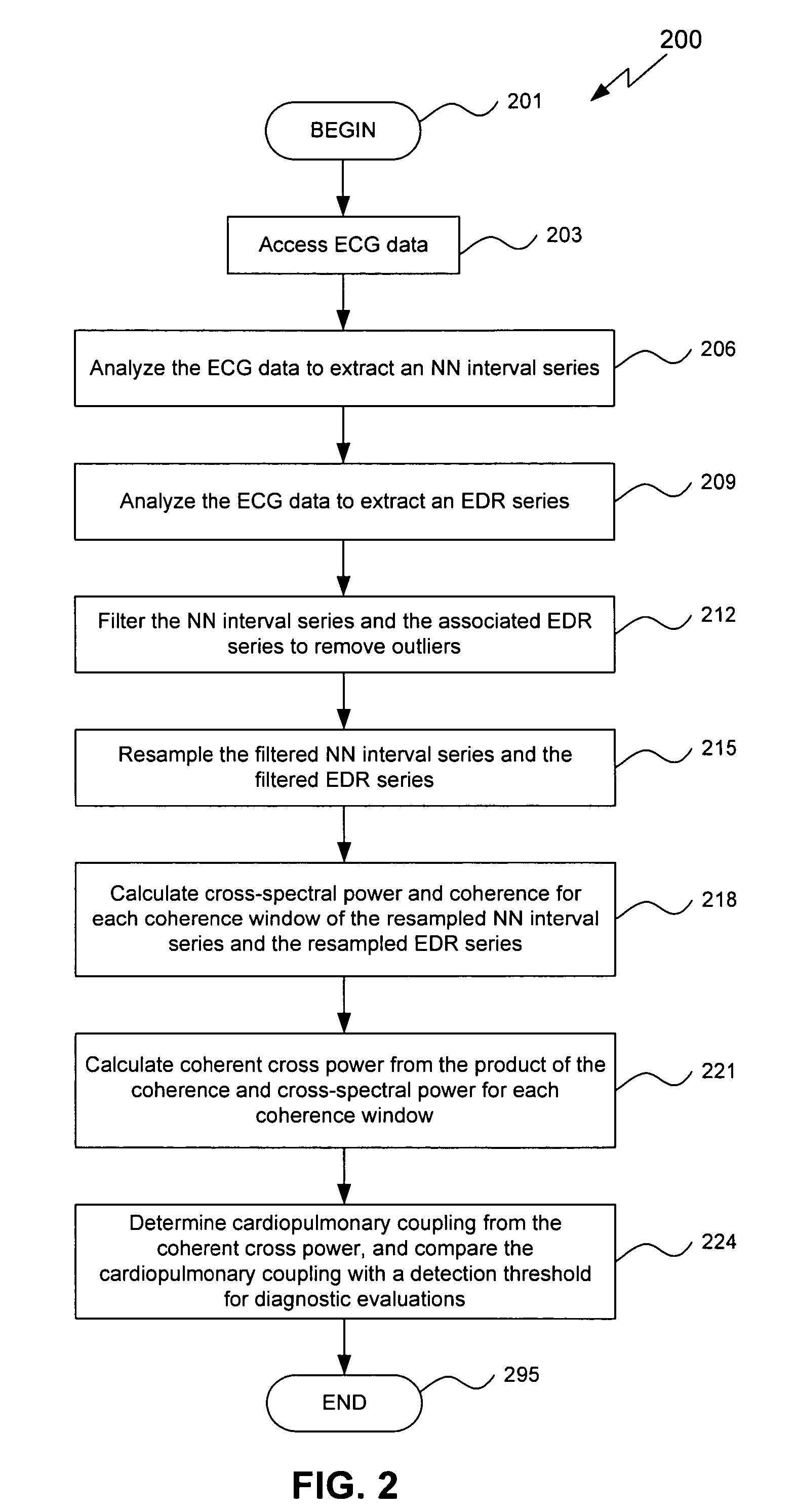
  • Figure 2
    Figure 2
  • Figure 3
    Figure 3
Patent Text Reader

Abstract

An assessment of sleep quality and sleep disordered breathing is determined from cardiopulmonary coupling between two physiological data series. An R-R interval series is derived from an electrocardiogram (ECG) signal. The normal beats from the R-R interval series are extracted to produce a normal-to-normal interval series. The amplitude variations in the QRS complex are used to extract a surrogate respiration signal (i.e., ECG-derived respiration) associated with the NN interval series. The two series are corrected to remove outliers, and resampled. The cross-spectral power and coherence of the two resampled signals are calculated over a plurality of coherence windows. For each coherence window, the product of the coherence and cross-spectral power is used to calculate coherent cross-power. Using the appropriate thresholds for the coherent cross-power, the proportion of sleep spent in CAP, non-CAP, and wake and / or REM are determined. Coherent cross-power can be applied to differentiate obstructive from non-obstructive disease, and admixtures of the same.
Need to check novelty before this filing date? Find Prior Art

Description

CROSS-REFERENCE TO RELATED APPLICATIONS

[0001] This application is a continuation-in-part of U.S. application Ser. No. 10 / 846,945, filed May 17, 2004, by Mietus et al., entitled “Assessment of Sleep Quality and Sleep Disordered Breathing Based on Cardiopulmonary Coupling,” incorporated herein by reference in its entirety.STATEMENT REGARDING FEDERALLY-SPONSORED RESEARCH AND DEVELOPMENT

[0002] Part of the work performed during development of this invention utilized U.S. Government funds. The U.S. Government has certain rights in this invention.BACKGROUND OF THE INVENTION

[0003] 1. Field of the Invention

[0004] The present invention relates generally to analyzing physiologic data, and more specifically, to non-invasively assessing sleep pathology and physiology from coherence and / or cross-power measurements.

[0005] 2. Related Art

[0006] At least five percent of the general population suffers from medically significant sleep disorders, the most common being sleep-disordered breathing (a...

Examples

Embodiment Construction

[0027] According to embodiments of the present invention, a method, system, and computer program product is provided to perform a quantitative analysis of cardiopulmonary coupling between two physiological signals to detect and evaluate sleep physiology.

[0028] This specification discloses one or more embodiments that incorporate the features of this invention. The embodiment(s) described, and references in the specification to “one embodiment”, “an embodiment”, “an example embodiment”, etc., indicate that the embodiment(s) described may include a particular feature, structure, or characteristic, but every embodiment may not necessarily include the particular feature, structure, or characteristic. Moreover, such phrases are not necessarily referring to the same embodiment. Further, when a particular feature, structure, or characteristic is described in connection with an embodiment, it is submitted that it is within the knowledge of one skilled in the art to effect such feature, str...