

Overlapped stents for scaffolding, flexibility and MRI compatibility
- Summary
- Abstract
- Description
- Claims
- Application Information
AI Technical Summary
Benefits of technology
Problems solved by technology
Method used
Image

Examples
Embodiment Construction
[0050] While this invention may be embodied in many different forms, there are described in detail herein several specific embodiments of the invention. This description is an exemplification of the principles of the invention and is not intended to limit the invention to the particular embodiments illustrated.
[0051] For the purposes of this disclosure, like reference numerals in the figures shall refer to like features unless otherwise indicated.
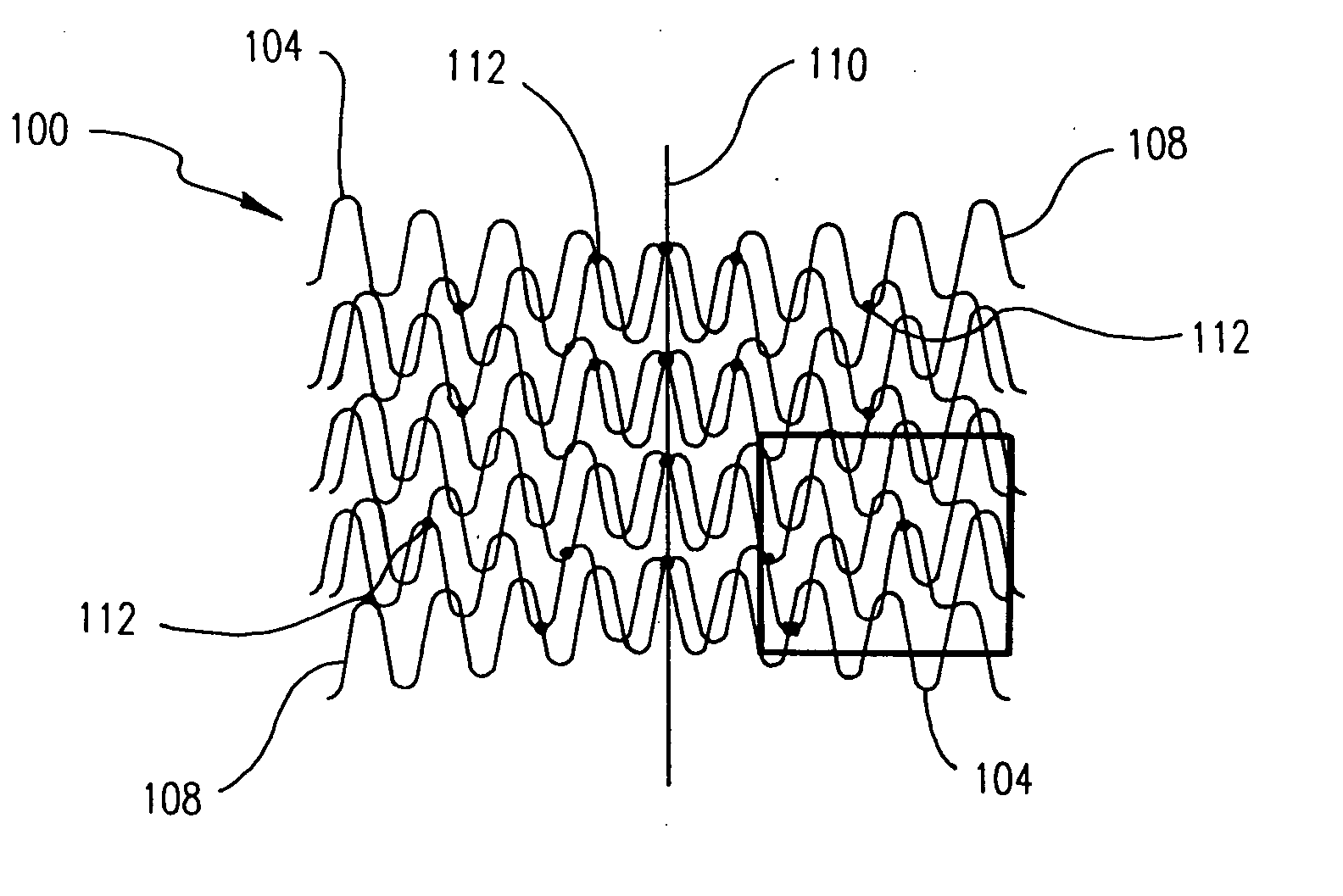
[0052] In one embodiment, the invention is directed to a tubular insert for a bodily vessel. The insert, as shown generally in the flat at 100 in FIG. 2c, comprises an inner stent 104 and an outer stent 108. At least a portion of inner stent 104 is disposed within the outer stent 108. The outer stent has a longitudinal axis 110 and is constructed so as to be free of any closed loops which are electrically conductive and which are disposed about the longitudinal axis such that the longitudinal axis passes through the closed loop. The inner...
PUM
 Login to View More
 Abstract
Description
Claims
Application Information
 Login to View More