
Semiconductor apparatus having stacked semiconductor components
a technology of semiconductor components and semiconductor devices, which is applied in the direction of electrical devices, semiconductor devices, and semiconductor/solid-state device details, etc., can solve the disadvantage of not being able to match the impedance of all wiring sections, the disadvantage of the individual semiconductor components connected to one another's wiring between the contact regions b>10/b>, and the bus system having branches in the signal line, etc., to achieve the effect of improving the wiring
- Summary
- Abstract
- Description
- Claims
- Application Information
AI Technical Summary
Benefits of technology
Problems solved by technology
Method used
Image

Examples
second embodiment
[0025] A diagrammatic illustration of the present invention is described in FIG. 7. After a first semiconductor component 21 has been embedded in the potting compound 20 and a rewiring 23 has been formed, a dielectric layer 40 is deposited. The dielectric layer 40 is configured in such a manner that it does not cover an external region of the rewiring 23 in the region of the potting compound 20. A conductive layer 41 is deposited onto the dielectric layer. This conductive layer 41 then forms an equipotential surface or an earth surface. In the case of a given electric constant of the dielectric 40 and the typical frequencies of the semiconductor component, the thickness of the dielectric layer 40 and the width of the wiring 23 are selected, in accordance with known techniques or knowledge of electrodynamics, in such a manner that it is possible to match the impedance in an optimum manner.
[0026] In subsequent steps, as described in the first exemplary embodiment, a second semiconduct...
third embodiment
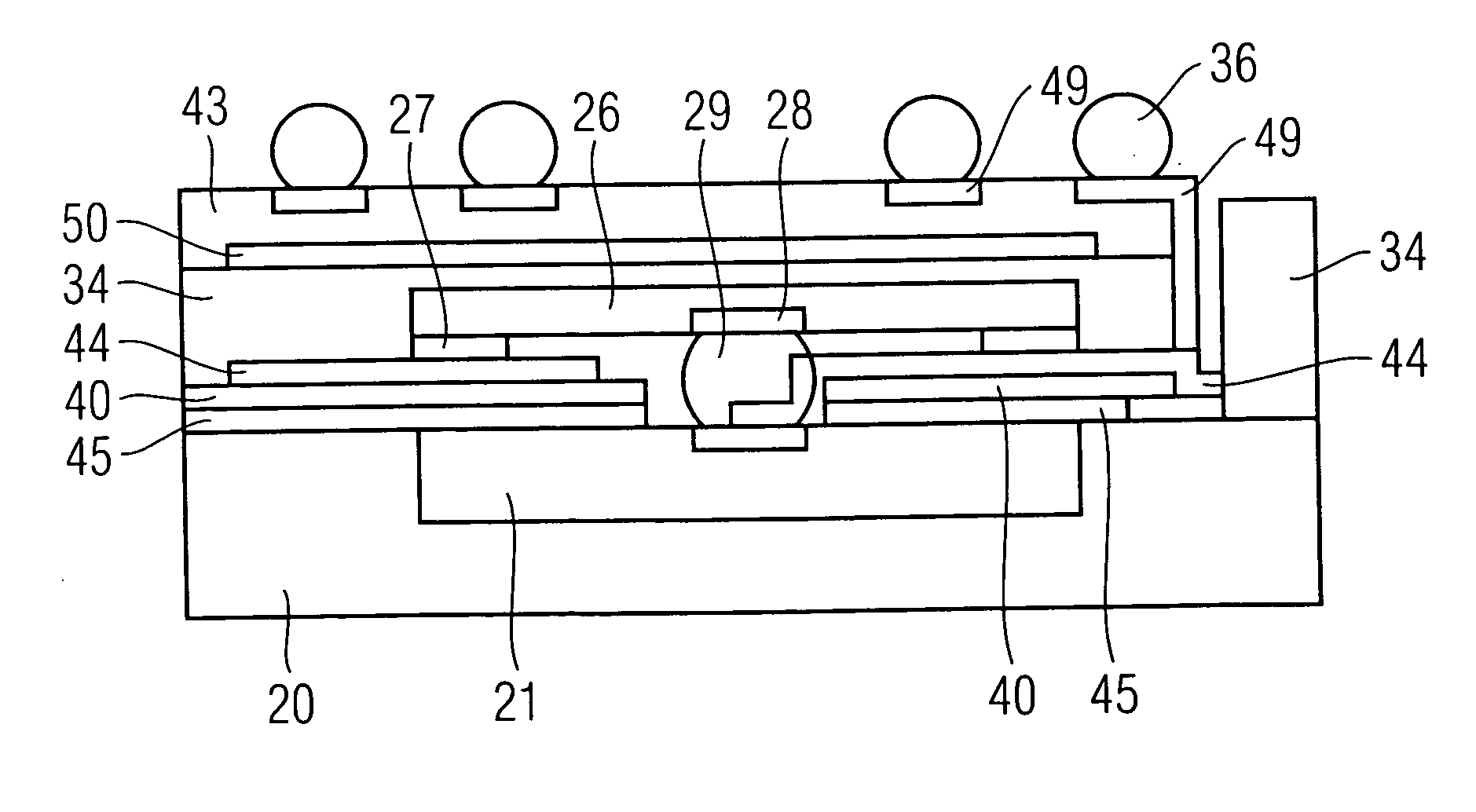
[0027]FIGS. 9 and 10 illustrate a third embodiment of the present invention. This embodiment differs from the second embodiment by virtue of the fact that an equipotential or earth surface 45 is applied to the first embedded semiconductor component 21 in a first step. This earth surface 45 does not touch the contact-connection region 22. A dielectric layer 40 is deposited onto the earth surface 45. A rewiring 44 is then formed. This rewiring contact-connects the contact-connection region 22. The impedance of this rewiring is matched using the earth surface 45 and the dielectric layer 40. The subsequent steps for producing the present invention correspond to those of the second embodiment.
[0028] Although the present invention was described with reference to preferred exemplary embodiments, it is not restricted thereto. In particular, various techniques are known in order to fasten the second semiconductor component on the first semiconductor component. Furthermore, the materials for ...
PUM
 Login to View More
 Abstract
Description
Claims
Application Information
 Login to View More