Unlock instant, AI-driven research and patent intelligence for your innovation.

Improvements relating to polymerisation reactions

a technology of polymerisation reaction and kinetics, which is applied in the direction of pretreatment surfaces, chemical/physical/physical-chemical processes, chemical/physical/physical-chemical stationary reactors, etc., can solve the problems of complicating the reaction kinetics even further, little control over the precise reaction kinetics, and the current reactor is adapted for plug-flow processes

Inactive Publication Date: 2006-08-31
JACHUCK ROSHAN JEET JEE +2
View PDF3 Cites 1 Cited by
  • Summary
  • Abstract
  • Description
  • Claims
  • Application Information

AI Technical Summary

Problems solved by technology

This means that there is little control over the precise reaction kinetics, since polymerisation initiation can occur at different times in different regions of the reactor volume.
Although mixing within the reactor vessel can help to reduce this problem, such mixing can in fact complicate the reaction kinetics even further.
However, current reactors adapted for plug flow processes have a number of disadvantages, including low surface area to volume ratios, no draw, low shear and high pressure drops at higher conversions.
This prior art reference does not provide any teaching as to how such polymerisation reactions can be controlled to give tight molecular weight distributions, nor does it demonstrate any detailed disclosure of how the use of a spinning surface can be adapted specifically for polymerisation reactions.
A limiting factor in terms of polymer conversion on the surface is the viscosity of the prepolymer and / or polymer mix.
Research by the present applicant indicates that conditions on a rotating surface reactor may contribute to a reduction in cage effects which would normally result in low initiator efficiency.

Method used

the structure of the environmentally friendly knitted fabric provided by the present invention; figure 2 Flow chart of the yarn wrapping machine for environmentally friendly knitted fabrics and storage devices; image 3 Is the parameter map of the yarn covering machine
View more

Image

Smart Image Click on the blue labels to locate them in the text.
Viewing Examples
Smart Image
  • Improvements relating to polymerisation reactions
  • Improvements relating to polymerisation reactions
  • Improvements relating to polymerisation reactions

Examples

Experimental program
Comparison scheme
Effect test

example 2

Cationic Polymerisation of Styrene

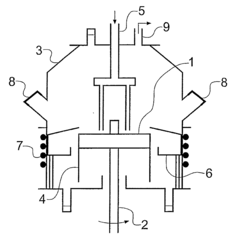
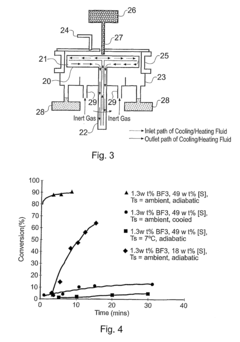
[0041]FIG. 3 shows an alternative spinning disc reactor including a hollow spinning disc 20 with an internal passage 21 for a heat transfer fluid and mounted on an axis of rotation 22. The disc 20 is enclosed within a housing 23 having a vent 24, the housing being provided with a cooling jacket 25. There is further provided a supply of monomer / catalyst 26 and a feed 27 for supplying the monomer / catalyst reactant mix to a central part of the surface of the disc 20. When the disc 20 is rotated, reactant will tend to spread across the surface of the disc 20 as a thin film, and product will be thrown from a periphery of the disc 20 for collection in reservoirs 28. An inert gas may be supplied to an interior of the housing 23 by way of pipes 29. The spinning disc reactor (SDR) of FIG. 3 was used for the cationic polymerisation of styrene using a silica supported Lewis acid catalyst. The thin, intensely mixed films produced under the centrifugal field of...

the structure of the environmentally friendly knitted fabric provided by the present invention; figure 2 Flow chart of the yarn wrapping machine for environmentally friendly knitted fabrics and storage devices; image 3 Is the parameter map of the yarn covering machine
Login to View More

PUM

No PUM Login to View More

Abstract

A method of conducting polymerisation reactions on a rotating surface reactor which allows substantially increased conversions (up to around 99%) to be achieved without a corresponding increase in polydispersity as would be expected as a result of the Trommsdorff-Norrish effect. The rotating surface reactor serves to disentangle and / or stretch growing polymer chains so as to result in better control over polymerisation kinetics.

Description

CROSS-REFERENCE TO RELATED APPLICATIONS [0001] This is a continuation of U.S. patent application Ser. No. 10 / 484,611, filed Jan. 20, 2004, which entered the U.S. National Stage from PCT Application No. PCT / GB02 / 03341, filed Jul. 22, 2002, which application claimed priority to Great Britain Patent Application No. GB01117642.9, filed Jul. 20, 2001. Each of the above applications are incorporated herein by reference. Priority of each of the above-referenced application is hereby claimed.STATEMENT REGARDING FEDERALLY SPONSORED RESEARCH OR DEVELOPMENT [0002] Not applicable REFERENCE TO A “MICROFICHE APPENDIX”[0003] Not applicable BACKGROUND OF THE INVENTION [0004] The present invention relates to methods for enhancing the kinetics of polymerisation reactions, and in particular to methods for achieving high rates of polymerisation and narrow molecular weight distribution, advantageously even at high molecular weights (for example up to 400,000 or above) and at high intrinsic viscosities (...

Claims

the structure of the environmentally friendly knitted fabric provided by the present invention; figure 2 Flow chart of the yarn wrapping machine for environmentally friendly knitted fabrics and storage devices; image 3 Is the parameter map of the yarn covering machine
Login to View More

Application Information

Patent Timeline
no application Login to View More
IPC IPC(8): C08F2/00B01J19/18C08F2/01C08F2/06
CPCB01J19/1887B01J2219/0009
Inventor JACHUCK, ROSHAN, JEET, JEEJONES, MICHAELHENDERSON, IAN
Owner JACHUCK ROSHAN JEET JEE