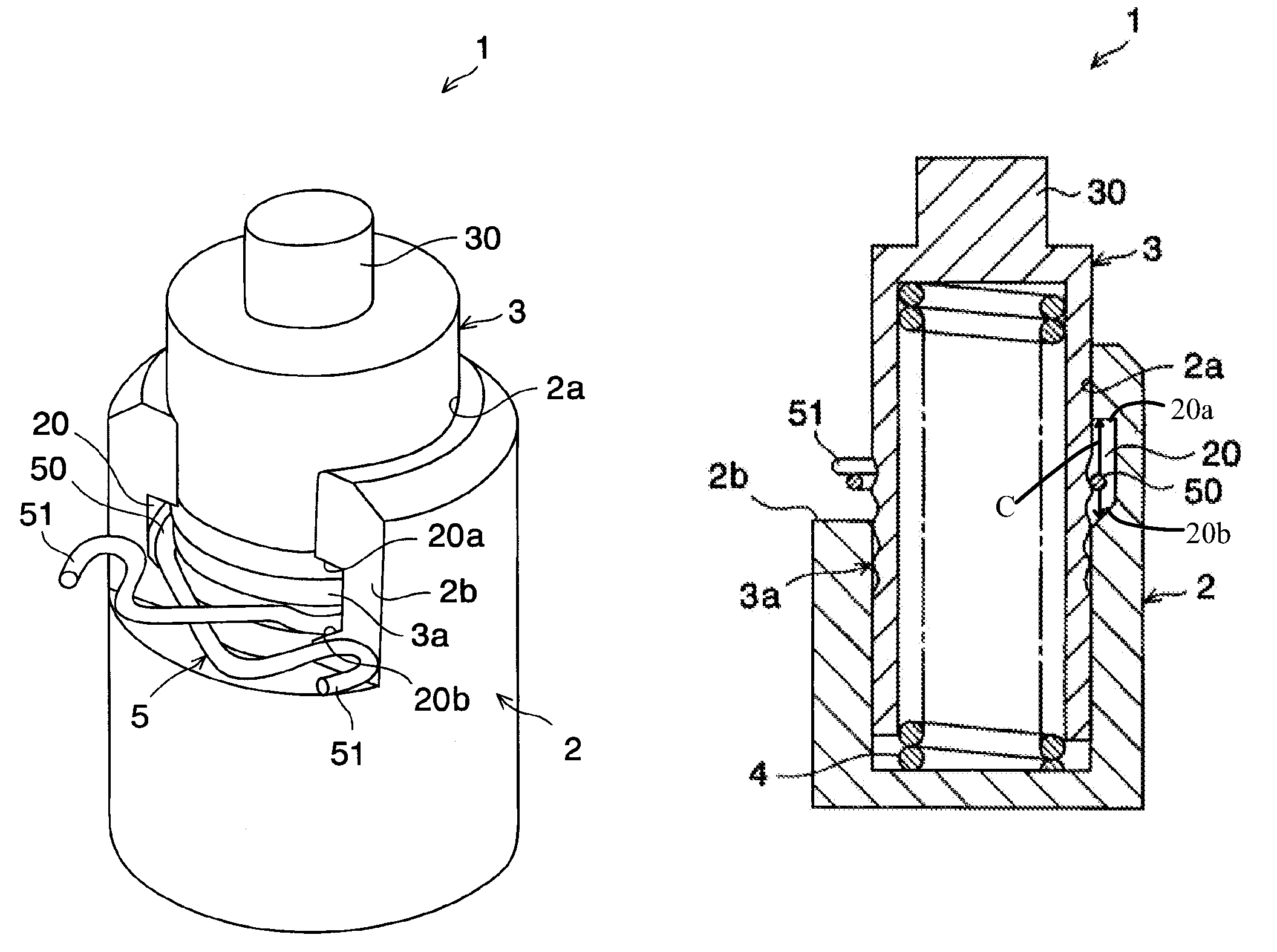
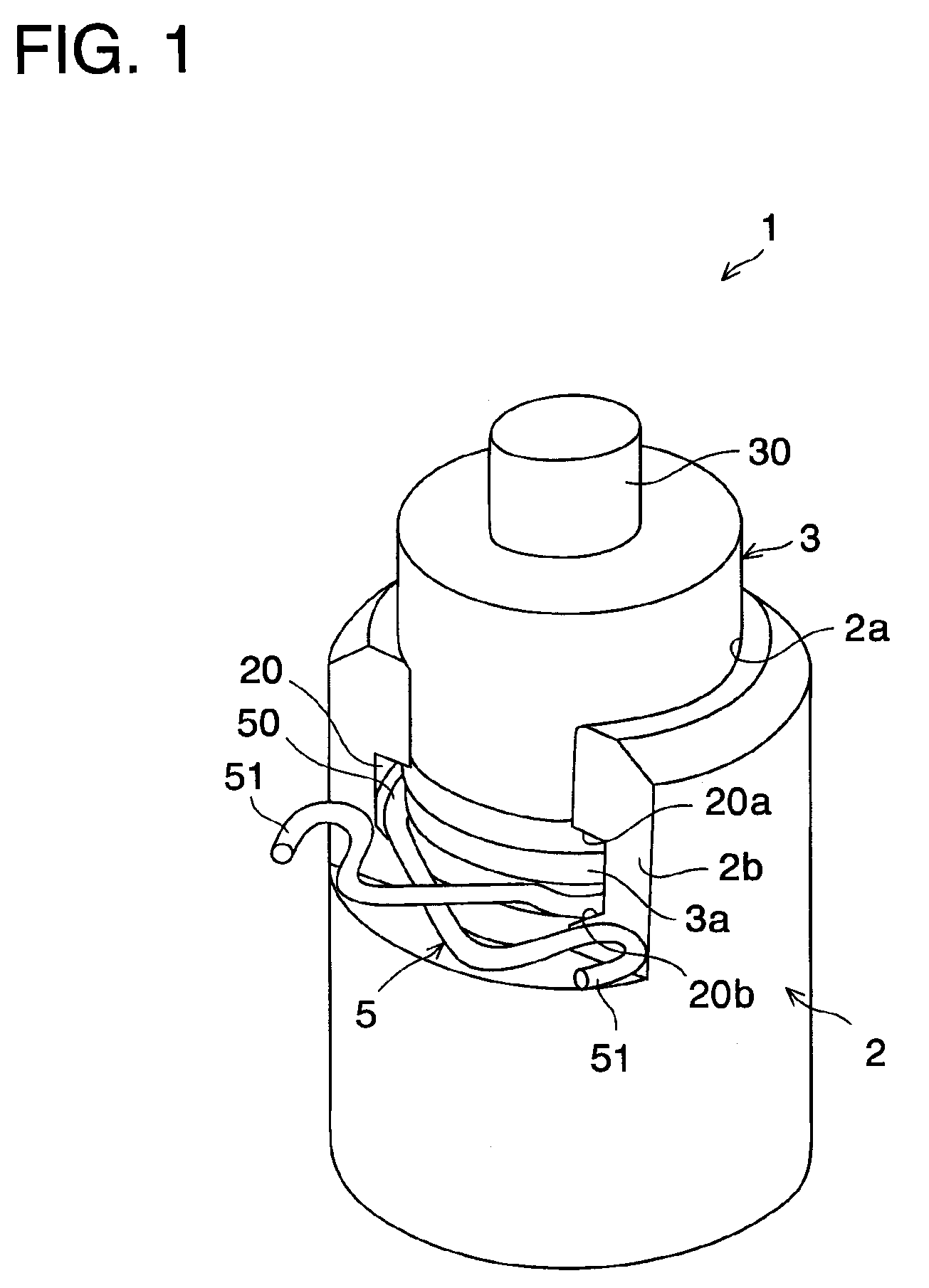
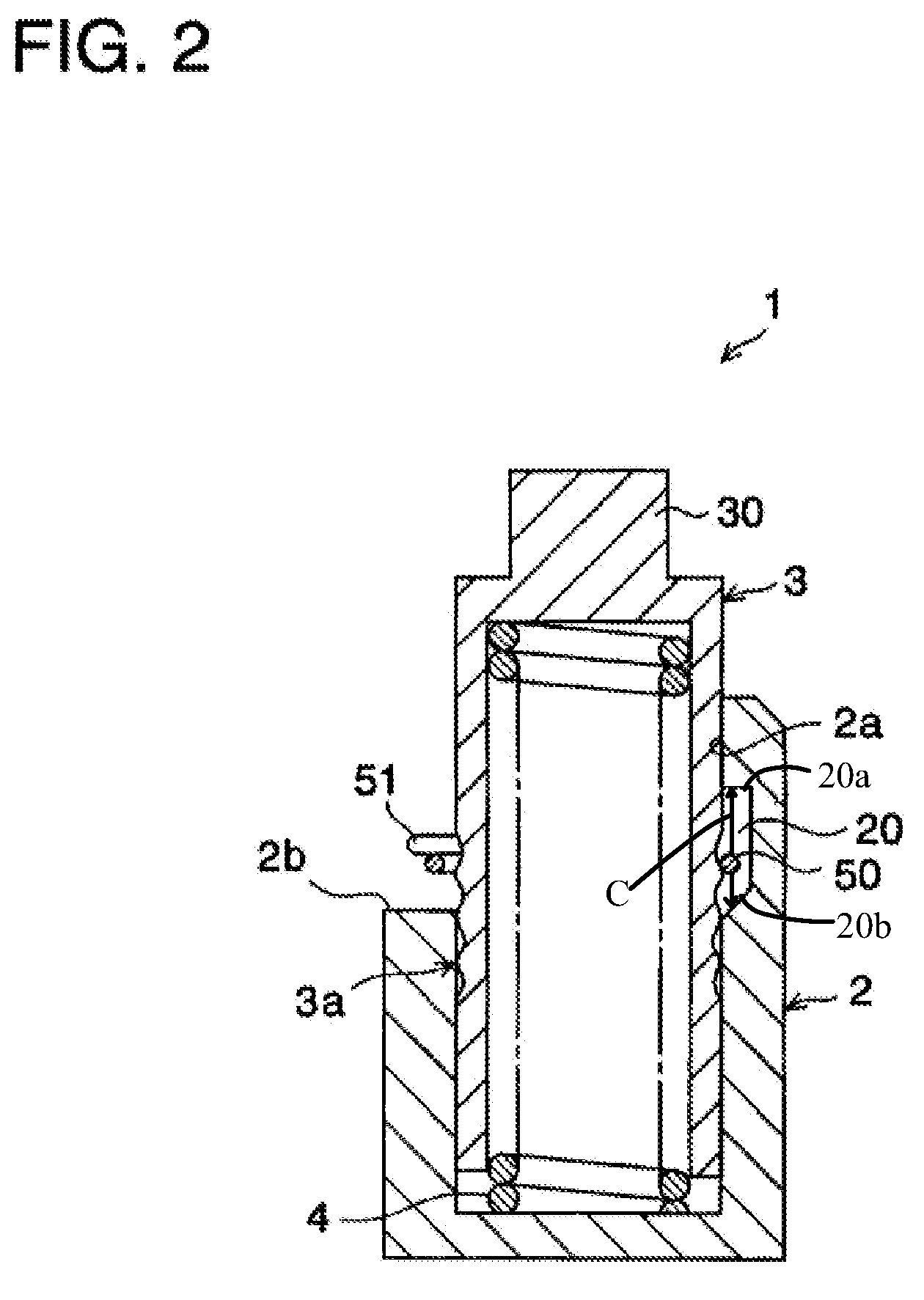
[0013] In the first embodiment of the present invention, when the piston moves in the protruding direction, during operation, the circlip member fitted on the rack teeth of the piston travels along with the piston, and the ring-shaped body of the circlip member contacts and engages with the upper stop surface of the piston bore of the housing. In this state, when the piston moves further in the protruding direction, the rack teeth of the piston travel over the ring-shaped body of the circlip member and the movement of the piston in the protruding direction is thus permitted.
[0014] When the piston moves in the retracting direction, the circlip member fitted on the rack teeth of the piston travels along with the piston and the ring-shaped body of the circlip member contacts and engages with the lower stop surface of the piston bore of the housing. In this state, the piston is locked in the retracting direction through the engagement of the ring-shaped body of the circlip member with the rack teeth of the piston and the lower stop surface of the piston bore, and the movement of the piston in the retracting direction is thus restricted. Also, when the ring-shaped body of the circlip member comes into contact with the lower stop surface of the piston bore, the wavy portion of the ring-shaped body elastically deforms in the axial direction. Thereby, a shock is relieved when the ring-shaped body of the circlip member impacts the lower stop surface of the piston bore thus decreasing the
impact sound at the time of retraction of the piston.
[0017] According to the second embodiment of the present invention, when the piston moves in the protruding direction during operation, the circlip member fitted on the rack teeth of the piston travels along with the piston, and the ring-shaped body of the circlip member contacts and engages with the upper stop surface of the piston bore of the housing. In this state, the rack teeth of the piston travel over the ring-shaped body of the circlip member and the movement of the piston in the protruding direction is thus permitted.
[0018] When the piston moves in the retracting direction, the circlip member fitted on the rack teeth of the piston travels along with the piston, and the ring-shaped body of the circlip member contacts and engages with the
washer member disposed on the lower stop surface of the piston bore of the housing. In this state, the piston is locked in the retracting direction through the engagement of the ring-shaped body of the circlip member with the rack teeth of the piston and the
washer on the lower stop surface of the piston bore, thus restricting the movement of the piston in the retracting direction. Also, when the ring-shaped body of the circlip member comes into contact with the
washer member on the lower stop surface of the piston bore, the washer member elastically deforms in the axial direction. Thereby, a shock is relieved when the ring-shaped body of the circlip member impacts the washer member and the
impact sound at the time of retraction of the piston is thus decreased.
[0021] In this case, during operation, when the piston moves in the retracting direction, the circlip member fitted on the rack teeth of the piston travels the clearance formed between the circlip member and the lower stop surface. Thereby, when the increased tension in the chain applies an excessive shock load to the piston, the excessive shock load is prevented from directly and immediately acting on the ring-shaped body engaged with the rack teeth of the piston.
[0022] The tensioner may be a mechanical tensioner. In this case, there is no need to provide an oil circuit that makes the entire structure of the tensioner complicated, simplifying the structure and reducing the manufacturing cost.



 Login to View More
  Login to View More