
Compounds and methods for treating seizure disorders
- Summary
- Abstract
- Description
- Claims
- Application Information
AI Technical Summary
Benefits of technology
Problems solved by technology
Method used
Image

Examples
example 1
Anticonvulsant and Antiepileptic Actions of 2-DG Against Kindled Seizures
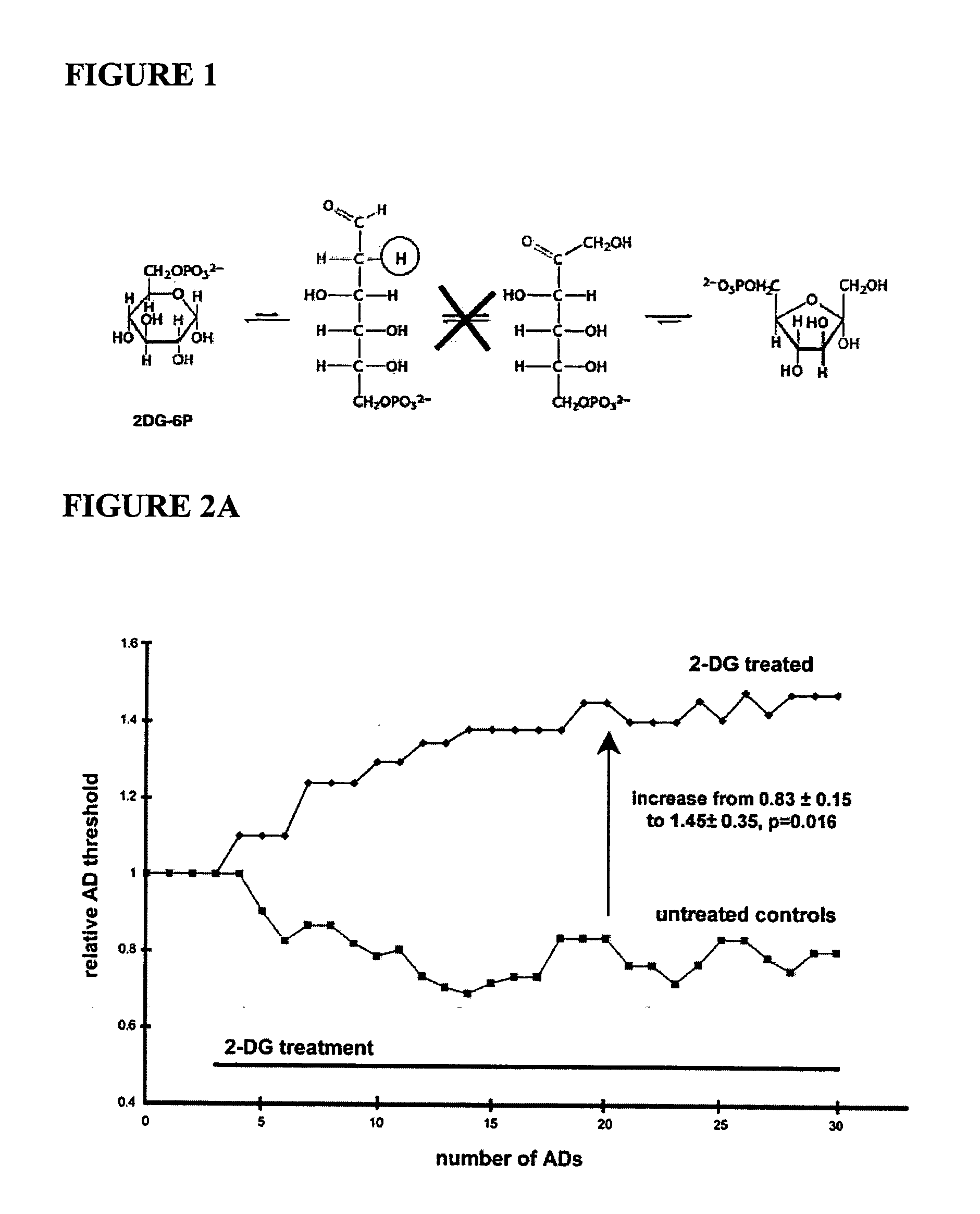
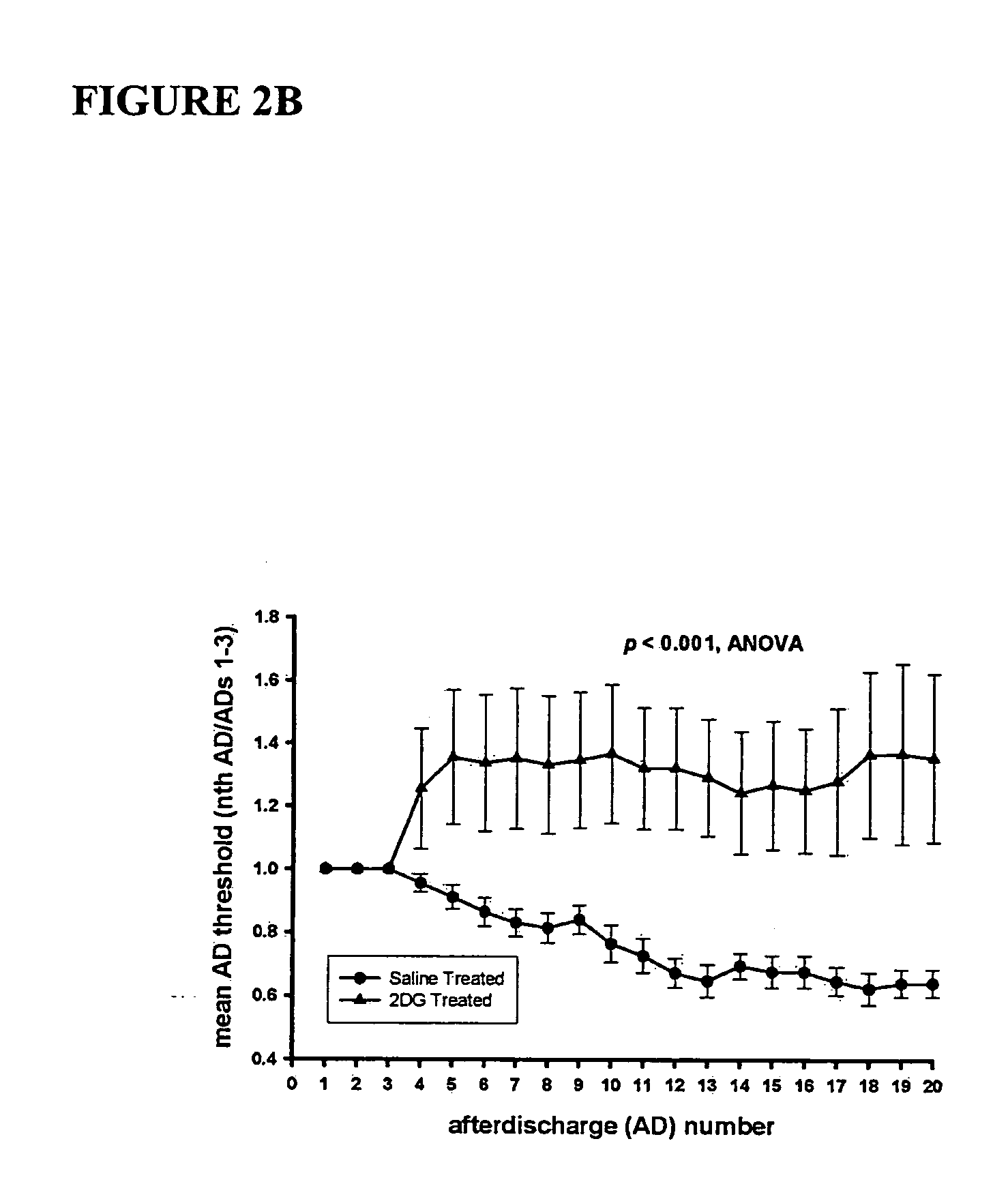
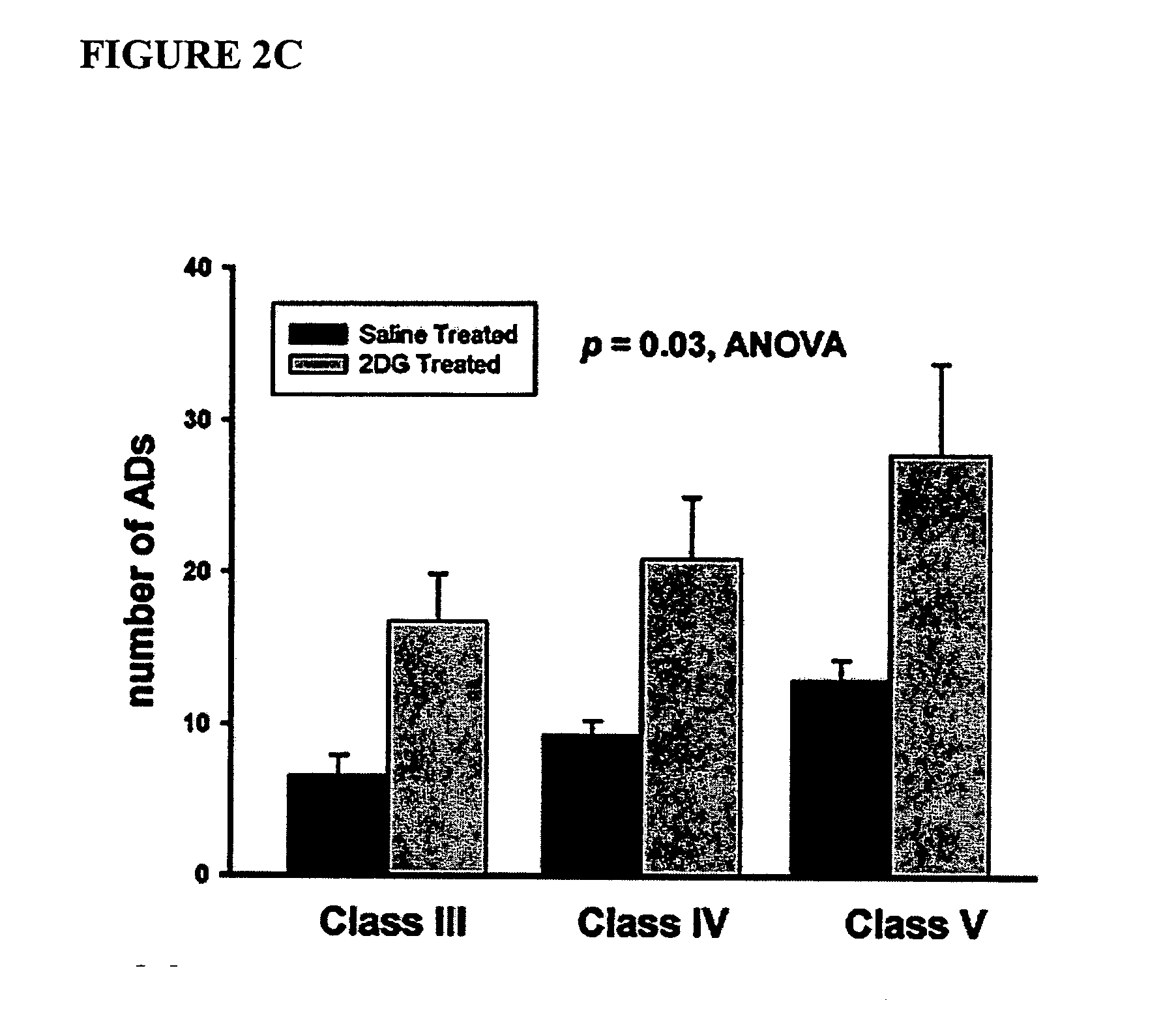
[0074] Anticonvulsant and antiepileptic effects of 2-deoxyglucose (2-DG) were evaluated in the kindling model of temporal lobe epilepsy.
[0075] In the kindling model, repeated activation of neural pathways in vivo induces progressive electrographic and behavioral seizures, permanent increases in susceptibility to additional seizures, and eventually spontaneous seizures (Goddard et al., 1969, Experimental Neurology 25: 295-330; Pinel, 1978, Experimental Neurology 58: 190-202; Wada et al., 1975, Canadian Journal of Neurological Sciences 2: 477-492; Sayin et al. 2003, Journal of Neuroscience 23: 2759-2768). Kindling has become the most extensively studied experimental model of epilepsy (McNamara, 1999, Nature 399: A15-22). In a typical kindling protocol, periodic stimulation delivered once or twice daily gradually evokes an increasing synchronous electrical afterdischarge (AD) or electrographic seizure accompanie...
example 2
Effect of 2-DG on Synchronized Bursting in Hippocampal Slices
[0082] To further confirm the anticonvulsant effects of 2-DG observed in kindled rats, the effect of 2-DG on synchronized bursting induced by elevation of [K+]o in rat hippocampal slices ex corpora was evaluated.
[0083] In these experiments, postnatal day 14 to 35 male Sprague-Dawley rats were anesthetized and decapitated. Brains were removed and transferred to ice cold artificial cerebrospinal fluid (ACSF), comprising 124 mM NaCl, 5 mM KCl, 1.25 mM NaH2PO4, 1.5 mM MgSO4, and 26 mM NaHCO3, supplemented with 10 mM glucose), which was continuously bubbled with 95% O2 and 5% CO2. Transverse hippocampal slices (˜400 microns) were prepared on a Leica VT1000s vibratome (Wetzlar Germany). The slices were allowed to recover for 1 hour at room temperature and were then transferred to an interface recording chamber at 34° C. in ACSF with 7.5 mM [K+]o. Extracellular recordings were made from the CA3 region with an Axioclamp 2B (Axon...
example 3
Reduction of Synchronized Bursting by Iodoacetate
[0087] To confirm that the results set forth above were due to antiglycolytic effects, the experiments set forth in Example 2 were repeated using ACSF supplemented with 10 mM glucose or 10 mM lactate in the presence of 200 uM iodoacetate, an inhibitor of the glycolytic enzyme glyceraldehyde phosphate dehydrogenase (EC 1.2.1.12). The results of these experiments are shown in FIGS. 6 and 7. FIG. 6 shows the rate of baseline synchronized bursting from a hippocampal slice in ACSF with 10 mM [K+]o 10 mM glucose, and 20 mM lactate. The reduction in burst frequency is shown in graphical form in FIG. 7. Iodoacetate reduced synchronized bursting, demonstrating that inhibiting glycolysis by glyceraldehyde phosphate dehydrogenase inhibition is also an effective means for reducing neural synchronization, the cellular event associated with various seizure disorders.
PUM
| Property | Measurement | Unit |
|---|---|---|
| Time | aaaaa | aaaaa |
| Threshold limit | aaaaa | aaaaa |
Abstract
Description
Claims
Application Information
 Login to View More