Unlock instant, AI-driven research and patent intelligence for your innovation.

Three layer composite panel from recycled polyurethanes

a three-layer composite and polyurethane technology, applied in the direction of synthetic resin layered products, transportation and packaging, other domestic articles, etc., can solve the problems of delamination and warpage, the foamed polyurethane, and the inability to melt and reuse in its original form, unlike thermoplastic materials, to achieve the effect of reducing the cost of manufacturing and reducing the cost of production

Active Publication Date: 2007-01-11
KESSING REINHARD
View PDF47 Cites 17 Cited by
  • Summary
  • Abstract
  • Description
  • Claims
  • Application Information

AI Technical Summary

Benefits of technology

[0012] In a preferred embodiment of the invention a process of manufacturing a composite panel from recycled polyurethanes and other materials incidental to the component being recycled is disclosed. The process comprises the steps of producing a core layer comprising the steps of cutting and milling recycled polyurethanes along with other materials incidental to at least one recycled component, passing the milled polyurethanes and other materials incidental to the recycled component through a screen to ensure all particles are not larger than about 3 millimeters in diameter, blending the recycled polyurethanes and other materials incidental to the recycled component with isocyanate and water and cleaning the recycled polyurethanes and other materials incidental to a recycled component in a wind sifter. The surface layer is produced by the steps of cutting and milling recycled polyurethanes and other materials incidental to at least one recycled component, and blending the recycled polyurethanes and other materials incidental to the recycled component with isocyanate and water; cleaning the recycled polyurethanes and other materials incidental to a recycled component in a wind sifter, passing the milled polyurethanes and other material

Problems solved by technology

Currently, laminate flooring is not generally used for commercial application or in residential areas such as kitchens and bathrooms, due to the thickness swell of fiberboard when exposed to moisture.
Water absorption tends to cause thickness swell of the fiberboard and often results in de-lamination and warping.
Most foamed polyurethanes, unlike thermoplastic materials, cannot be melted and reused in its original form.
These homogeneous boards were not fabricated using a three-layer construction, did not have a closed, non-porous smooth surface layer, and therefore were suitable only for high pressure lamination, but not for direct lamination.
Therefore, none of the methods of manufacture or boards mentioned above describe a three layer composite panel made from recycled, non-organic components with a reduced thickness swell and a closed, non-porous smooth surface suitable for direct lamination.

Method used

the structure of the environmentally friendly knitted fabric provided by the present invention; figure 2 Flow chart of the yarn wrapping machine for environmentally friendly knitted fabrics and storage devices; image 3 Is the parameter map of the yarn covering machine
View more

Image

Smart Image Click on the blue labels to locate them in the text.
Viewing Examples
Smart Image
  • Three layer composite panel from recycled polyurethanes
  • Three layer composite panel from recycled polyurethanes
  • Three layer composite panel from recycled polyurethanes

Examples

Experimental program
Comparison scheme
Effect test

Embodiment Construction

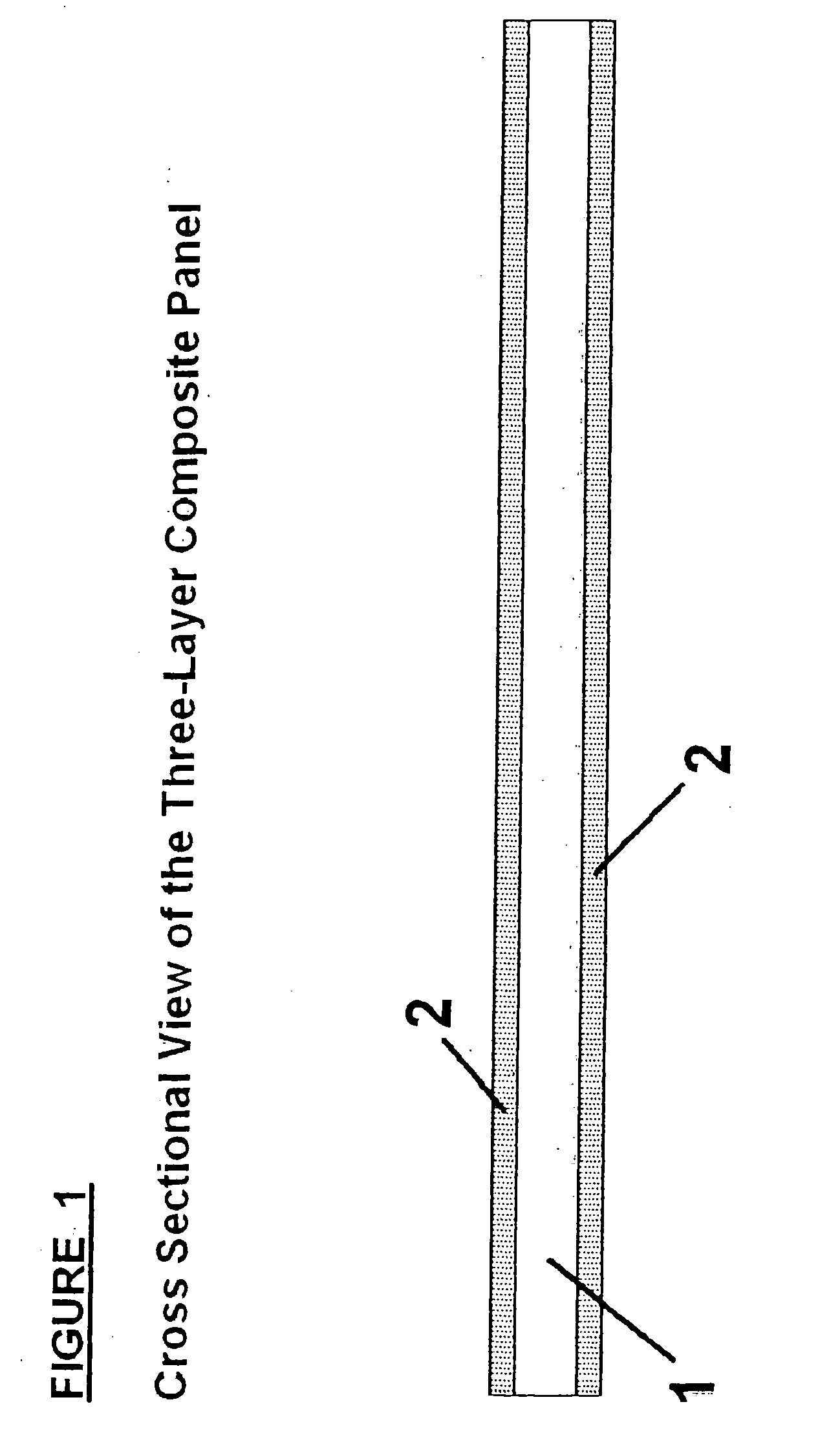
[0018] Referring to FIG. 1, the composite panel is made up of three layers: a core layer 1 and two surface layers 2. The core layer 1 is made primarily of recycled polyurethanes, which comprises a blend of recycled car headliners, recycled insulated foam panels and / or recycled polyisocyanurate foam. Optionally, the core 1 may be composed of recycled polyurethanes from just one source of recycled car headliners, recycled insulated foam panels or recycled polyisocyanurate foam. The core layer 1 also contains other materials incidental to the recycled components being used and the recycling process. Such materials incidental to the recycled components consist of various materials that are found in the recycled component. For instance, if the source of polyurethane is vehicle headliners, the incidental materials are the other components found within a vehicle headliner. These other materials may include composite resins, cloth, adhesives, fiberglass, plastics, and other materials.

[0019...

the structure of the environmentally friendly knitted fabric provided by the present invention; figure 2 Flow chart of the yarn wrapping machine for environmentally friendly knitted fabrics and storage devices; image 3 Is the parameter map of the yarn covering machine
Login to View More

PUM

PropertyMeasurementUnit
Temperatureaaaaaaaaaa
Weightaaaaaaaaaa
Login to View More

Abstract

A process for the manufacture of a three layer composite panel with improved moisture resistance, minimal thickness swell, thermal stability, and a smooth hard surface suitable for direct lamination. The composite panel is produced utilizing recycled polyurethanes, preferably obtained from vehicle headliners, insulated foam panels, foam insulation, energy absorbent panels, and polyisocyanurate foams along with materials incidental to at least one recycled component including composite resins, cloth, adhesives, fiberglass, and plastics. The composite panel is composed of a core layer pressed between two surface layers.

Description

CROSS-REFERENCE TO RELATED APPLICATIONS [0001] This application is a continuation of U.S. patent application Ser. No. 11 / 175,642, filed Jul. 6, 2005.TECHNICAL FIELD [0002] The invention relates generally to a process for the manufacture of a three-layer composite panel with improved moisture resistance, minimal thickness swell, thermal stability, and a smooth hard surface suitable for direct lamination. The invention also relates to the composite panel produced by the process. The composite panel is produced utilizing primarily recycled rigid and semi rigid polyurethane foams, preferably obtained from vehicle headliners, insulated foam panels, energy absorbent panels, polyisocyanurate foam bun stock along with materials incidental to at least one recycled component, including composite resins, cloth, adhesives, fiberglass and plastics. The composite panel is composed of a core layer and two surface layers that are bonded in a press. BACKGROUND OF THE INVENTION [0003] Composite panel...

Claims

the structure of the environmentally friendly knitted fabric provided by the present invention; figure 2 Flow chart of the yarn wrapping machine for environmentally friendly knitted fabrics and storage devices; image 3 Is the parameter map of the yarn covering machine
Login to View More

Application Information

Patent Timeline
no application Login to View More
IPC IPC(8): B32B3/26
CPCB29B17/0042B29K2075/00B32B2607/00B29K2105/04B29K2995/0001B29L2007/002B32B5/32B32B27/40B32B2272/00B32B2305/70B32B2309/02B32B2309/04B32B2309/12B32B2375/00Y10T428/249953Y10T428/31551Y10T428/31554Y02W30/62B32B5/18B32B2266/0278B32B2307/56
Inventor KESSING, REINHARD H.
Owner KESSING REINHARD