

Storage and visualization of points of interest in a navigation system
a navigation system and point of interest technology, applied in the field of route guidance by a navigation system, can solve the problems of system not being able to be manipulated by the user to add new pois, system cannot be adapted to the individual needs of the user, and providing the driver with standardized non-individualized information
- Summary
- Abstract
- Description
- Claims
- Application Information
AI Technical Summary
Benefits of technology
Problems solved by technology
Method used
Image

Examples
Embodiment Construction
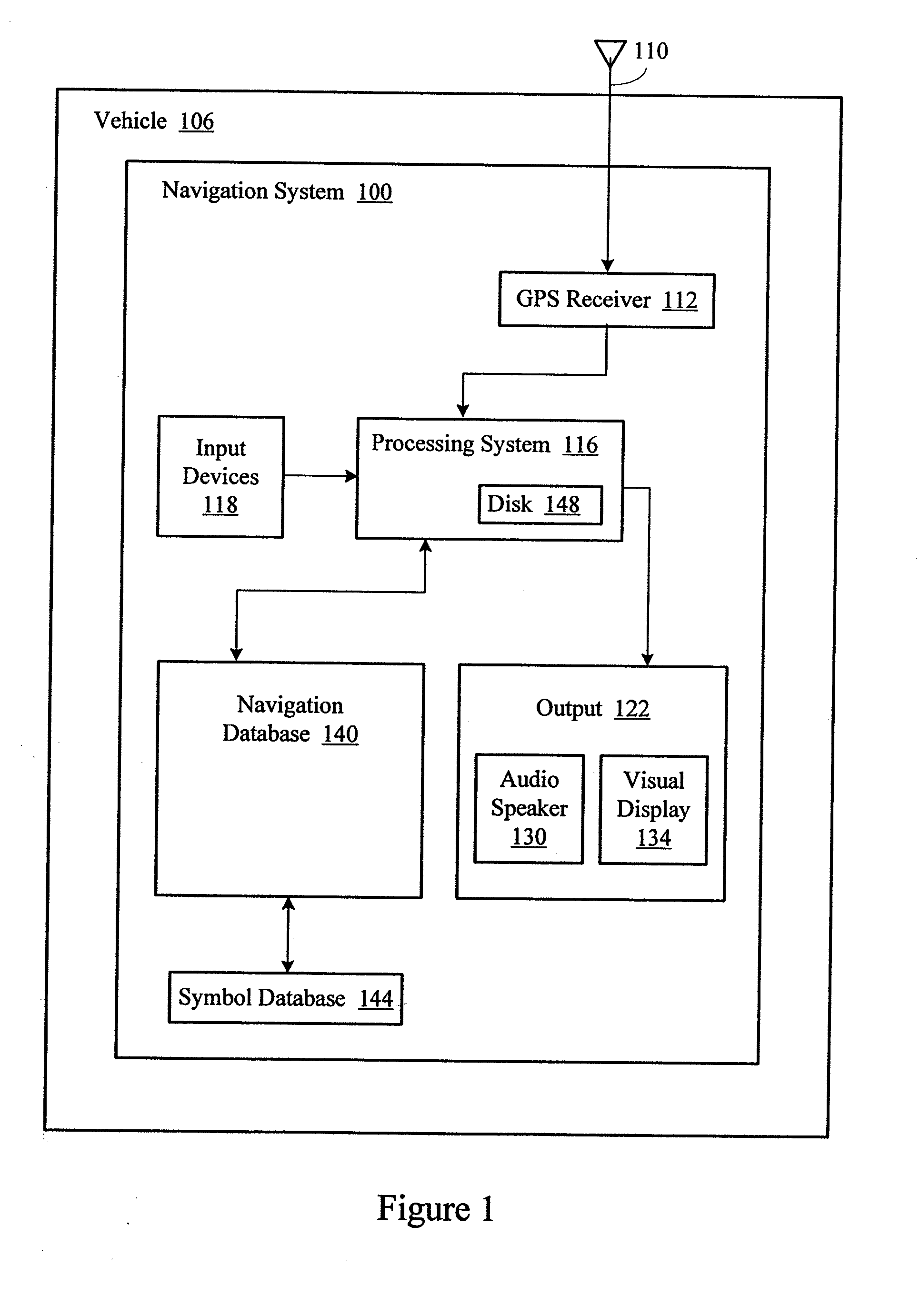
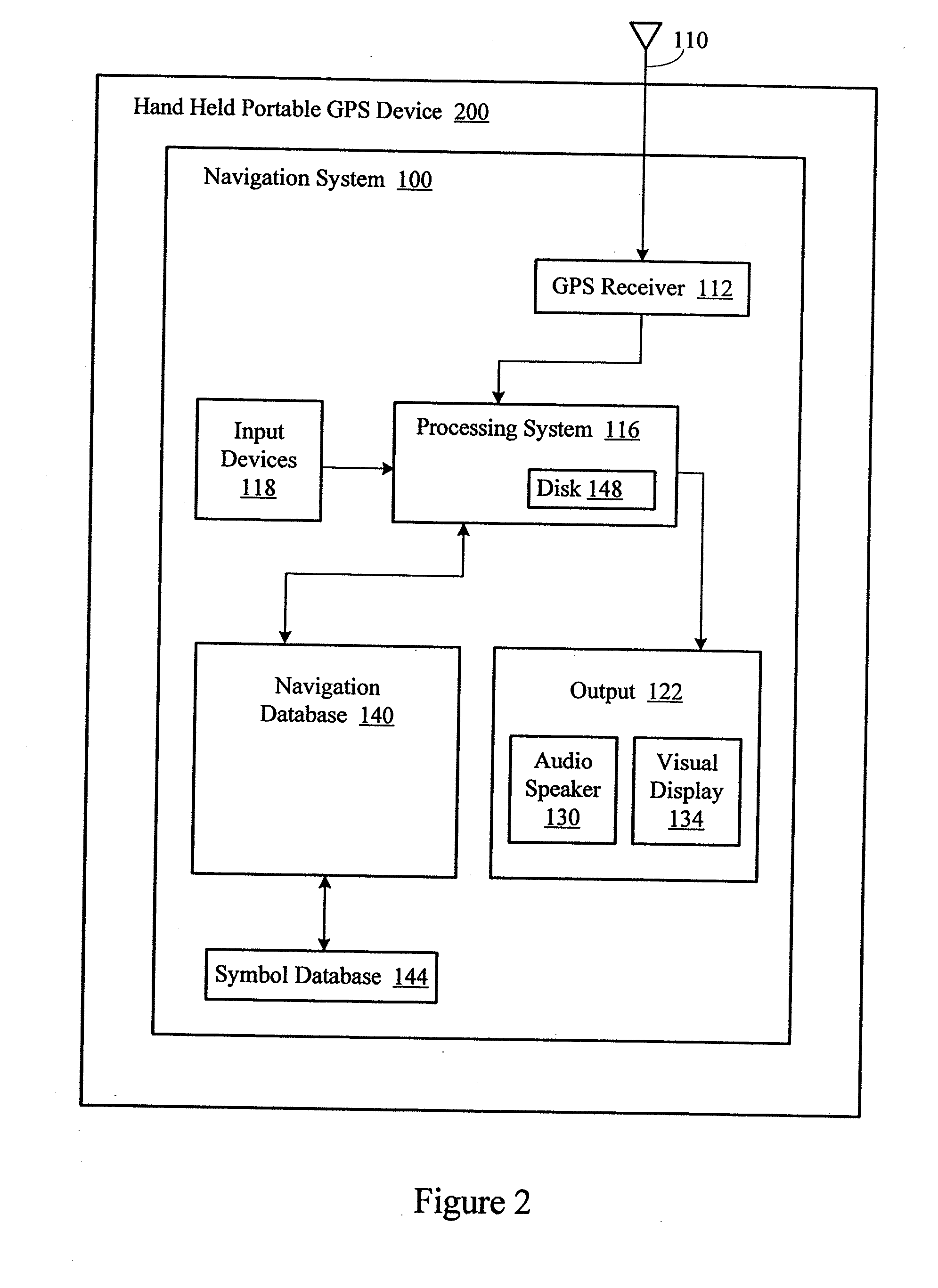
[0025]FIG. 1 shows a navigation system 100. The navigation system 100 may be installed in a vehicle 106, such as an automobile, motorcycle, ship, or airplane. The navigation system 100 may include a GPS antenna 110, typically mounted on the vehicle, and a GPS receiver 112 configured to receive the GPS signals from the antenna. The navigation system 100 may include a processing system 116 connected to the GPS receiver. The processing system 116 may receive user input from various input devices 118, and may output information on various output devices 122, such as an audio speaker 130 and a visual display 134. The processing system 116 may also be coupled to a navigation or map database 140, which may provide the user with the basic map or route. The navigation database 140 may be in turn coupled to a symbol database 144. The navigation system 100 may store computer-executable program instructions and data on a disk 148 and / or may contain non-volatile memory for such storage.
[0026] T...
PUM
 Login to View More
 Abstract
Description
Claims
Application Information
 Login to View More