
Ancillary terrestrial component services using multiple frequency bands
- Summary
- Abstract
- Description
- Claims
- Application Information
AI Technical Summary
Benefits of technology
Problems solved by technology
Method used
Image

Examples
Embodiment Construction
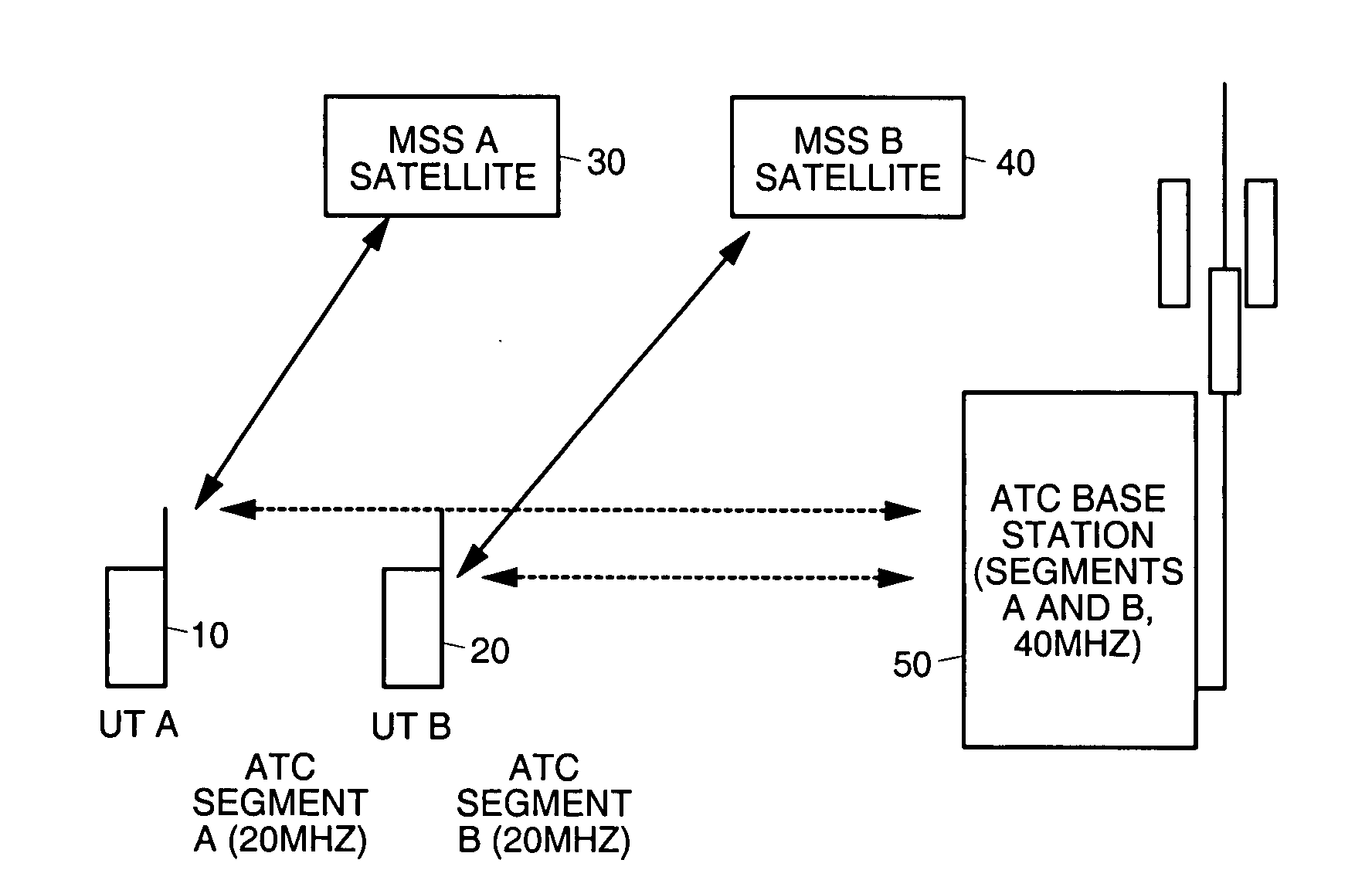
[0040]In FIG. 1 there is seen that two types of user terminals (UT) may be employed, user terminal A 10 and user terminal B 20; one for the air interface and frequency band of MSS operator A 30, and one for the air interface and frequency band of MSS operator B 40. A user subscribing to MSS provider A or B for the MSS portion of services in order to obtain coverage in different regions of the world, such as U.S. or Europe or coverage within a given region such as better coverage at northern latitudes versus temperate latitudes or different data rates or pricing plans or specific services like push-to-talk, may select either A or B on such bases. ATC Base Station segments A and B 50 at 40 MHz are seen to operate from MSS A 30 and MSS B 40.
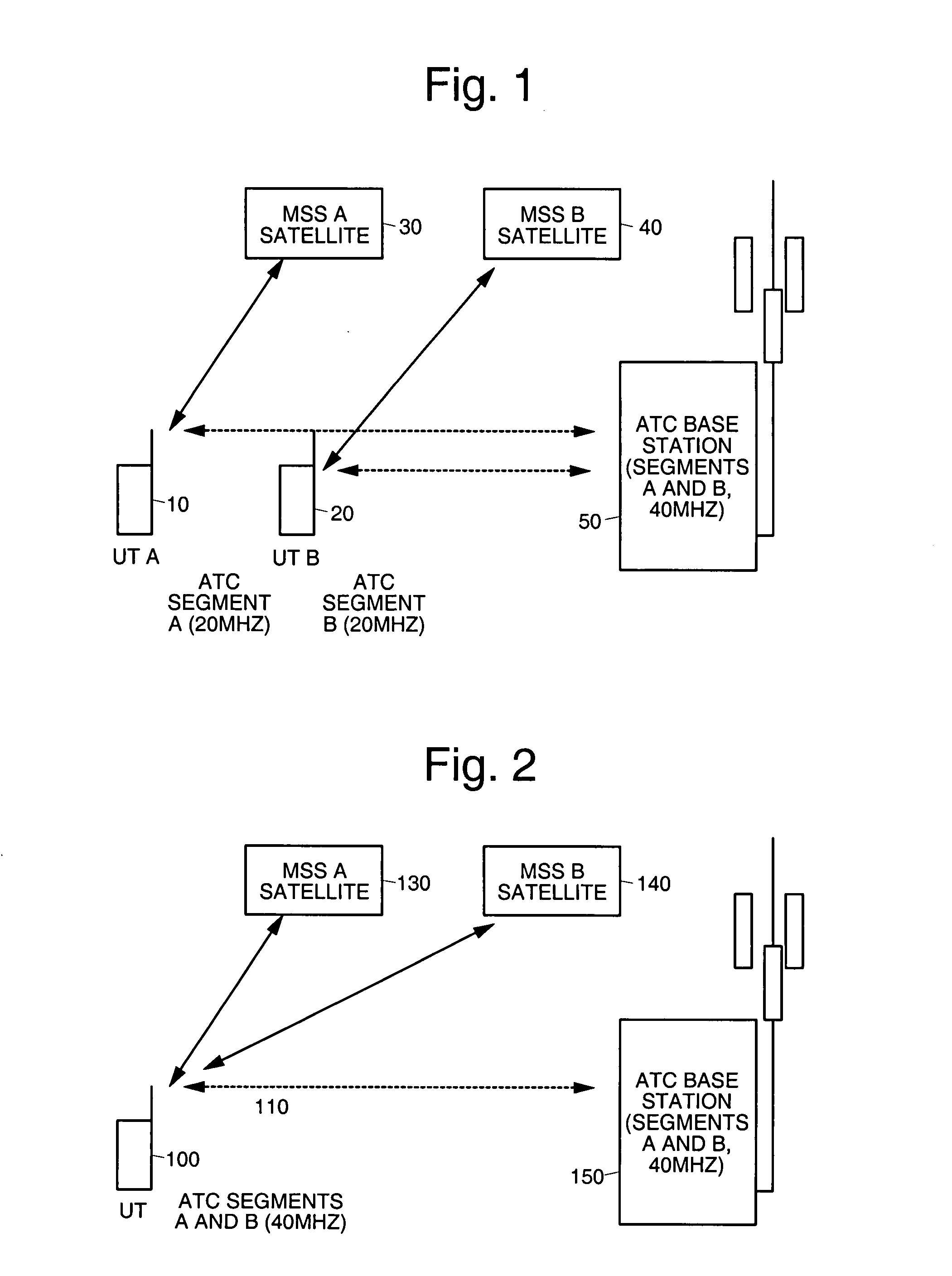
[0041]In FIG. 2 there is seen a multimode UT 100 which is capable of operating in the entire 40 MHz band. The UT 100 employs air interfaces 110 and frequencies of either MSS operator A 130 or B 140 at any given time. ATC Base Station 150 is seen to ...
PUM
 Login to View More
 Abstract
Description
Claims
Application Information
 Login to View More