
Protein Switches Incorporating Cytochrome C3 in Monolayers and Method for Producing Same
a technology of protein switches and cytochrome c3, which is applied in the field of biomolecular switching using monolayers of globular proteins, can solve the problems of lack of easily reproducible materials that exhibit reliable and reversible switching, etc., and achieves less power consumption, easy fabrication, and hampered research on molecular switching technology.
- Summary
- Abstract
- Description
- Claims
- Application Information
AI Technical Summary
Benefits of technology
Problems solved by technology
Method used
Image

Examples
Embodiment Construction
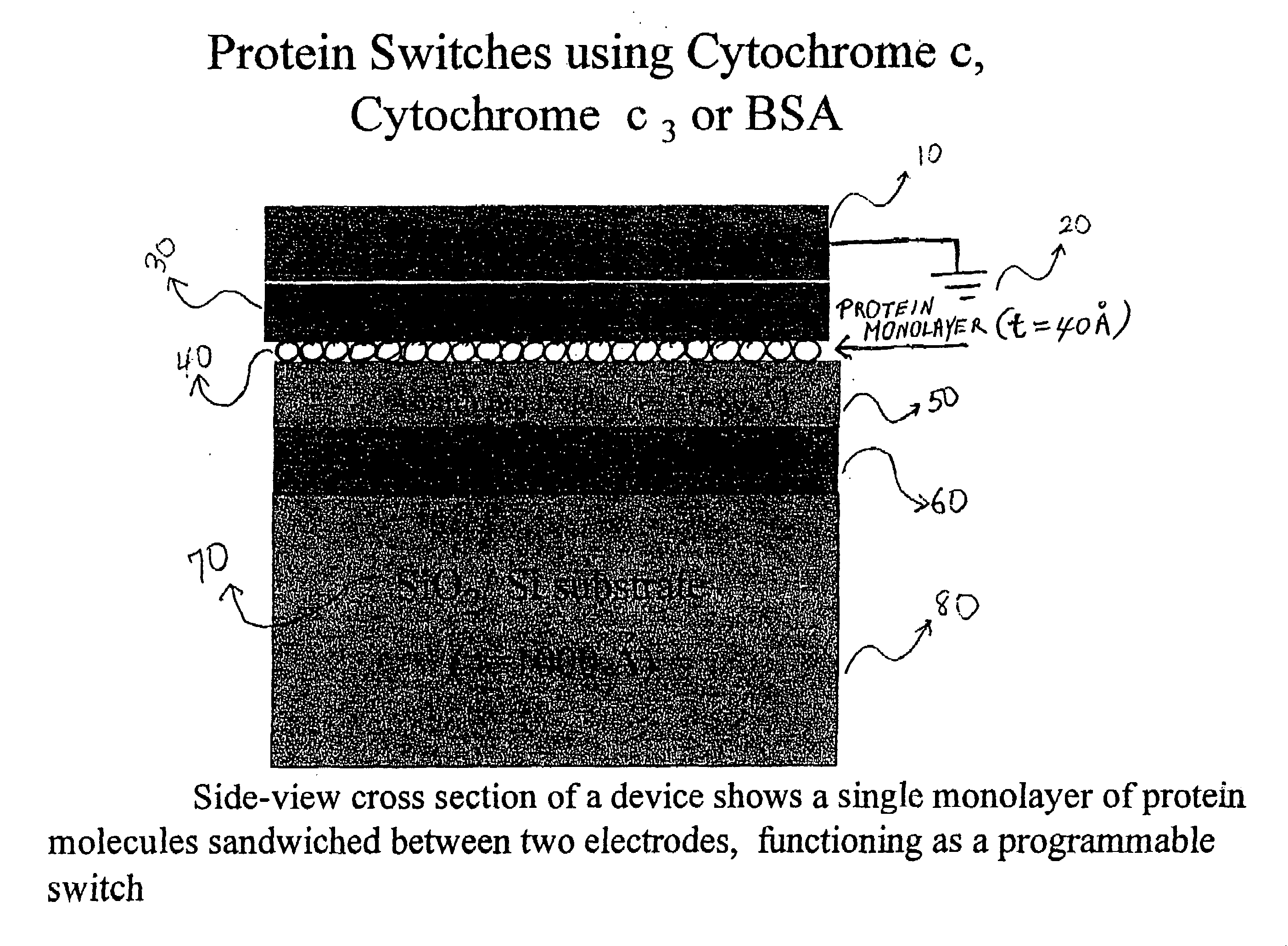
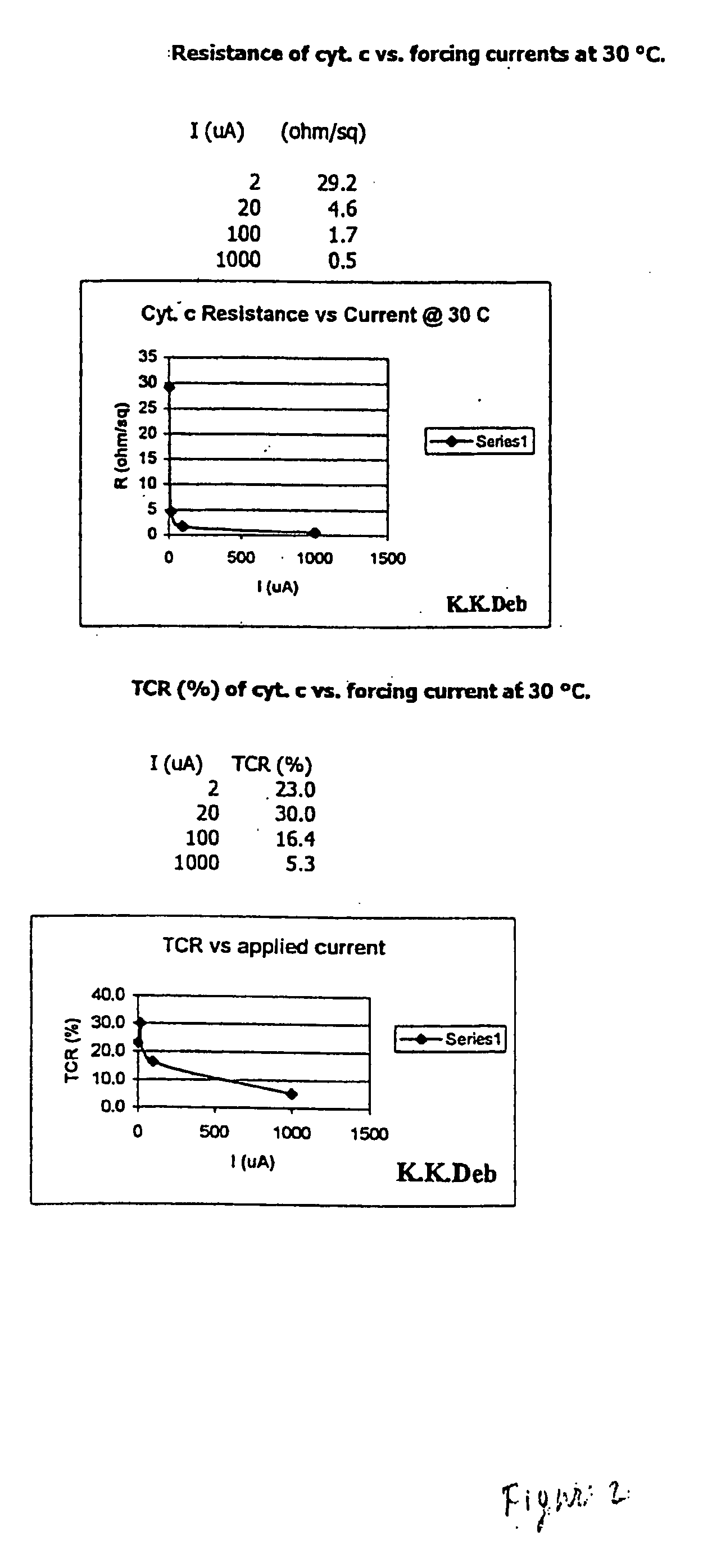
[0012]The present invention involves electrical switching properties of Cytochrome c, cytochrome c3 or (BSA), which all are conductive in monolayer structure. Cytochrome c is a % 12 kD globular protein composed of one polypeptide chain and a single iron protoporphyrin IX (heme) group whose orientation with respect to the three-dimensional polypeptide conformation is known. The computer-generated 3-D structure of cytachrome c [2] is shown in FIG. 3. Cytochrome c monolayer about 40-Å thick adsorbed on a suitable substrate is known to exhibit≅25% temperature coefficient of resistance near ambient temperature [3]. This is an example of a technical breakthrough in the IR bolometer technology recently demonstrated by the author. The monolayers of the same proteins also exhibit low sheet resistance around 0.5 to 1 Ω / sq with a forcing current of about 1 mA. The Ω / sq. behavior of cytochrome c monolayer is quite predictable and this low value of resistance could allow these films to carry tre...
PUM
 Login to View More
 Abstract
Description
Claims
Application Information
 Login to View More