
Secret sharing apparatus, method, and program
a technology of secret sharing and apparatus, applied in the field of secret sharing apparatus, method and program, can solve the problems of increasing the risk of theft, requiring a large amount of calculation, and disadvantageously requiring high-speed calculation of shamir (k, n)-threshold scheme, and achieve the effect of high speed
- Summary
- Abstract
- Description
- Claims
- Application Information
AI Technical Summary
Benefits of technology
Problems solved by technology
Method used
Image

Examples
first embodiment
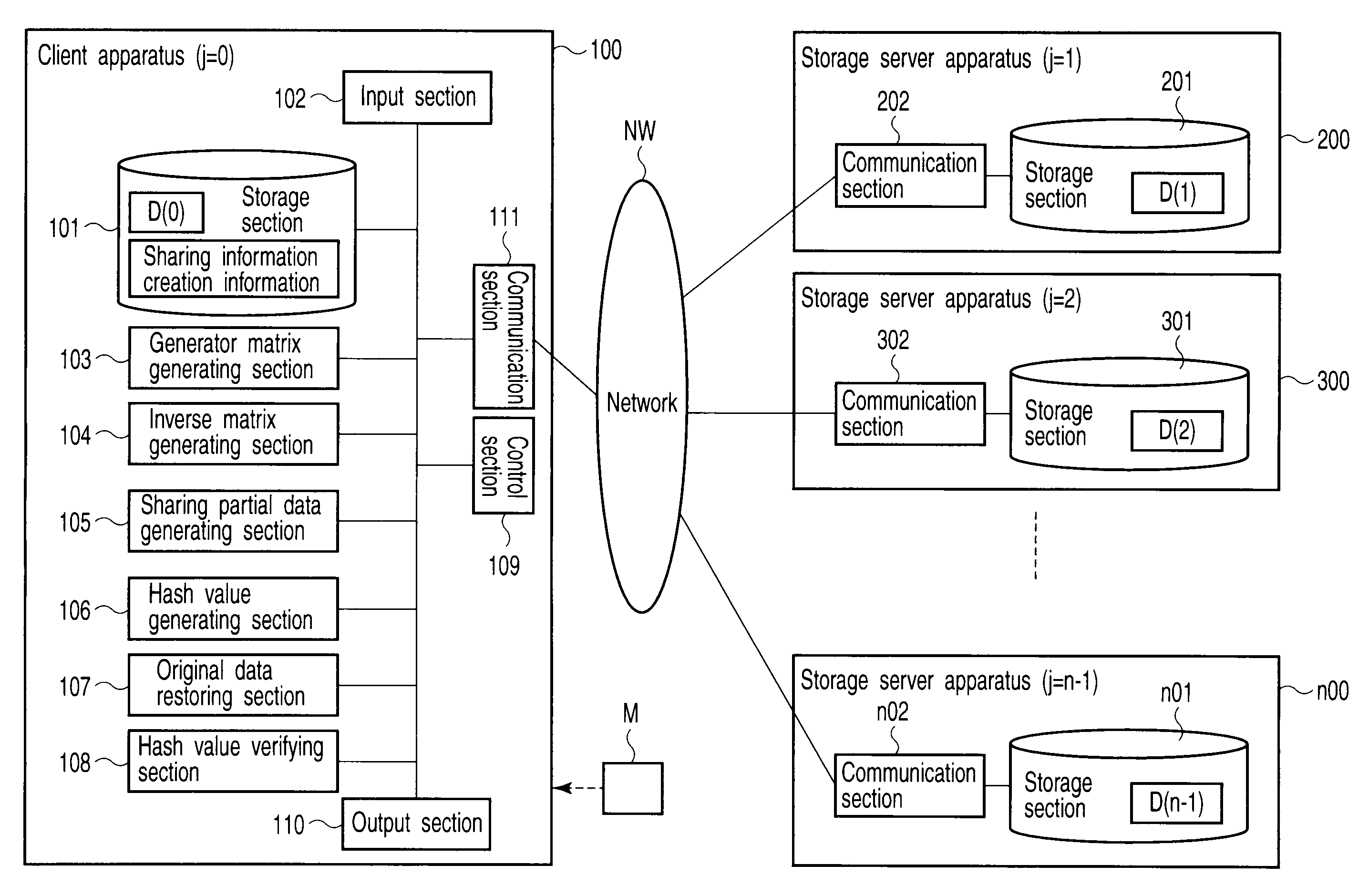
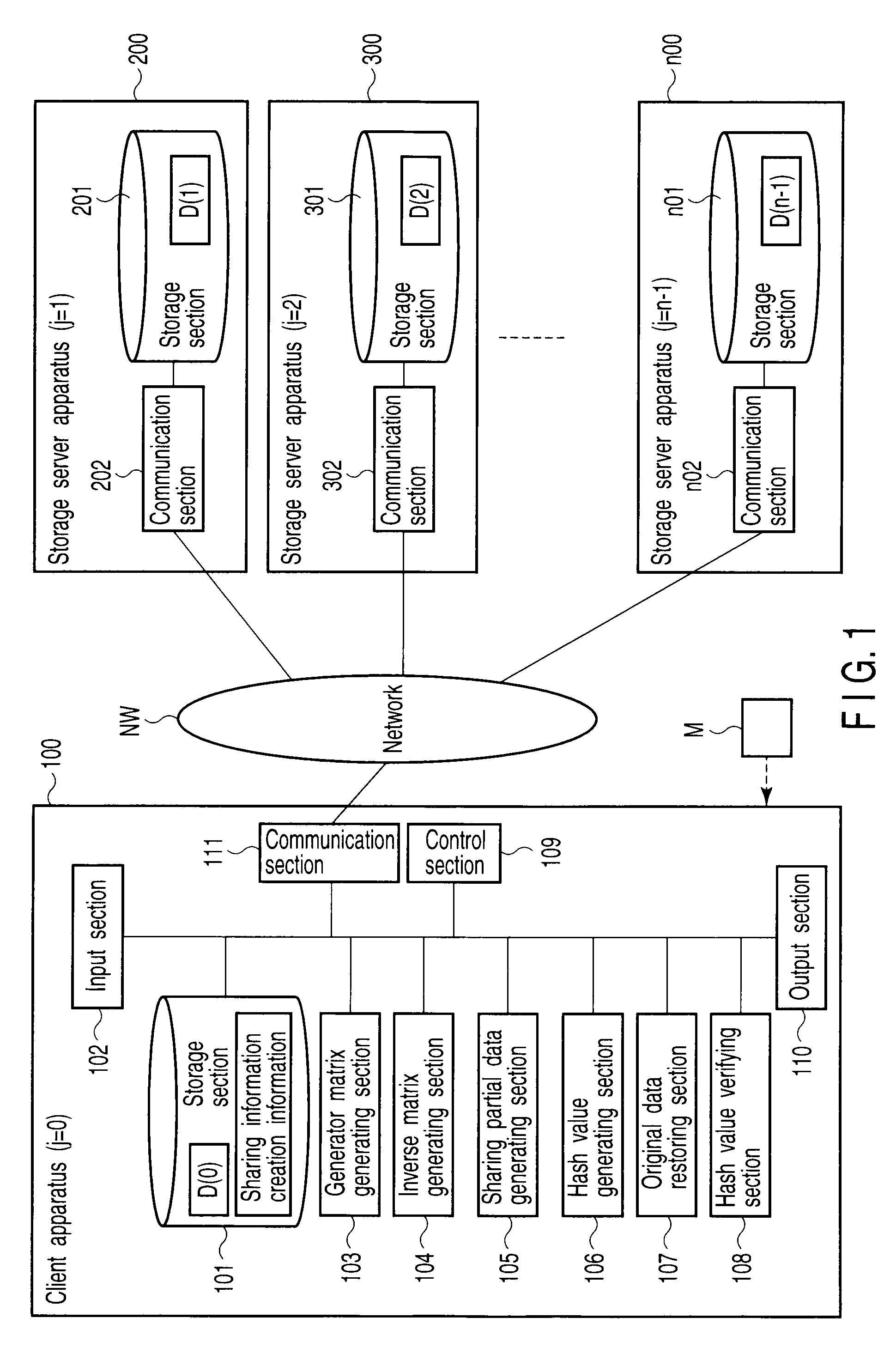
[0041]FIG. 1 is a schematic diagram showing the configuration of a secret sharing system according to a first embodiment of the present invention. The secret sharing system has one client apparatus 100 and n−1 storage server apparatuses 200, 300, . . . , n00 connected together and to the client apparatus 100 via a network NW such as the Internet.
[0042]A total of the n apparatuses 100, 200, 300, . . . , n0 correspond to n members in a (k,n)-threshold scheme. In particular, n storage sections 101, 201, . . . , n01 individually provided in the n apparatuses 100, 200, . . . , n00 correspond to n storage devices individually possessed by the n members. A j number (row number) indicating the order of distribution of sharing information is assigned to each of the apparatuses 100, 200, 300, . . . , n00. For example, j=0th is assigned to the client apparatus 100, and j=1st is assigned to the storage server apparatus 200. j=2nd is assigned to the storage server apparatus 300, . . . , and j=n−...
second embodiment
[0133]FIG. 24 is a schematic diagram showing the configuration of a secret sharing system according to a second embodiment of the present invention.
[0134]The present embodiment is a variation of the first embodiment comprising a secret sharing system based on the (K,n)-threshold scheme to enable sharing to be performed in accordance with a sharing algorithm. In this case, the above-described generator matrix generating section 103 and the inverse matrix generating section 104 are omitted. Furthermore, the functions of the sharing partial data generating section 105a and the control section 109a are changed.
[0135]A sharing partial data generating section 105a has a function of generating, under the control of a control section 109a, n(n−1) sharing partial data D(j,i) on the based of the secret information temporarily stored in the storage section 101 as shown in FIGS. 4 and 5 by way of example (k=4 and n=5). Specifically, the sharing partial data generating section 105a has functions...
third embodiment
[0171]Now, description will be given of a secret sharing system according to a third embodiment of the present invention.
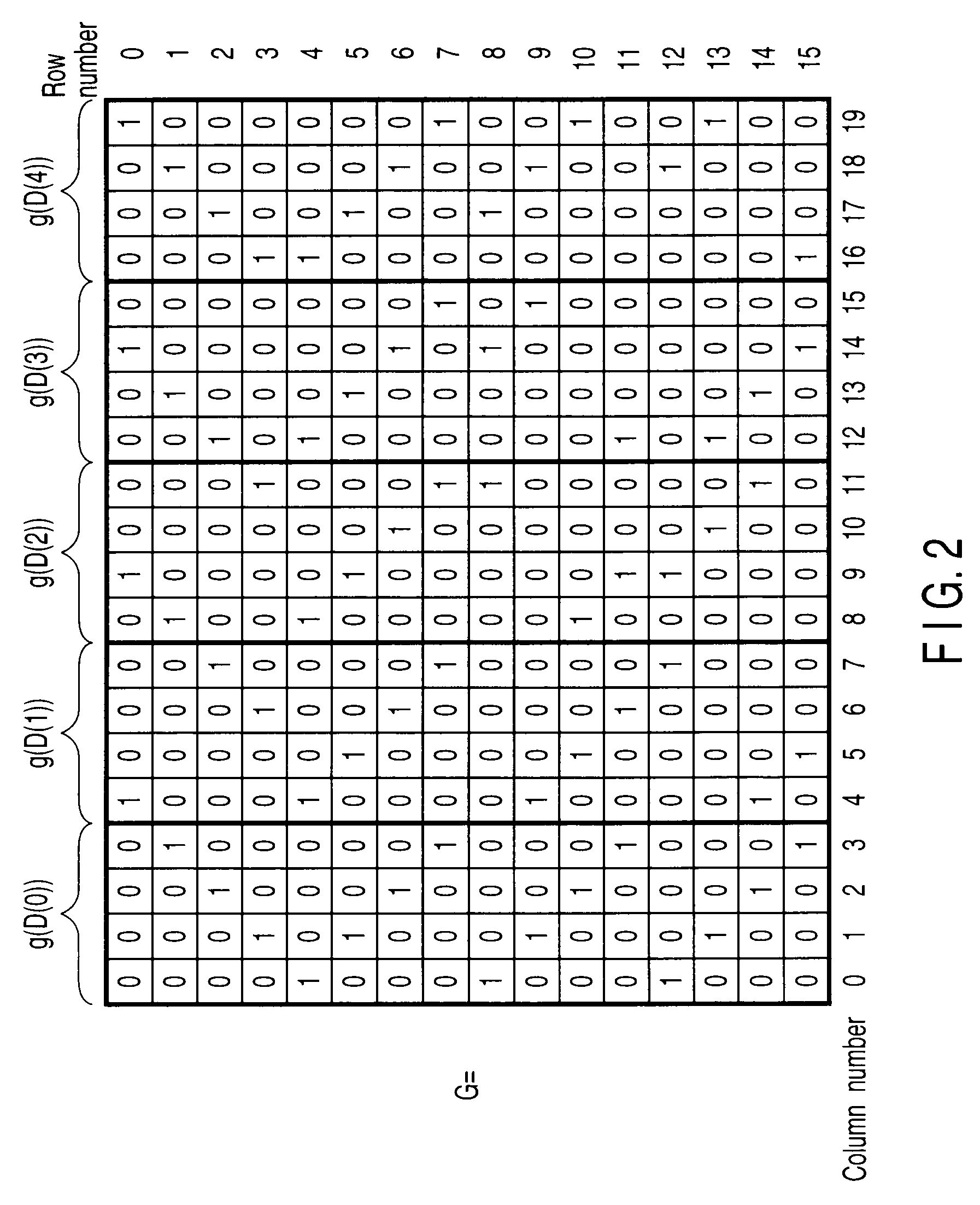
[0172]The present embodiment is a variation of the first embodiment, and relates to a generator matrix G with a bit pattern different from that according to the first embodiment as well as a sharing process utilizing this generator matrix G.
[0173]In this case, as shown in an example of the (4,5)-threshold scheme with k=4 and n=5 in FIG. 27, the 0th to 11th rows of the generator matrix G have the same values as those of the 4th to 15th rows in the case of j=0 to 2 shown in FIGS. 11 to 15, and the 12th to 15th rows of the generator matrix G have the same values as those in the case of j=3 as shown in FIGS. 28 and 29.
[0174]As shown in FIG. 30, in a method for generating the generator matrix G, steps ST4-2 to ST4-4 for the first minor matrix i in FIG. 8 are omitted, steps ST4-1, ST4-5, and ST4-6 are executed which are similar to steps ST4-1, ST4-5, and ST4-6 for the s...
PUM
 Login to View More
 Abstract
Description
Claims
Application Information
 Login to View More