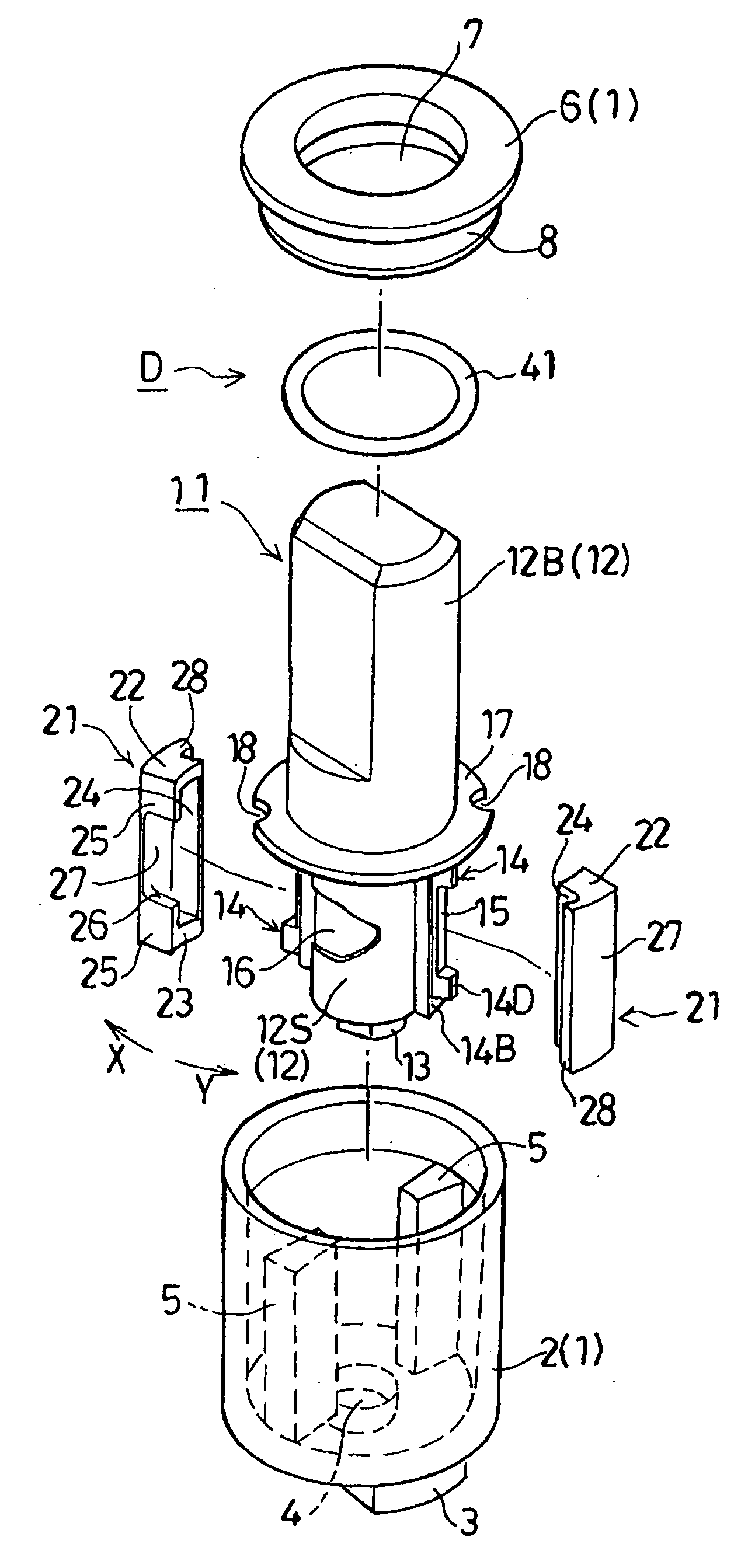
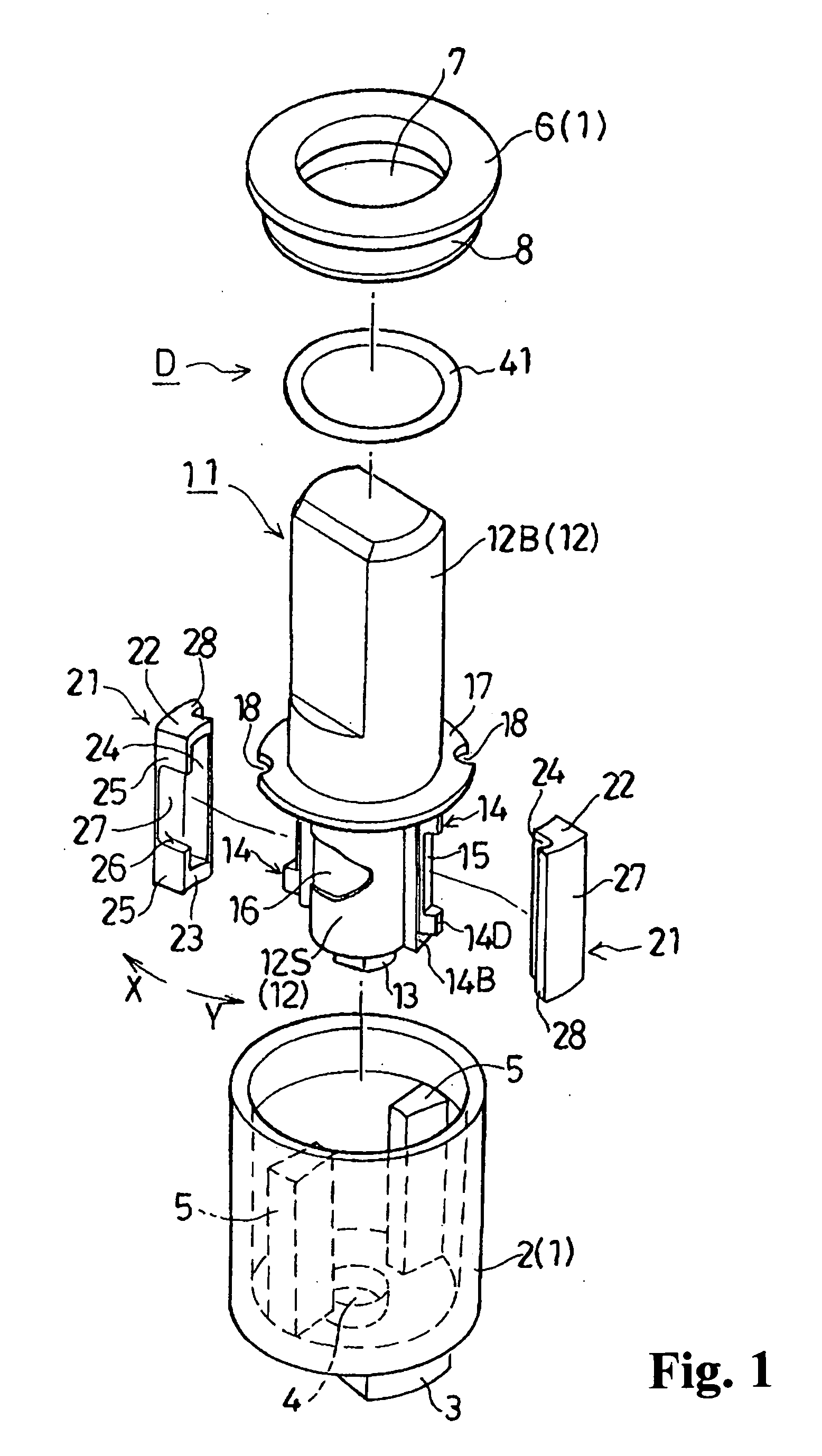
[0013]According to the invention, the wing portion is formed in an asymmetric shape with respect to the rotational direction relative to the straight line extending radially from the shaft portion. The tip side surface of the wing portion which is located on the tip side of the rotational direction when the rotor rotates in the damping torque generating direction, becomes the sloping surface which slopes to the back end side of the rotational direction from the tip side toward the outside of the radial direction from the inside of the radial direction. The back end side surface of the wing portion which is located on the back end side of the rotational direction when the rotor rotates in the damping torque generating direction, becomes the flat surface which runs parallel to the straight line extending radially. Also, the inner surface of the control valve member which faces the sloping surface, is the parallel sloping surface which runs parallel to the sloping surface, and the inner surface of the control valve member which faces the flat surface, is the parallel flat surface which runs parallel to the flat surface. Accordingly, even if the moving distance relative to the rotor (wing portion) of the control valve member is shortened, the circulation passage for the viscous fluid can be sufficiently maintained.
[0014]Therefore, the play of the control valve member can be shortened, so that the response of the control valve member improves.
[0015]The width of the tip portion of the control valve member with the parallel sloping surface, which is perpendicular to the shaft of the shaft portion, widens toward the outside of the radial direction from the inside of the radial direction. Accordingly, the length of the circumferential direction of the control valve member contacting the inner perimeter surface of the housing is prolonged or extended, so that the posture of the control valve member is stabilized, and its operation is stabilized.
[0016]In addition, the protruding wall extending in the circumferential direction is provided in the tip portion of the control valve member with the parallel sloping surface. Accordingly, pressurized viscous fluid in a damped state pushes the protruding wall in the radial direction and presses the control valve member against the inner perimeter surface of the housing. As a result, the posture of the control valve member is additionally stabilized.
[0017]Moreover, since the protruding wall contacts the inner perimeter surface of the housing, the posture of the control valve member is stabilized further.
[0018]Also, since the heat expansion coefficient of the control valve member is made below the heat expansion coefficient of the housing or the rotor, even if the temperature rises and the
viscosity of the viscous fluid decreases, because orifices (gaps between the housing and the control valve member, and between the rotor and the control valve member) narrow, variation in the damping torque can be controlled.


 Login to View More
  Login to View More