

Transferring A Logical Partition ('LPAR') Between Two Server Computing Devices Based On LPAR Customer Requirements
a server computing and customer-specific technology, applied in the field of data processing, can solve the problems of computer systems becoming extremely complicated devices
- Summary
- Abstract
- Description
- Claims
- Application Information
AI Technical Summary
Benefits of technology
Problems solved by technology
Method used
Image

Examples
Embodiment Construction
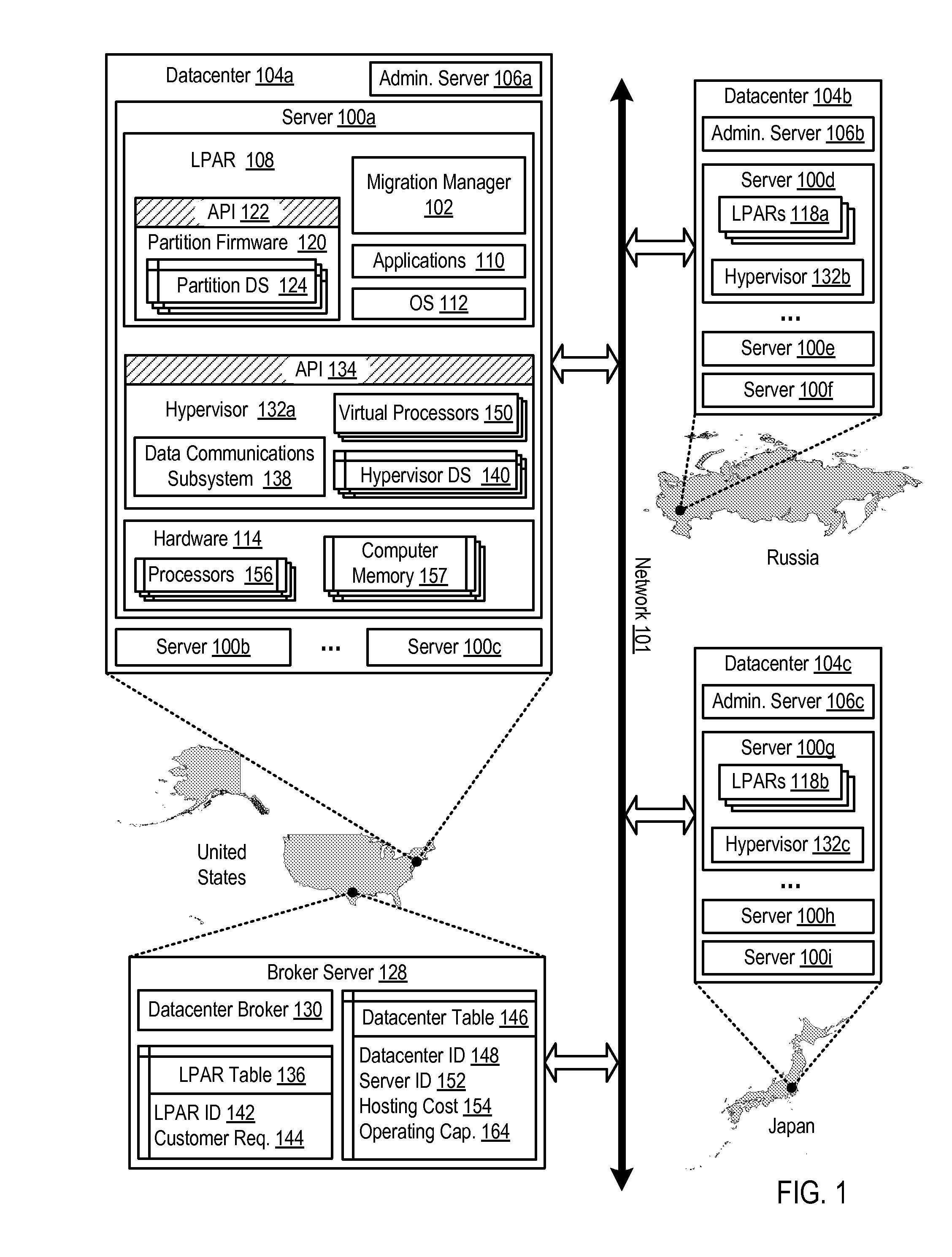
[0013]Exemplary methods, apparatus, and products for transferring a logical partition (‘LPAR’) between two server computing devices based on LPAR customer requirements in accordance with the present invention are described with reference to the accompanying drawings, beginning with FIG. 1. FIG. 1 sets forth a block diagram of an exemplary system for transferring a LPAR (108) between two of a plurality of server computing devices (100) based on LPAR customer requirements (126) according to embodiments of the present invention. The server computing devices (100) of FIG. 1 are connected together through a data communications network (101). Each server computing device (100) has server operating capabilities and is associated with LPAR hosting costs for supporting LPARs. Server operating capabilities describe the computing resources provided by a particular server for hosting an LPAR. For example, server operating capabilities may describe the server's processors, processor utilization,...
PUM
 Login to View More
 Abstract
Description
Claims
Application Information
 Login to View More