
Lighting device, display device and television receiver
a technology of display device and light source, which is applied in the direction of lighting and heating equipment, television systems, instruments, etc., can solve problems such as uneven brightness
- Summary
- Abstract
- Description
- Claims
- Application Information
AI Technical Summary
Benefits of technology
Problems solved by technology
Method used
Image

Examples
embodiment 1
[0035]An embodiment 1 according to the present invention will be explained with reference to FIGS. 1 to 5.
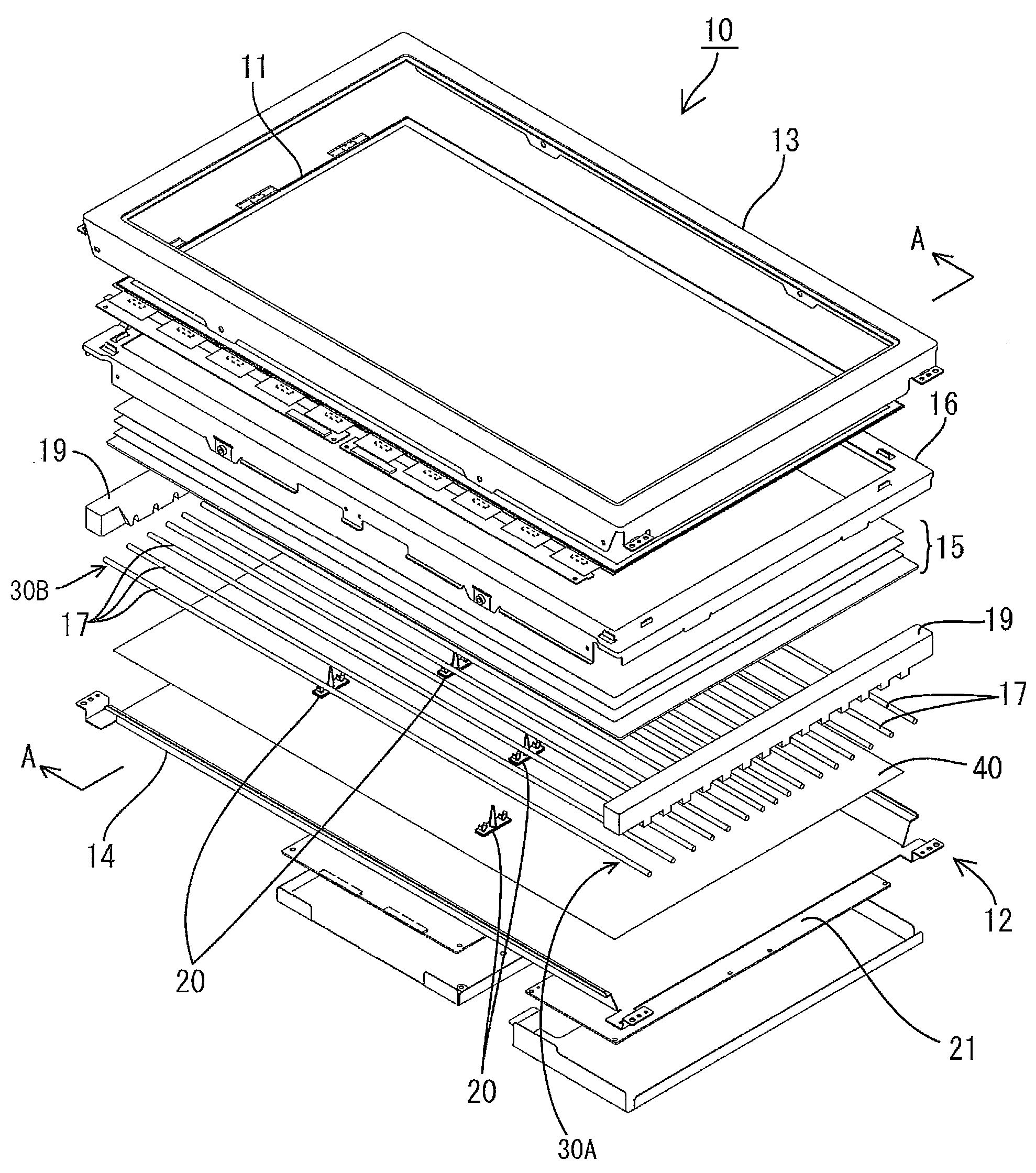
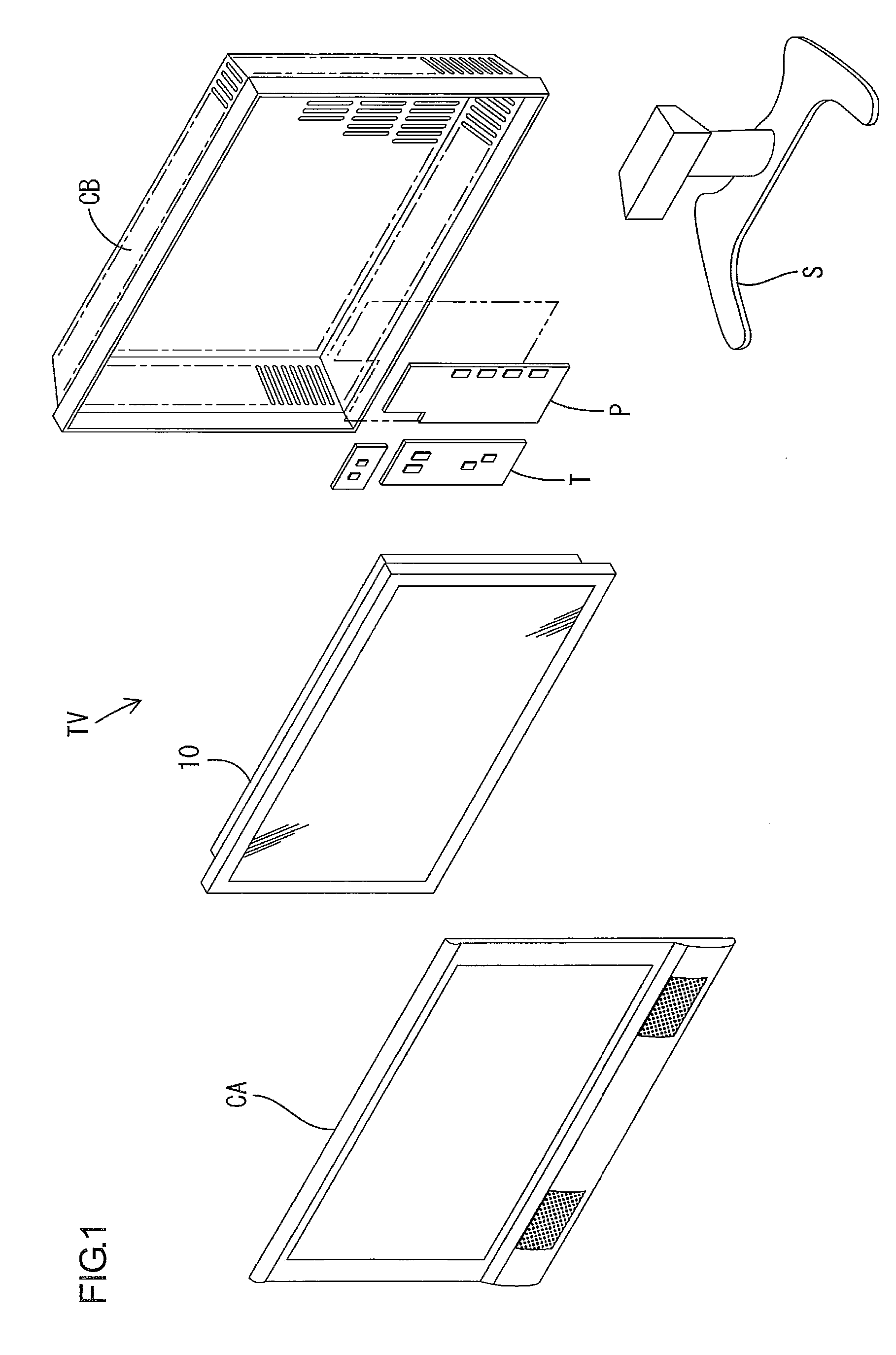
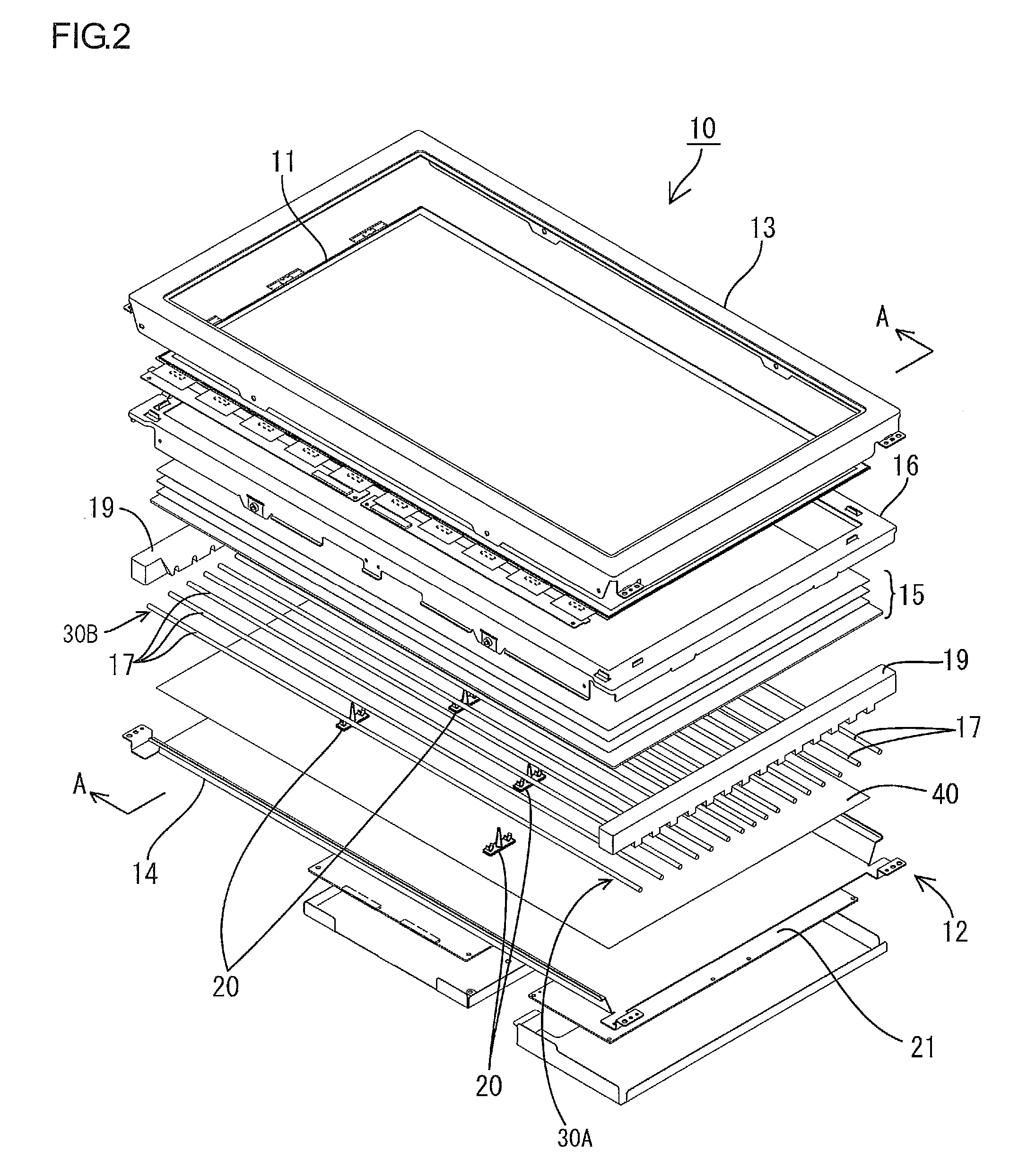
[0036]FIG. 1 is an exploded perspective view showing the general construction of a television receiver according to the present embodiment. FIG. 2 is an exploded perspective view showing the general construction of a liquid crystal display device. FIG. 3 is a sectional view showing the general construction of the liquid crystal display device along the line A-A. FIG. 4 is an explanatory diagram schematically showing the construction and operational effects of a characteristic part of a backlight device. FIG. 5 is a plan view schematically showing the construction of a light reflecting sheet.
[0037]Referring to FIG. 1, the television receiver TV according to the present embodiment includes a liquid crystal display device 10, and front and back cabinets CA and CB capable of holding the liquid crystal display device 10 therebetween. Further included are a power source P, a tuner T a...
embodiment 2
[0067]Next, an embodiment 2 of the present invention will be explained with reference to FIG. 6.
[0068]In the above embodiment 1, the arrangement of the opening sections 50 is determined solely based on the difference in illumination brightness between the narrow-interval area 17A and the wide-interval areas 17B. In the present embodiment, the arrangement of opening sections 51 is determined further based on the difference in illumination brightness due to voltage difference among areas of cold cathode tubes 17. The other constructions are similar to the above embodiment 1. Therefore, the same parts as the above embodiment are designated by the same symbols, and redundant explanations are omitted. FIG. 6 is a plan view schematically showing the construction of a light reflecting sheet according to the present embodiment.
[0069]An inverter board 21 for supplying drive voltage to the cold cathode tubes 17 is mounted on one side of the backlight chassis 14 corresponding to a long-side-di...
embodiment 3
[0078]Next, an embodiment 3 of the present invention will be explained with reference to FIG. 7. The difference from the above embodiments 1 and 2 is in the arrangement of opening sections and the shapes of through holes. The other constructions are similar to the above embodiments. Therefore, the same parts as the above embodiments are designated by the same symbols, and redundant explanations are omitted. FIG. 7 is a plan view schematically showing the construction of a light reflecting sheet according to the present embodiment.
[0079]Referring to FIG. 7, through holes 23 and opening sections 52 are formed on the light reflecting sheet 42. Each through hole 23 has a square shape. On the other hand, the opening sections 52 have circular or oval shapes of varying planar dimension.
[0080]The opening sections 52 are arranged in a row along the long-side direction of the light reflecting sheet 42 (or along the axial direction of the cold cathode tube 17). In the areas of the light reflec...
PUM
 Login to View More
 Abstract
Description
Claims
Application Information
 Login to View More