This helps you quickly interpret patents by identifying the three key elements:
Problems solved by technology
Method used
Benefits of technology
Benefits of technology
[0010]The present invention relates to novel antiviral compounds represented herein below, pharmaceutical compositions comprising such compounds, and methods for the treatment or prophylaxis of viral (particu
Problems solved by technology
Due to the high degree of variability in the viral surface antigens, existence of multiple viral genotypes, and demonstrated specificity of immunity, the development of a successful vaccine in the near future is unlikely.
This therapy remains less effective against infections caused by HCV genotype 1 (which constitutes ˜75% of all HCV
Method used
the structure of the environmentally friendly knitted fabric provided by the present invention; figure 2 Flow chart of the yarn wrapping machine for environmentally friendly knitted fabrics and storage devices; image 3 Is the parameter map of the yarn covering machine
View more
Image
Smart Image Click on the blue labels to locate them in the text.
Viewing Examples
Smart Image
Click on the blue label to locate the original text in one second.
Reading with bidirectional positioning of images and text.
Smart Image
Examples
Experimental program
Comparison scheme
Effect test
Example
Example 1
[0169]
[0170]Step 1a. A mixture of N-Boc-L-proline (5.754 g, 26.7 mmol) and TEA (3.73 mL, 26.7 mmol) in THF (60 mL) at −20° C. was treated with ethyl chloroformate (2.55 mL, 26.7 mmol) for 30 minutes before a slow addition of 4-bromo-1,2-diaminobenzene (5.00 g, 26.7 mmol) in THF (20 mL). It was then kept at −20° C. for 1 hour and then slowly warmed up to rt and stirred at rt overnight. The volatiles were evaporated and the residue was partitioned (EtOAc-water). The organics were washed with brine, dried (Na2SO4), filtered and evaporated to give the crude desired compound as a dark brown foam (10.7 g). ESIMS m / z=384.18, 386.18 [M+H]+.
[0171]Step 1b. A solution of the crude compound from step 1a (10.7 g, theo. 26.7 mmol) in glacial acetic acid (100 mL) was heated at 50° C. for 2 hours. The volatiles were evaporated off and the residue was partitioned (EtOAc-saturated aqueous NaHCO3). The organics were washed with brine, dried (Na2SO4), filtered and evaporated. The residue was p...
Example
Example 2
[0173]
[0174]Step 2a. A solution of the compound from step 1c (79.0 mg, 0.122 mmol) in 1,4-dioxane (1 mL) was treated with HCl in 1,4-dioxane (4 M, 4 mL) rt for 30 minutes. The volatiles were evaporated off to give the crude desired compound as a yellow solid which was directly used in the next step. ESIMS m / z=449.39 [M+H]+.
[0175]Step 2b. A mixture of the crude compound from step 2a (0.122 mmol at most) and (R)-dimethylamino phenyl acetic acid (prepared according to WO 2008 / 021927, 54.5 mg, 0.305 mmol) in DMF (3 mL) was treated with HATU (0.102 g, 0.268 mmol) in the presence of DIPEA (0.30 mL, 2.44 mmol) for 2 hours at rt and the volatiles were evaporated off to provide a brown syrup. It was purified by reverse phase HPLC (C18, H2O / CH3CN / TFA) to give the title compound as its TFA salts and as a white solid (0.116 g, 2 steps 78%). ESIMS m / z=771.70 [M+H]+.
Example
Example 3
[0176]
[0177]A mixture of the crude compound from step 2a (0.122 mmol at most) and (R)-(methoxycarbonyl)amino phenyl acetic acid (prepared according to WO 2008 / 021927, 76.4 mg, 0.366 mmol) in DMF (3 mL) was treated with HATU (0.102 g, 0.268 mmol) in the presence of DIPEA (0.30 mL, 2.44 mmol) for 2 hours at rt and the volatiles were evaporated off to provide a brown syrup. It was purified by flash column chromatography (silica, CH2Cl2-MeOH) to give the title compound as a yellow solid (82.4 mg, 2 steps 81%). ESIMS m / z=831.59 [M+H]−.
the structure of the environmentally friendly knitted fabric provided by the present invention; figure 2 Flow chart of the yarn wrapping machine for environmentally friendly knitted fabrics and storage devices; image 3 Is the parameter map of the yarn covering machine
Login to View More
PUM
Property
Measurement
Unit
Volume
aaaaa
aaaaa
Volume
aaaaa
aaaaa
Volume
aaaaa
aaaaa
Login to View More
Abstract
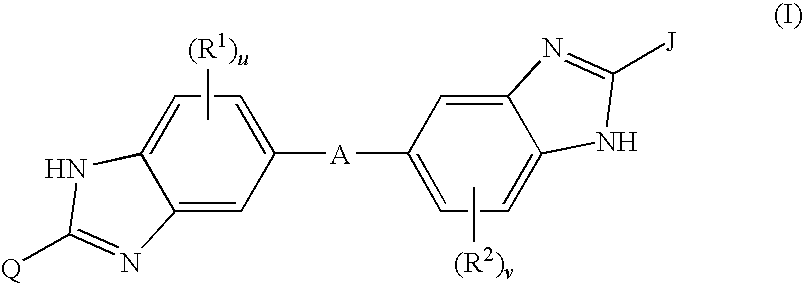
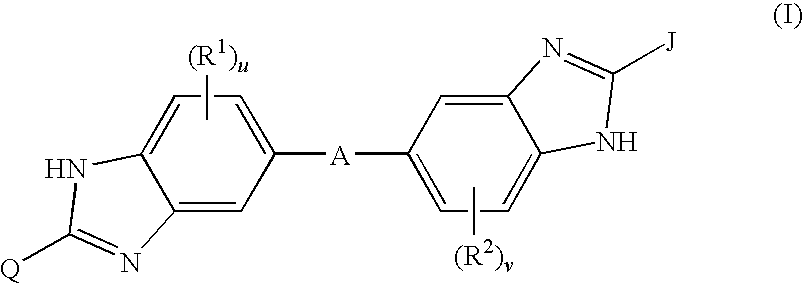
The present invention discloses compounds of Formula (I), or pharmaceutically acceptable salts, esters, or prodrugs thereof:
which inhibit RNA-containing virus, particularly the hepatitis C virus (HCV). Consequently, the compounds of the present invention interfere with the life cycle of the hepatitis C virus and are also useful as antiviral agents. The present invention further relates to pharmaceutical compositions comprising the aforementioned compounds for administration to a subject suffering from HCV infection. The invention also relates to methods of treating an HCV infection in a subject by administering a pharmaceutical composition comprising the compounds of the present invention.
Description
RELATED APPLICATION[0001]This application claims the benefit of U.S. Provisional Application No. 61 / 151,079 filed Feb. 9, 2009. The entire teachings of the above application are incorporated herein by reference.TECHNICAL FIELD[0002]The present invention relates to novel antiviral agents. More specifically, the present invention relates to compounds which can inhibit the function of the NS5A protein encoded by Hepatitis C virus (HCV), compositions comprising such compounds, methods for inhibiting HCV viral replication, methods for treating or preventing HCV infection, and processes for making the compounds.BACKGROUND OF THE INVENTION[0003]Infection with HCV is a major cause of human liver disease throughout the world. In the US, an estimated 4.5 million Americans are chronically infected with HCV. Although only 30% of acute infections are symptomatic, greater than 85% of infected individuals develop chronic, persistent infection. Treatment costs for HCV infection have been estimated ...
Claims
the structure of the environmentally friendly knitted fabric provided by the present invention; figure 2 Flow chart of the yarn wrapping machine for environmentally friendly knitted fabrics and storage devices; image 3 Is the parameter map of the yarn covering machine
Login to View More
Application Information
Patent Timeline
Application Date:The date an application was filed.
Publication Date:The date a patent or application was officially published.
First Publication Date:The earliest publication date of a patent with the same application number.
Issue Date:Publication date of the patent grant document.
PCT Entry Date:The Entry date of PCT National Phase.
Estimated Expiry Date:The statutory expiry date of a patent right according to the Patent Law, and it is the longest term of protection that the patent right can achieve without the termination of the patent right due to other reasons(Term extension factor has been taken into account ).
Invalid Date:Actual expiry date is based on effective date or publication date of legal transaction data of invalid patent.


 Login to View More