
Behaviour Pattern Analysis System, Mobile Terminal, Behaviour Pattern Analysis Method, and Program
a behaviour pattern and analysis system technology, applied in the field of behavior pattern analysis systems, can solve problems such as difficulty in knowing such specific content of behaviours
- Summary
- Abstract
- Description
- Claims
- Application Information
AI Technical Summary
Benefits of technology
Problems solved by technology
Method used
Image

Examples
first embodiment
1: First Embodiment
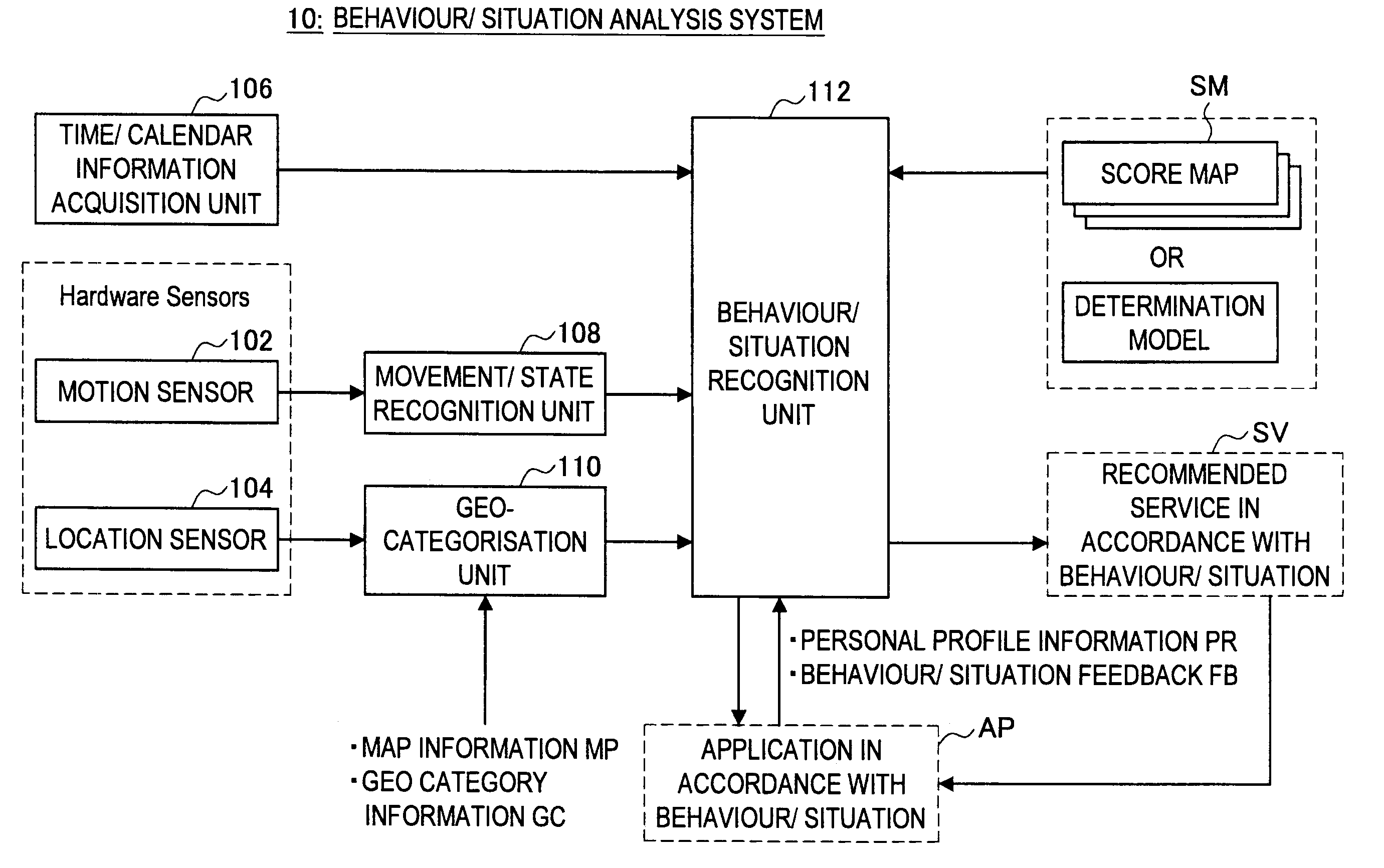
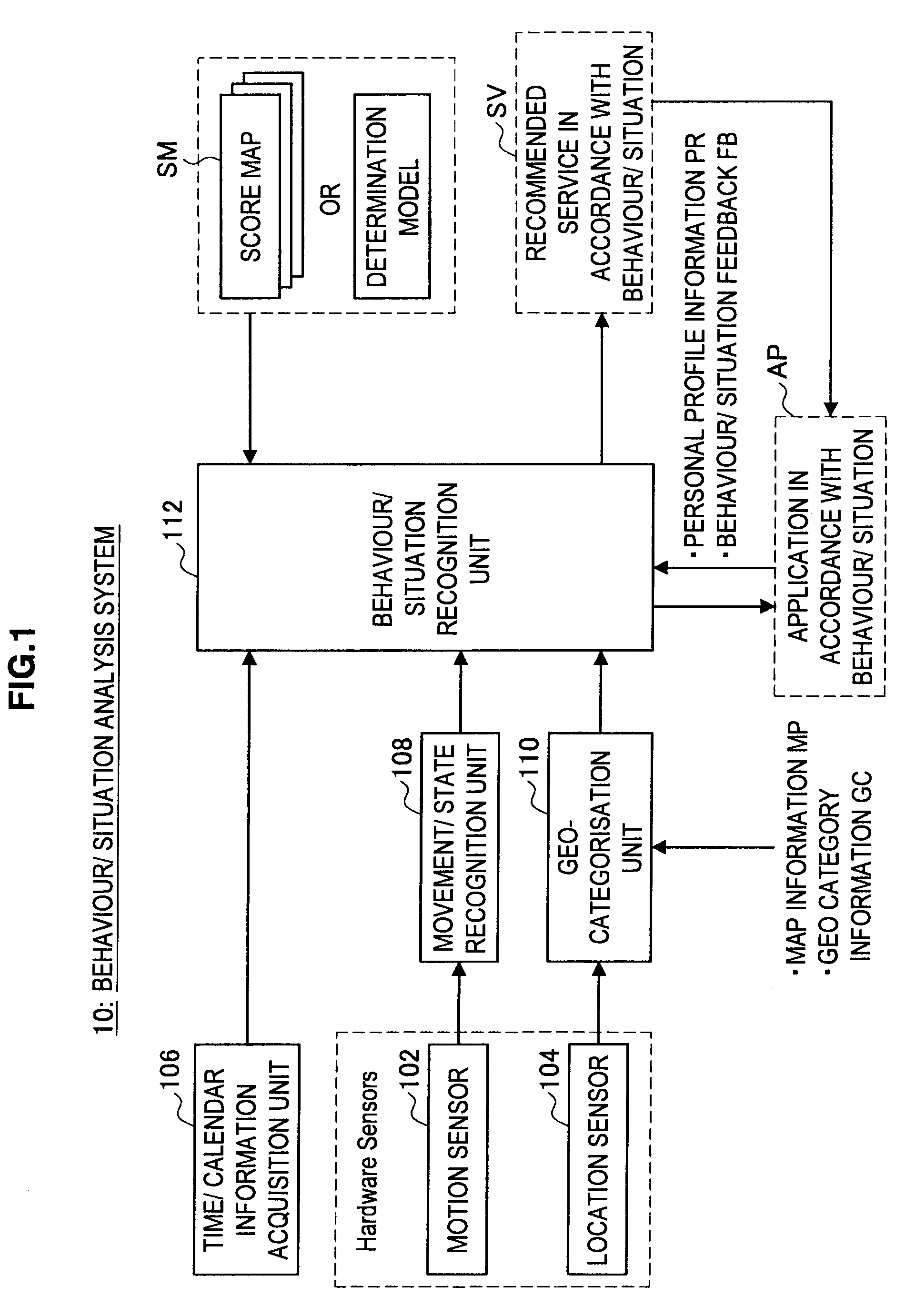
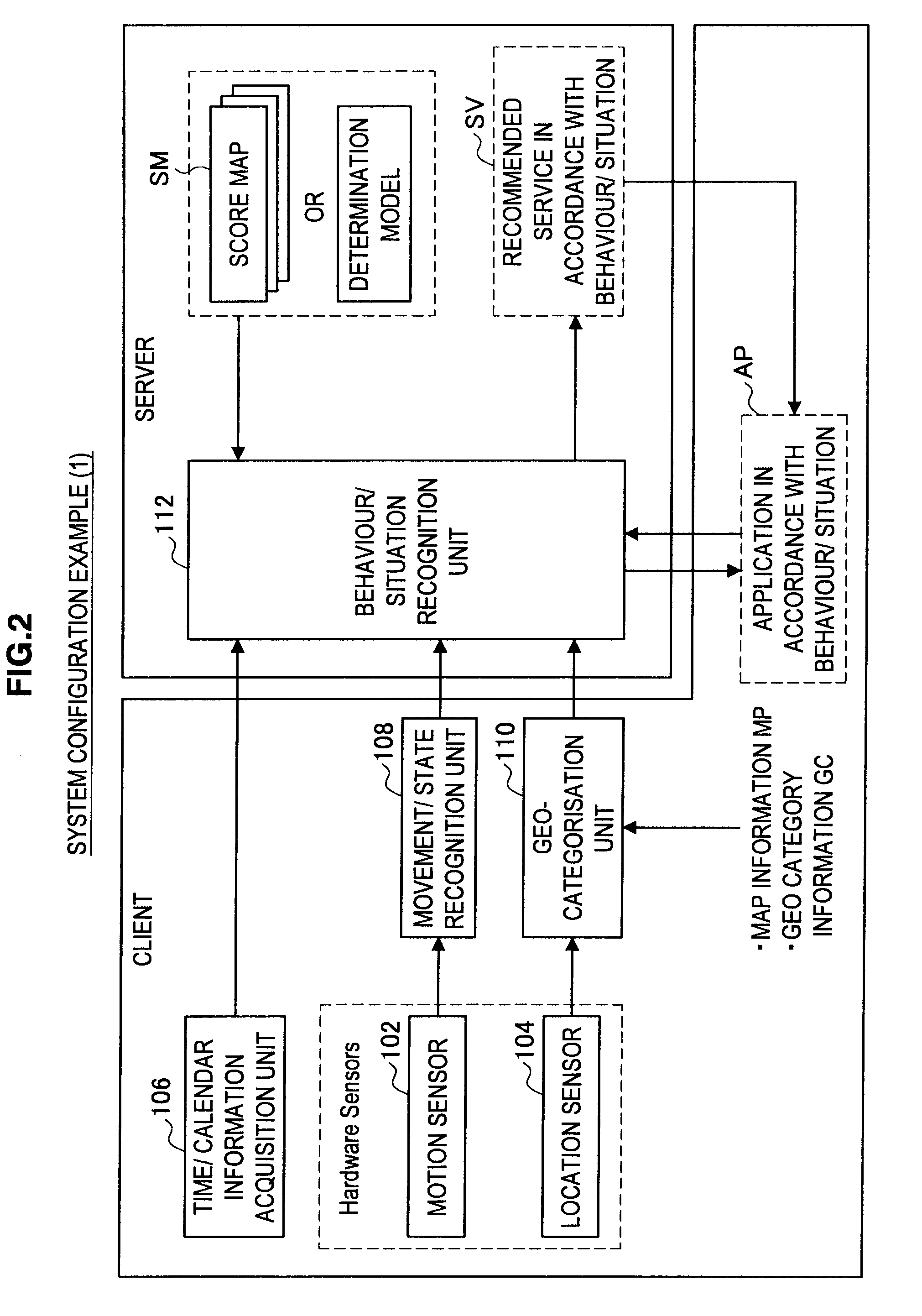
[0096]The first embodiment of the present invention will be described. The present embodiment relates to a technology of detecting a behaviour and a situation of a user by using information on the user's movement and state detected by using a motion sensor and location information detected by a location sensor. Additionally, as the motion sensor, a three-axis acceleration sensor (including an acceleration sensor, a gravity detection sensor, a fall detection sensor, and the like), a three-axis gyro sensor (including an angular velocity sensor, a hand-blur compensation sensor, a geomagnetic sensor, and the like), and the like, are used, for example. Also, as the location sensor, a GPS (Global Positioning System) is used, for example. However, since the latitude and longitude of the current location can be detected from an RFID) (Radio Frequency Identification), a Wi-Fi access point, information on a wireless base station, and the like, and such detection means can a...
second embodiment
2: Second Embodiment
[0268]Next, the second embodiment of the present invention will be described. The present embodiment relates to a method of using a behaviour / situation pattern obtained by the behaviour / situation pattern detection method described in the first embodiment described above. Particularly, the technology of the present embodiment relates to a method of correlating schedule information registered by a user and a behaviour / situation pattern that is detected with each other, and providing the user with appropriate information in accordance with the situation.
[0269]
[0270]First, an overview of a function realised by a behaviour / situation analysis system 20 according to the present embodiment will be described with reference to FIGS. 31 and 32. FIGS. 31 and 32 are explanatory diagrams showing an effective method of presenting information based on correlation with a schedule application.
[0271]First, reference will be made to FIG. 31. In the example of FIG. 31, schedule infor...
third embodiment
3: Third Embodiment
[0320]Next, the third embodiment of the present invention will be described. The present embodiment relates to a method of using a behaviour / situation pattern obtained by the behaviour / situation pattern detection method described in the first embodiment described above. Particularly, the technology of the present embodiment relates to a technology of finely controlling a notification timing of ToDo information that is registered as a future scheduled event of a user. The present embodiment further relates to a technology of sharing the ToDo information among multiple users and adequately controlling notification receivers according to the behaviour / situation pattern of each user.
[0321]
[0322]First, an overview of a function to be realised by a behaviour / situation analysis system 30 according to the present embodiment will be described with reference to FIGS. 36 and 37. FIGS. 36 and 37 are explanatory diagrams showing an effective method of presenting information ba...
PUM
 Login to View More
 Abstract
Description
Claims
Application Information
 Login to View More