

Online anode pressure bias to maximize bleed velocity while meeting emission constraint
a technology of anode pressure bias and emission constraint, which is applied in the direction of electrochemical generators, electrical apparatus, fuel cells, etc., can solve the problems of increasing the cost of manufacturing, increasing the risk of failure of fuel cells, so as to increase the amount of water purged, increase the stability of the stack, and maximize the velocity of the anode flow channel
- Summary
- Abstract
- Description
- Claims
- Application Information
AI Technical Summary
Benefits of technology
Problems solved by technology
Method used
Image

Examples
Embodiment Construction
[0018]The following discussion of the embodiments of the invention directed to a method for determining an online anode pressure bias to maximize an anode bleed velocity while meeting a hydrogen emission constraint is merely exemplary in nature, and is in no way intended to limit the invention or its applications or uses.
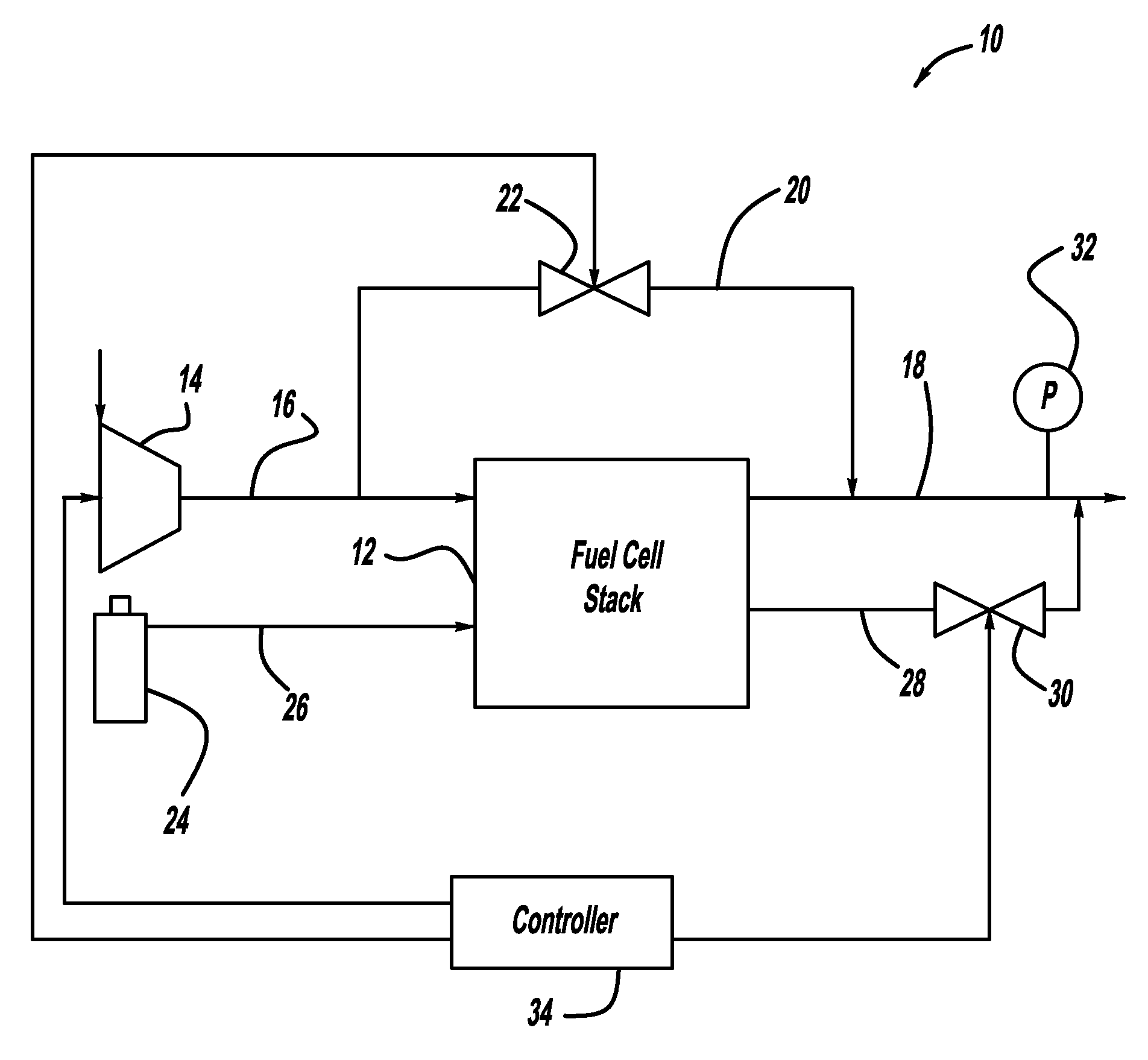
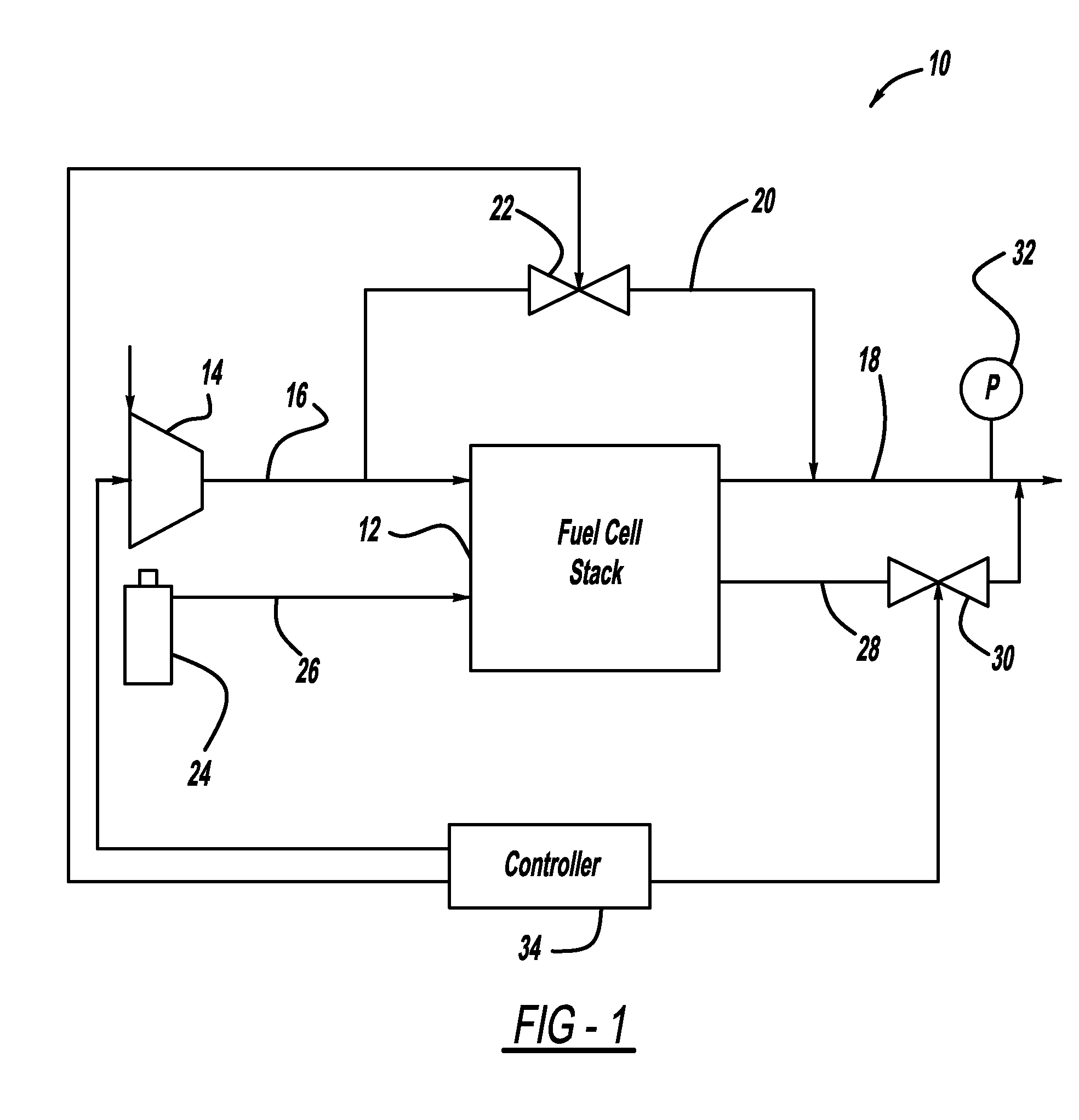
[0019]FIG. 1 is a schematic block diagram of a fuel cell system 10 including a fuel cell stack 12. The fuel cell system 10 includes a compressor 14 that provides cathode air to the cathode side of the stack 12 on a cathode input line 16. Cathode exhaust is output from the fuel cell stack 12 on cathode exhaust gas line 18. Cathode exhaust pressure is measured by a pressure sensor 32 in the line 18. A by-pass line 20 is provided around the fuel cell stack 12 and a by-pass valve 22 in the line 20 can be opened to allow the air from the compressor 14 to by-pass the cathode side of the fuel cell stack 12. Hydrogen fuel is provided to the anode side of the fuel cell stack...
PUM
| Property | Measurement | Unit |
|---|---|---|
| flow rate | aaaaa | aaaaa |
| concentration | aaaaa | aaaaa |
| pressure | aaaaa | aaaaa |
Abstract
Description
Claims
Application Information
 Login to View More