Low side zener reference voltage extended drain SCR clamps

a technology of reference voltage and scr clamps, applied in the direction of semiconductor devices, semiconductor/solid-state device details, electrical apparatus, etc., can solve the problem of unpredictability of triggering under different loads

a technology of reference voltage and scr clamps, applied in the direction of semiconductor devices, semiconductor/solid-state device details, electrical apparatus, etc., can solve the problem of unpredictability of triggering under different loads

US20110241069A1Active Publication Date: 2011-10-06NAT SEMICON CORP

Image

Smart Image Click on the blue labels to locate them in the text.
Viewing Examples
Smart Image
  • Low side zener reference voltage extended drain SCR clamps
  • Low side zener reference voltage extended drain SCR clamps
  • Low side zener reference voltage extended drain SCR clamps

Examples

Experimental program
Comparison scheme
Effect test

Embodiment Construction

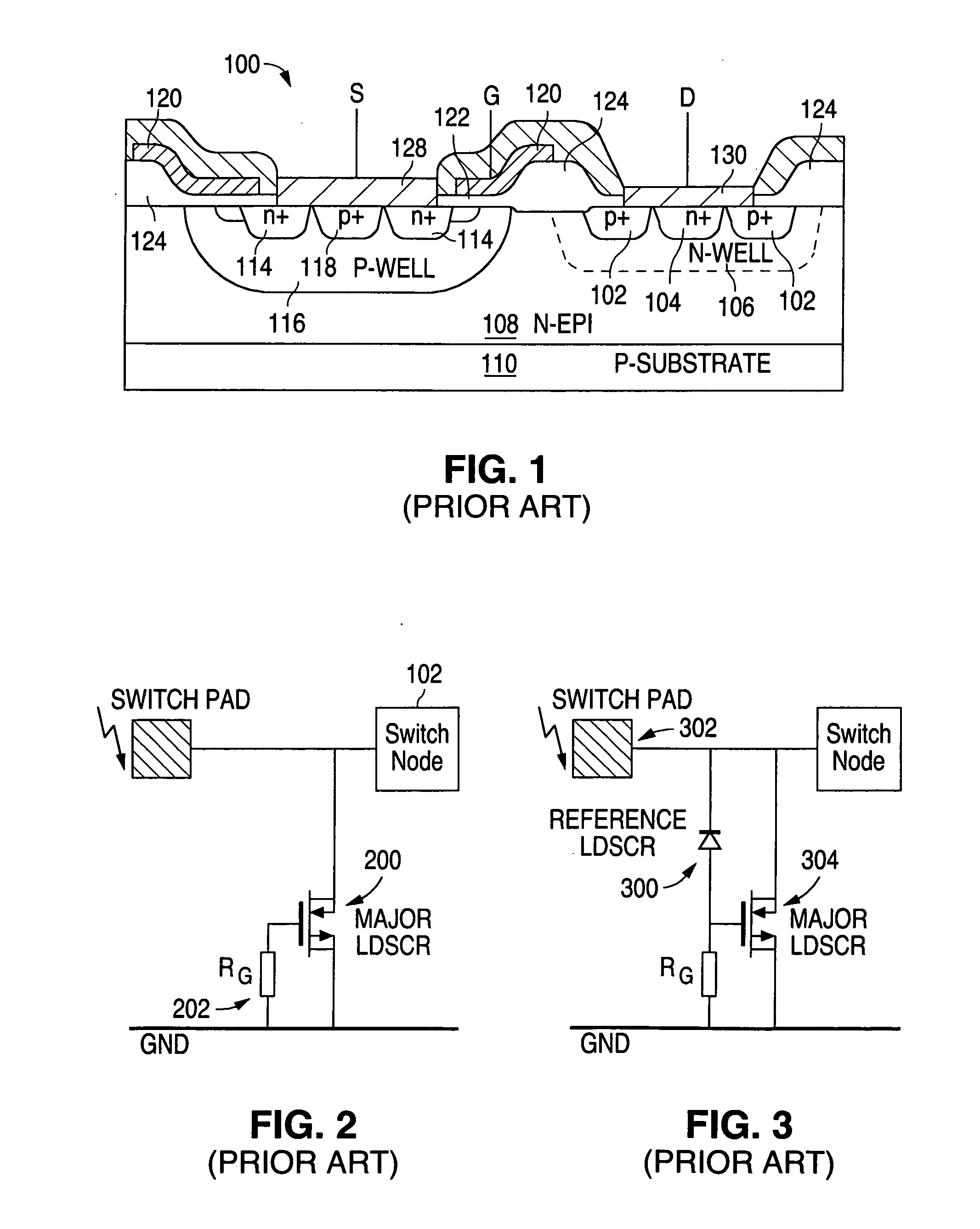
[0015]A typical LDMOS-SCR as known in the art was described above with respect to FIG. 1 with its n+ drain 104 formed in an n-well 106 and n+ source regions 118 formed in a p-well 116. The n-well defines a short drift region extending to underneath the gate poly 120. The device is bounded on either side by an isolation region (not shown).

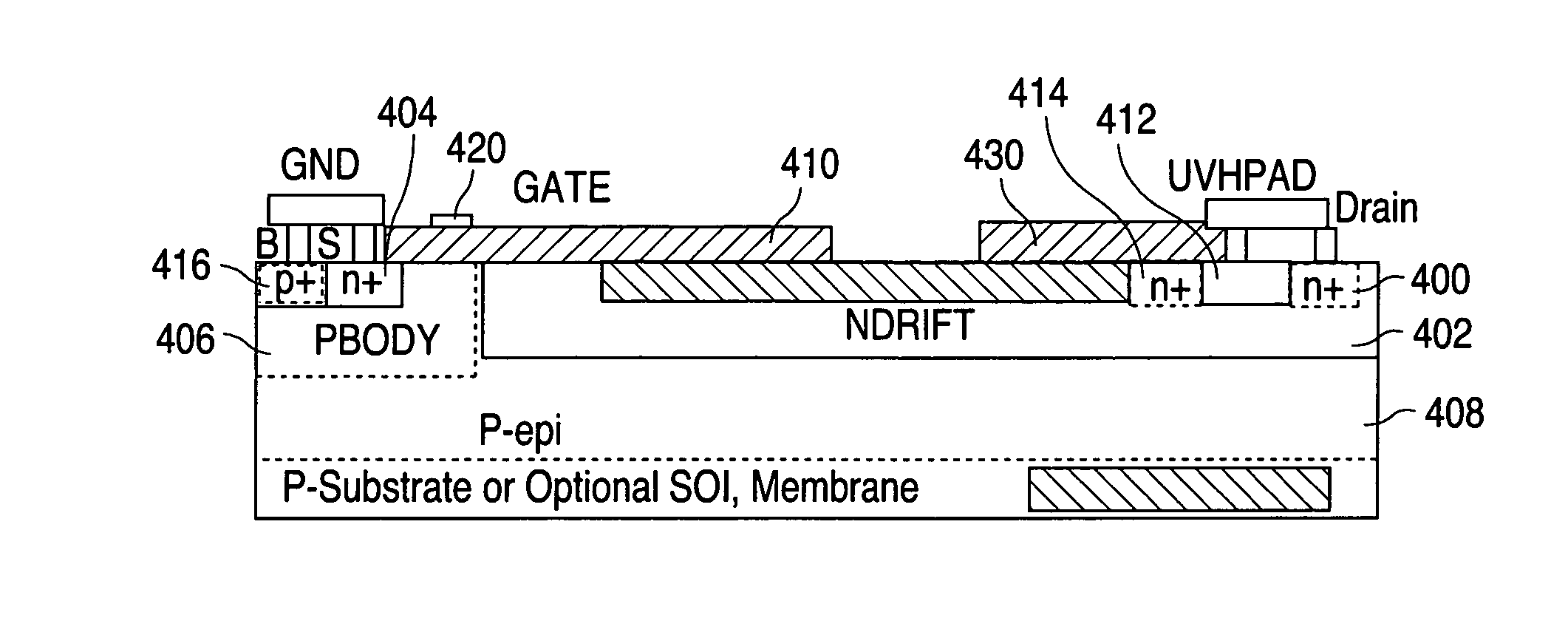
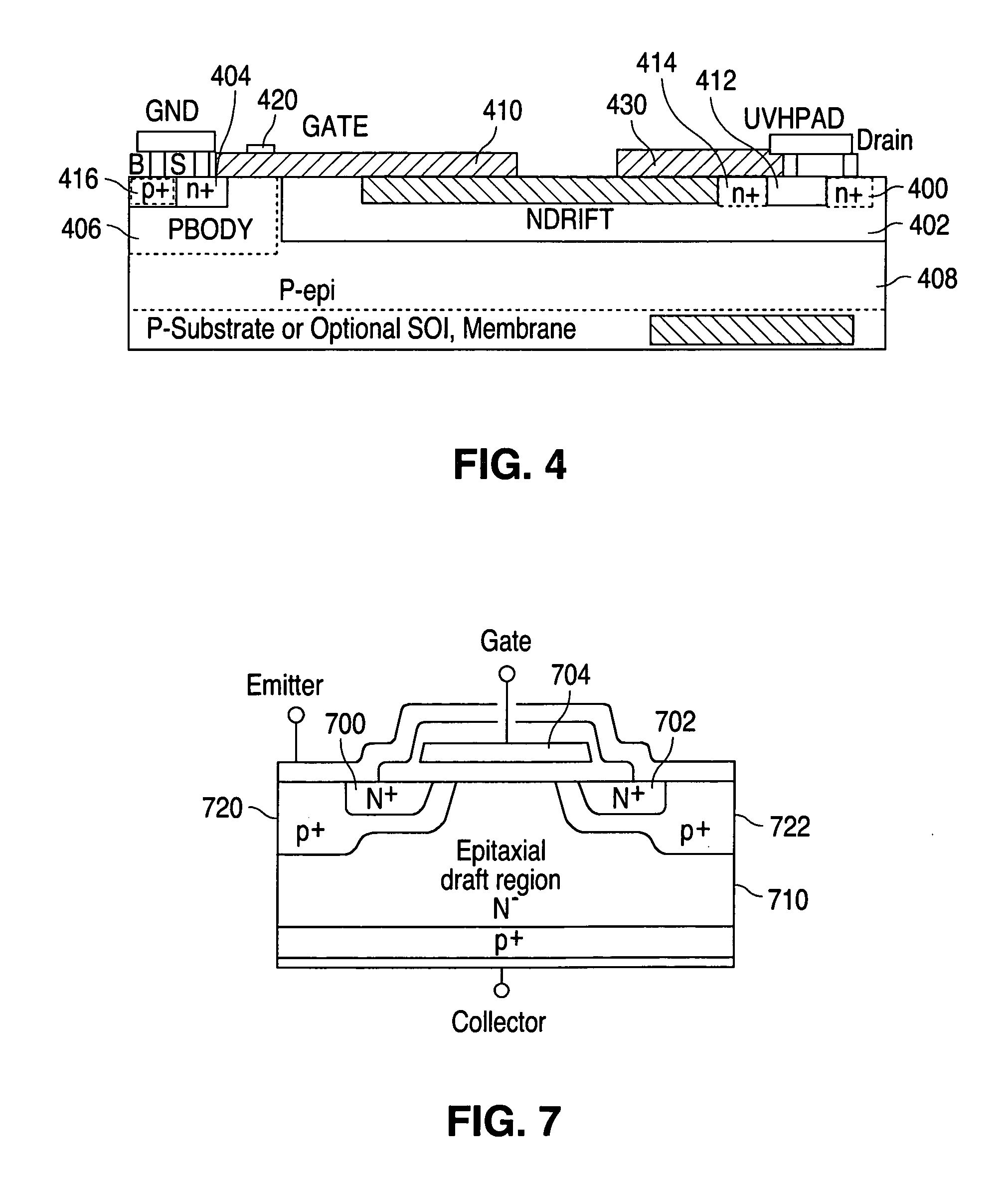
[0016]In contrast to the configuration described above, the LDMOS-SCR-like structure of the invention (that is referred to herein as UHV LDMOS) provides for a symmetrical drift region formed around a central pad defining the drain region of the device. One such embodiment is shown in cross-section in FIG. 4, which shows an n+ drain 400 formed in a long n-drift region 402, which will be discussed in greater detail below. The n+ source 404 is formed in a p-body or p-well 406. The n-drift region 402 and p-body 406 are, in turn formed in a p-epitaxial region 408. A poly gate 410 with gate contact 420 is formed near to the source region, and is spaced fr...

the structure of the environmentally friendly knitted fabric provided by the present invention; figure 2 Flow chart of the yarn wrapping machine for environmentally friendly knitted fabrics and storage devices; image 3 Is the parameter map of the yarn covering machine
Login to View More

PUM

No PUM Login to View More

Abstract

In an ultra high voltage lateral DMOS-type device (UHV LDMOS device), a central pad that defines the drain region is surrounded by a racetrack-shaped source region with striations of alternating n-type and p-type material radiating outwardly from the pad to the source to provide for an adjustable snapback voltage.

Description

FIELD OF THE INVENTION[0001]The invention relates to ESD protection of high voltage devices.BACKGROUND OF THE INVENTION[0002]In an endeavor to integrate green energy sources such as solar energy into the national grid, and provide cost effective electric car chargers and street lighting, a strong emphasis has been placed on providing an integrated circuit solution for electric car motor drivers, solar energy conversion, and other dc to grid ac conversion applications. This commonly requires voltage ranges of 600 V and above. Grid tolerant circuits for instance are tolerant to 700-1000V. These high voltage devices differ both functionally and structurally from low voltage devices since they need to deal with high voltages during normal operation without triggering as is discussed in greater detail below. High voltage devices have, for instance, been implemented as Lateral DMOS (LDMOS) (which is a self-aligned device implemented in a BiCMOS process) or as drain-extended MOS (DeMOS) (w...

Claims

the structure of the environmentally friendly knitted fabric provided by the present invention; figure 2 Flow chart of the yarn wrapping machine for environmentally friendly knitted fabrics and storage devices; image 3 Is the parameter map of the yarn covering machine
Login to View More

Application Information

Patent Timeline
06 Oct 2011
Publication
US20110241069A1
IPC
H01L27/06; H01L21/8248
CPC
H01L27/0262; H01L27/027; H01L29/0634; H01L29/749; H01L29/7393; H01L29/7436; H01L29/0696
Inventors
VASHCHENKO, VLADISLAV