

Resonance Energy Transfer Assay with Cleavage Sequence and Spacer
a technology of energy transfer and cleavage sequence, which is applied in the field of fluorescence resonance energy transfer for protease assays, can solve the problems of inability to study the catalytic kinetics of toxins, and complicated and expensive amplification processes, so as to improve the sensitivity and specificity, improve the sensitivity and improve the effect of energy transfer
- Summary
- Abstract
- Description
- Claims
- Application Information
AI Technical Summary
Benefits of technology
Problems solved by technology
Method used
Image

Examples
example 1
Bio-Sensors Based on CFP-YFP FRET Pair and Botulinum Neurotoxin Protease Activity
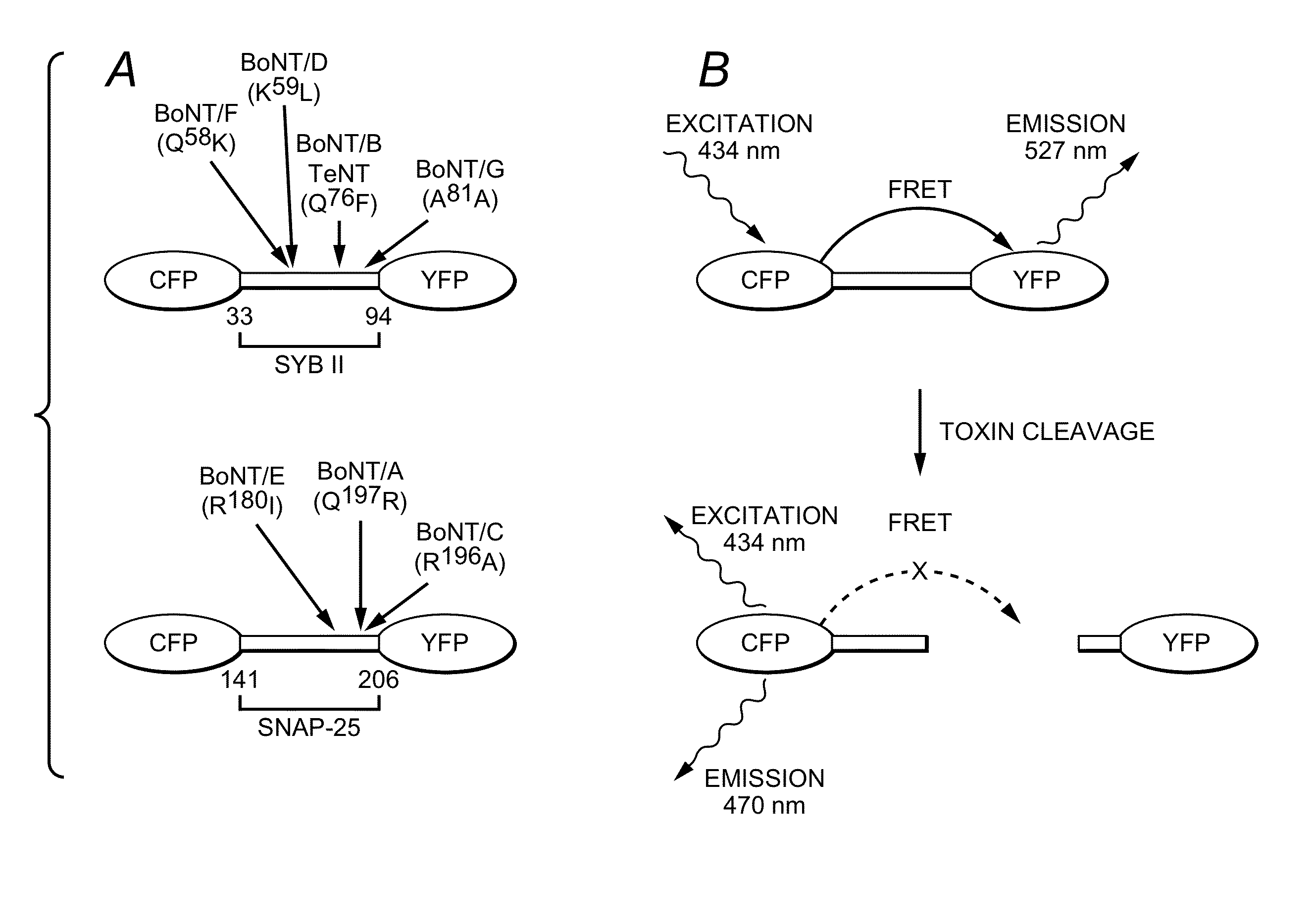
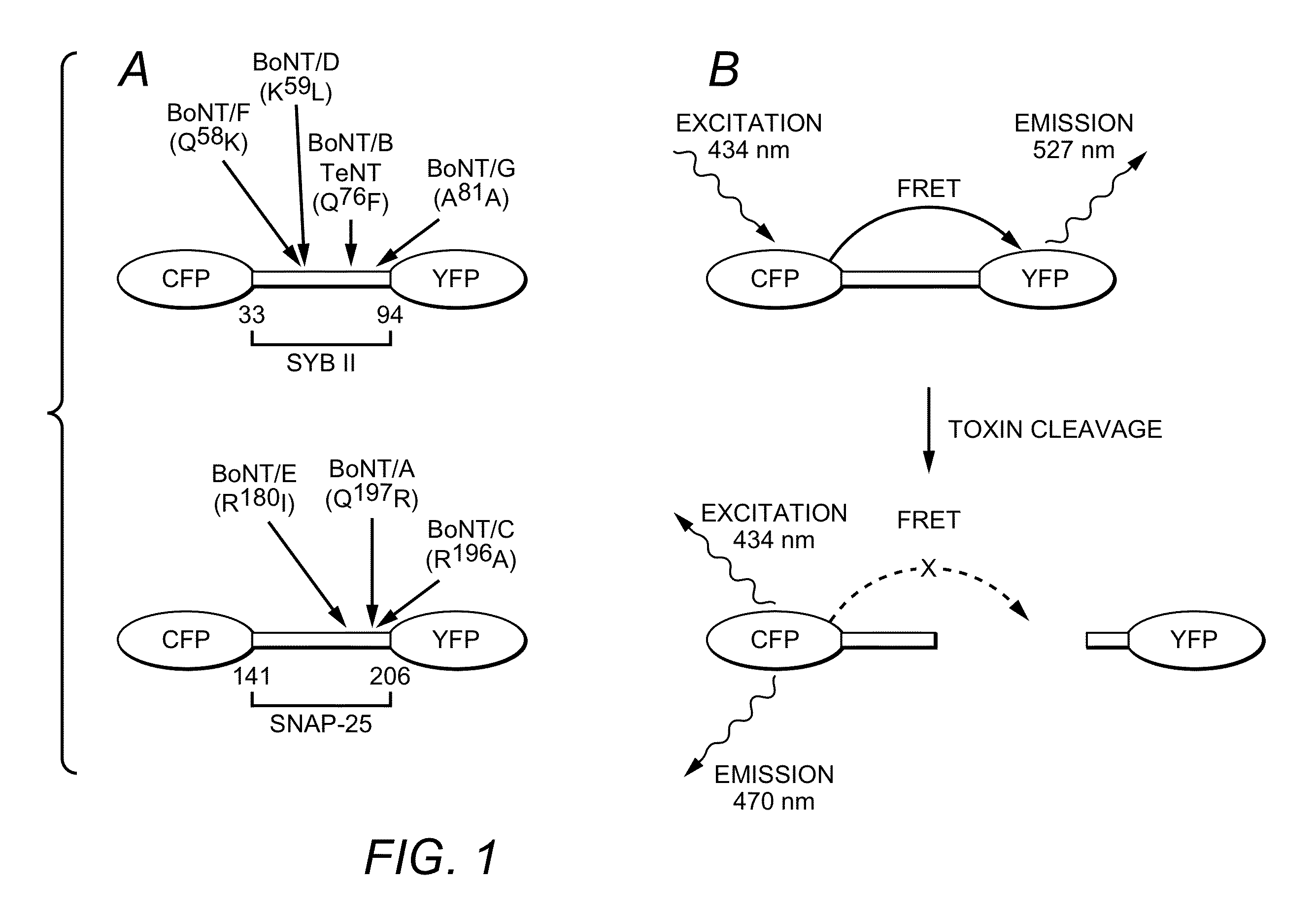
[0117]In order to monitor botulinum neurotoxin protease activity using FRET method, CFP and YFP protein are connected via syb II or SNAP-25 fragment, denoted as CFP-SybII-YFP and CFP-SNAP-25-YFP, respectively (FIG. 1A). Short fragments of toxin substrates were used instead of the full-length protein to optimize the CFP-YFP energy transfer efficiency, which falls exponentially as the distance increases. However, the cleavage efficiency by BoNTs decreases significantly as the target protein fragments get too short. Therefore, the region that contain amino acid 33-96 of synaptobrevin sequence was used because it has been reported to retain the same cleavage rate by BoNT / B, F, and TeNT as the full length synaptobrevin protein does. Similarly, residues 141-206 of SNAP-25 were selected to ensure that the construct can still be recognized and cleaved by BoNT / A and E.
[0118]The FRET assay is depicted in FIG. 1B....
example 2
Monitoring the Cleavage of Bio-Sensor Proteins by Botulinum Neurotoxins In Vitro
[0120]300 nM chimera protein CFP-SybII-YFP was mixed with 50 nM pre-reduced BoNT / B holotoxin in a cuvette. The emission spectra were collected at different time points after adding BoNT / B (0, 2, 5, 10, 30, 60 min, etc). At the end of each scan, a small volume of sample (30.mu.1) was taken out from the cuvette and mixed with SDS-loading buffer. These samples later were subjected to SDS-page gels and the cleavage of chimera proteins were visualized using an antibody against the his.sub.6 tag in the recombinant chimera protein. As shown in FIG. 3A, the incubation of bio-sensor protein with BoNT / B resulted in a decrease of YFP emission and increase of CFP emission. The decrease of FRET ratio is consistent with the degree of cleavage of the chimera protein by BoNT / B (FIG. 3A, low panel). This result demonstrates the cleavage of the bio-sensor protein can be monitored in real time by recording the change in it...
example 3
Monitoring Botulinum Neurotoxin Protease Activity in Real Time Using a Microplate Spectrofluorometer
[0122]The above experiments demonstrated that the activity of botulinum neurotoxin can be detected in vitro by monitoring the changes of the emission spectra of their target bio-sensor proteins. We then determined if we could monitor the cleavage of bio-sensor proteins in real time using a microplate reader—this will demonstrate the feasibility to adapt this assay for future high-throughput screening. As shown in FIG. 4A, 300 nM CFP-SNAP-25-YFP chimera protein was mixed with 10 nM BoNT / A in a 96-well plate. CFP was excited at 436 nm and the fluorescence of the CFP channel (470 nM) and YFP channel (527 nM) were recorded over 90 min at 30 sec intervals. Addition of BoNT / A resulted in the decrease of YFP channel emission and the increase of CFP channel emission. This result enabled us to trace the kinetics of botulinum neurotoxin enzymatic activity in multiple samples in real time. For i...
PUM
| Property | Measurement | Unit |
|---|---|---|
| length | aaaaa | aaaaa |
| length | aaaaa | aaaaa |
| length | aaaaa | aaaaa |
Abstract
Description
Claims
Application Information
 Login to View More