System and method for detecting address resolution protocol (ARP) spoofing

a technology of address resolution protocol and address resolution protocol, which is applied in the field of system and method for detecting address resolution protocol (arp) spoofing, can solve the problems of increasing the difficulty of malicious codes and other destructive forms of information being downloaded from a web server, and domestic websites being hacked by foreign attackers. to achieve the effect of easy detection of arp spoofing attacks

US20130111589A1Active Publication Date: 2013-05-02SAMSUNG SDS CO LTD
2 Cites 38 Cited by

Patent Information

Authority / Receiving Office
US · United States
Patent Type
Applications(United States)
Current Assignee / Owner
Publication Date
2013-05-02

Smart Images

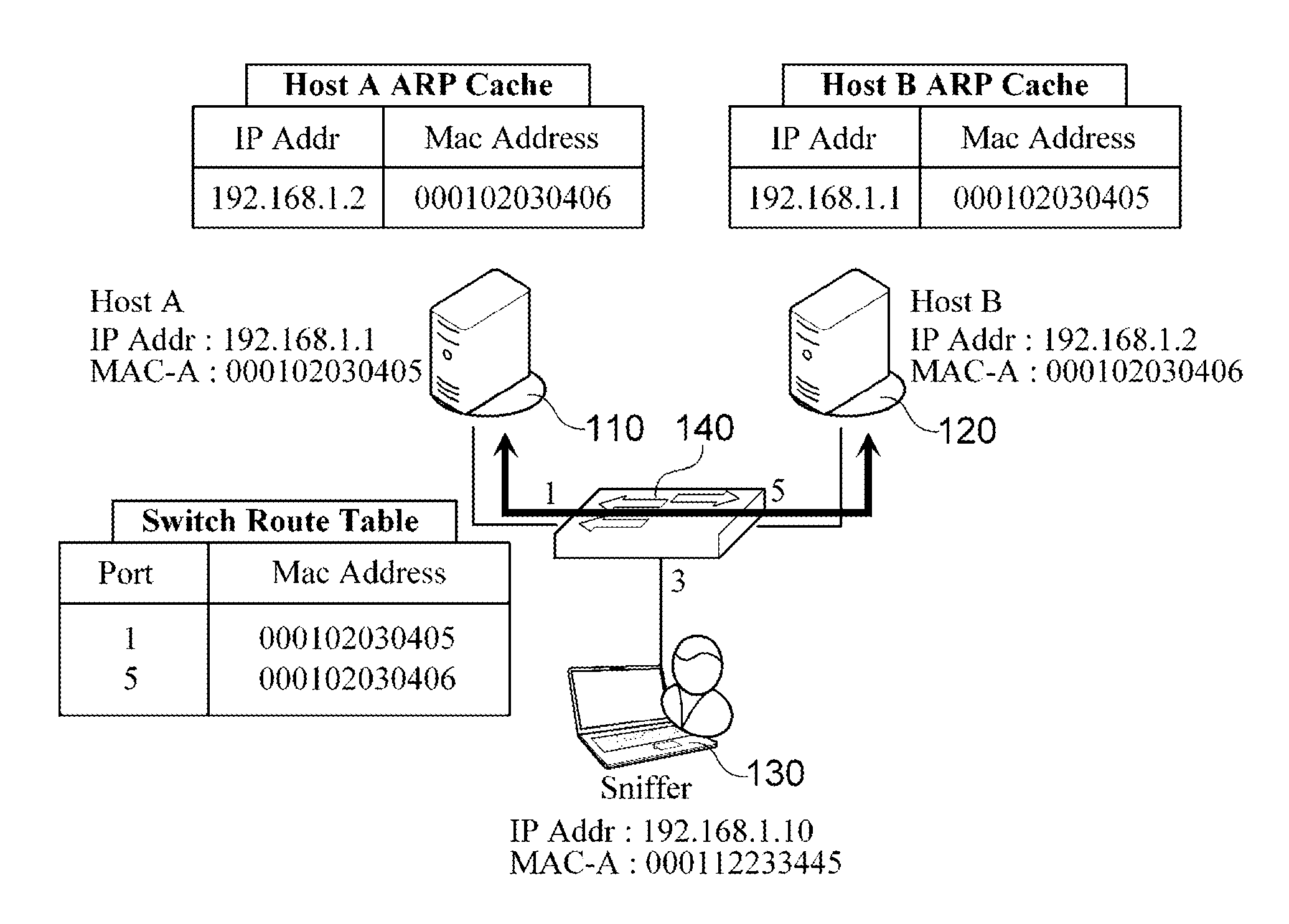
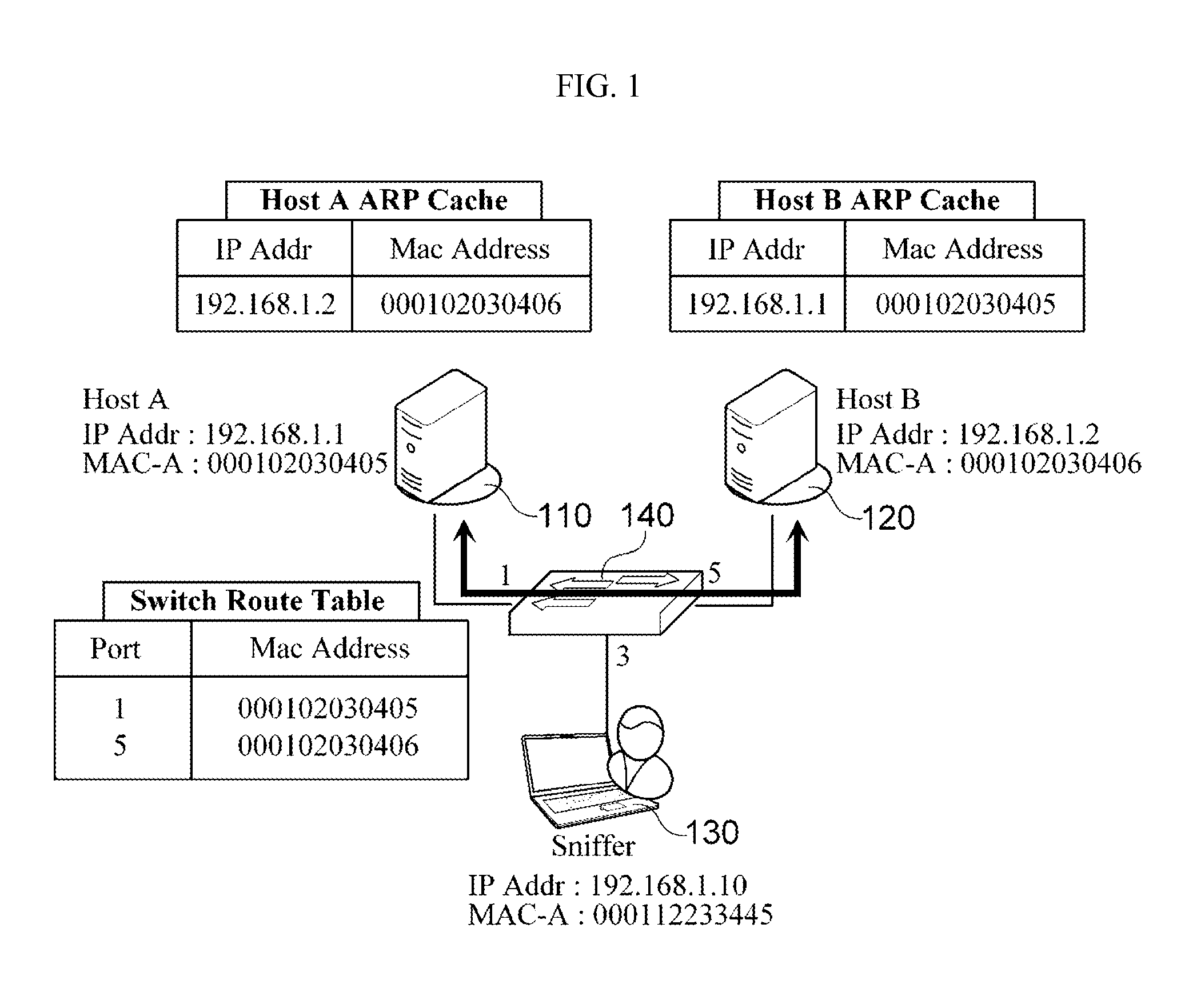
  • Figure 1
    Figure 1
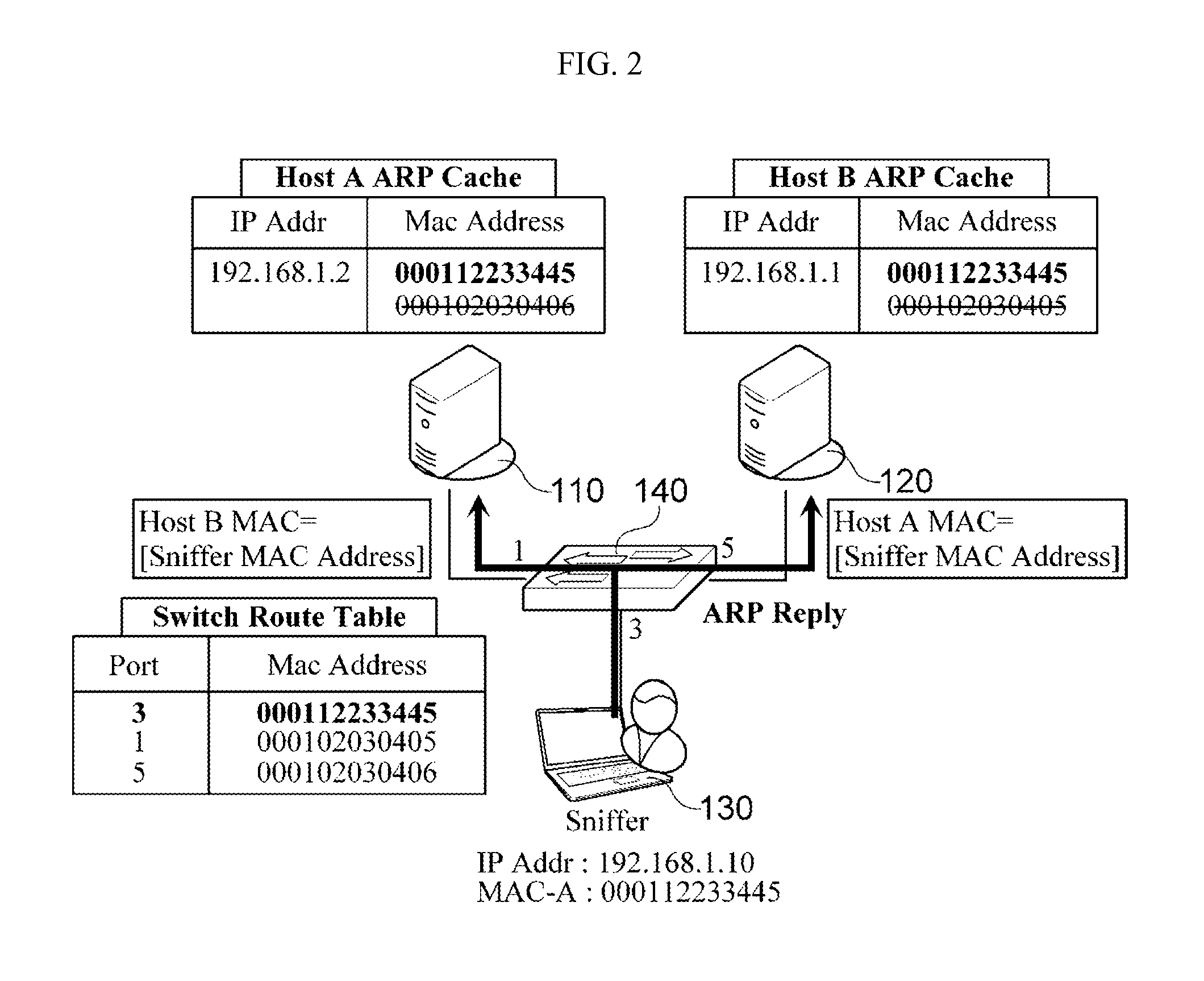
  • Figure 2
    Figure 2
  • Figure 3
    Figure 3
Patent Text Reader

Abstract

There are provided a system and method for detecting Address Resolution Protocol (ARP) attacks. The ARP spoofing attack detection system includes: a reception module which receives an ARP packet, and which determines whether the received ARP packet is an unsolicited ARP packet; a transmission module which creates, if the ARP packet is an unsolicited ARP packet, an ARP request packet corresponding to the unsolicited ARP packet, and which broadcasts the ARP request packet; and a detection module which determines, if an ARP response packet corresponding to the ARP request packet is received, whether an input port of the ARP response packet is identical to an input port of the unsolicited ARP packet, and which determines that an ARP spoofing attack has occurred if the input port of the ARP response packet is not identical to the input port of the unsolicited ARP packet.
Need to check novelty before this filing date? Find Prior Art

Description

CROSS-REFERENCE TO RELATED APPLICATION

[0001] This application claims priority from Korean Patent Application No. 10-2011-0111562, filed on Oct. 28, 2011, the disclosure of which is incorporated herein by reference in its entirety.BACKGROUND

[0002] 1. Field

[0003] Exemplary embodiments relate to a technique for detecting external attacks relating to Address Resolution Protocol (ARP) spoofing by using the vulnerabilities of ARP.

[0004] 2. Discussion of Related Art

[0005] Recently, incidents in which overseas attackers hack domestic websites and insert malicious codes into the domestic websites have been frequently occurring. In the case of such hacking, generally, web servers are hacked, and then malicious codes are inserted by using the hacked web servers. However, recently, cases in which malicious codes and other destructive forms of information are downloaded from a web server which has not been hacked have been occurring. The cases are generated when a sniffer hacks another server which r...

Examples

Embodiment Construction

[0016]Exemplary embodiments will be described in detail below with reference to the accompanying drawings. While the present disclosure is shown and described in connection with exemplary embodiments thereof, it will be apparent to those skilled in the art that various modifications can be made without departing from the spirit and scope of the present disclosure.

[0017]FIGS. 1 and 2 are views which illustrate an aspect of a general Address Resolution Protocol (ARP) spoofing attack. In particular, FIG. 1 is a view which illustrates a state in which no ARP spoofing attack is generated, and FIG. 2 is a view which illustrates a state which may exist after an ARP spoofing attack is generated.

[0018]As shown in FIG. 1, a host A 110 (IP address: 192.168.1.1, MAC address: 000102030405) and a host B 120 (IP address: 192.168.1.2, M AC address: 000102030406) are connected to each other via a L2 switch 140 in order to receive / transmit packets from / to each other. In this case, an ARP cache table ...