Inflation cuff with transient-resistant over-pressure preventor

US20130131626A1Inactive Publication Date: 2013-05-23HOLLISTER INCORPORAED
2 Cites 12 Cited by

Patent Information

Authority / Receiving Office
US · United States
Current Assignee / Owner
Publication Date
2013-05-23
Estimated Expiration
Not applicable · inactive patent

Smart Images

  • Figure 1
    Figure 1
  • Figure 2
    Figure 2
  • Figure 3
    Figure 3
Patent Text Reader

Abstract

A catheter system (10) with a valve assembly (12) that expels excess inflation fluid when a cuff or balloon (16) of the catheter system is overinflated. The valve assembly includes a luer-activated spool (34) biased toward a sealed condition, a precision relief / check valve (56) biased toward a scaled condition, a primary valve body outlet (22), a valve body feedback inlet (24), and a secondary valve body outlet (26). An inflation lumen (48) is in fluid communication with the primary valve body outlet and an interior of the cuff or balloon. A feedback lumen (54) is in fluid communication with the interior of the cuff or balloon and the valve body feedback inlet. When feedback fluid builds up pressure in excess of the restoring force of the relief spring, the relief / check valve opens, unsealing an expulsion pathway and relieving excess fluid from the cuff or balloon.
Need to check novelty before this filing date? Find Prior Art

Description

FIELD OF THE DISCLOSURE

[0001] This disclosure relates generally to catheter systems provided with inflatable cuffs or balloons and, more specifically, to inflation valve mechanisms that relieve excess fluid when such cuffs or balloons are inflated in excess of a predetermined pressure or volume, while being resistant to transient spikes in pressure, such as experienced upon inflation or during peristalsis.BACKGROUND

[0002] Catheter systems are increasingly provided with cuffs or balloons in order to secure the catheter in place, such as in the rectum, or to dilate surrounding tissue, such as in urinary applications (e.g., Foley catheters and inflatable pessaries), cardiac, or endotracheal applications. While various attempts have been made to design inflation systems for such catheters to prevent over-inflation, such as check valves that can be used to bleed or relieve excess fluid, such attempts have heretofore failed to adequately resist transients, or temporary spikes in cuff or bal...

Examples

Embodiment Construction

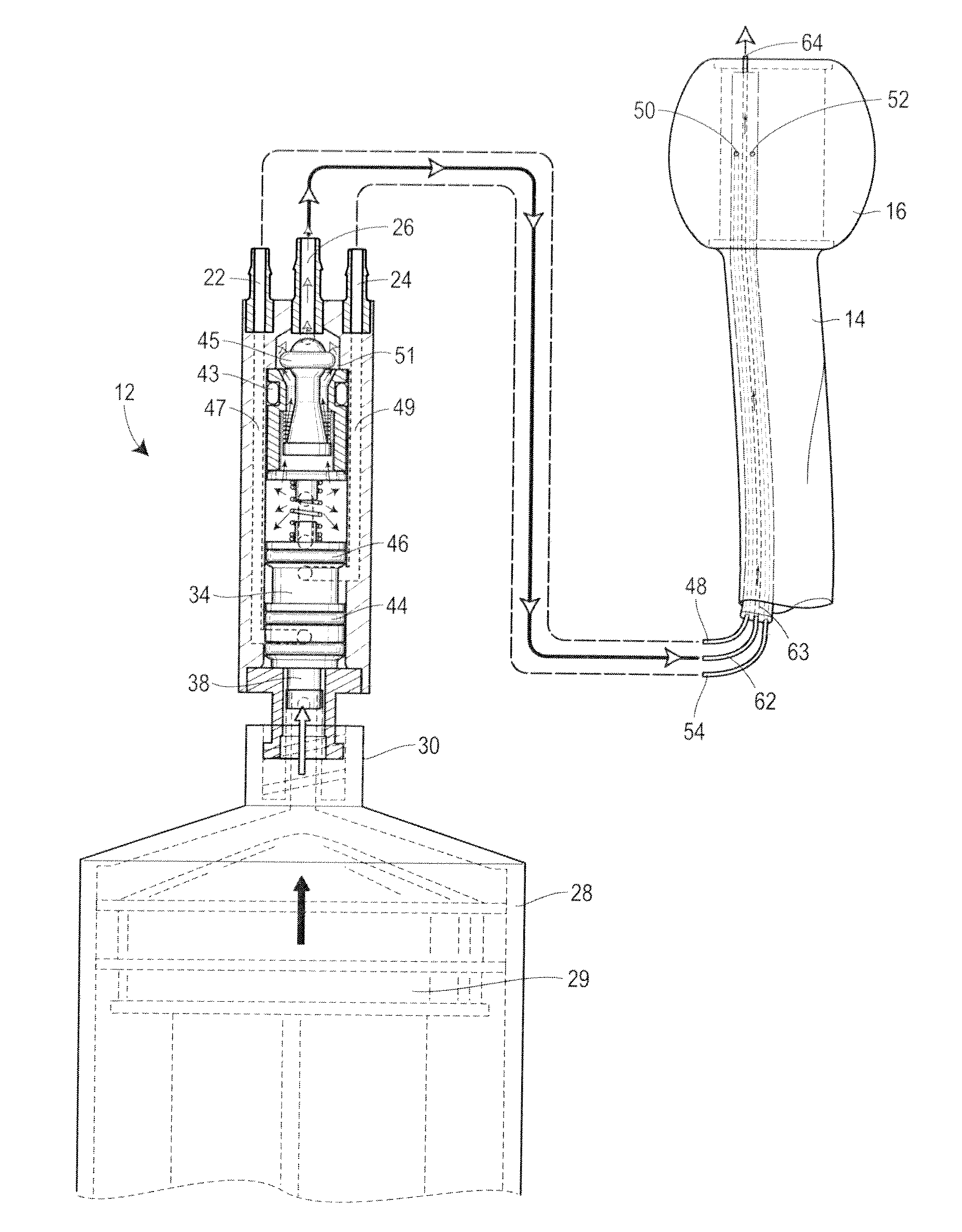
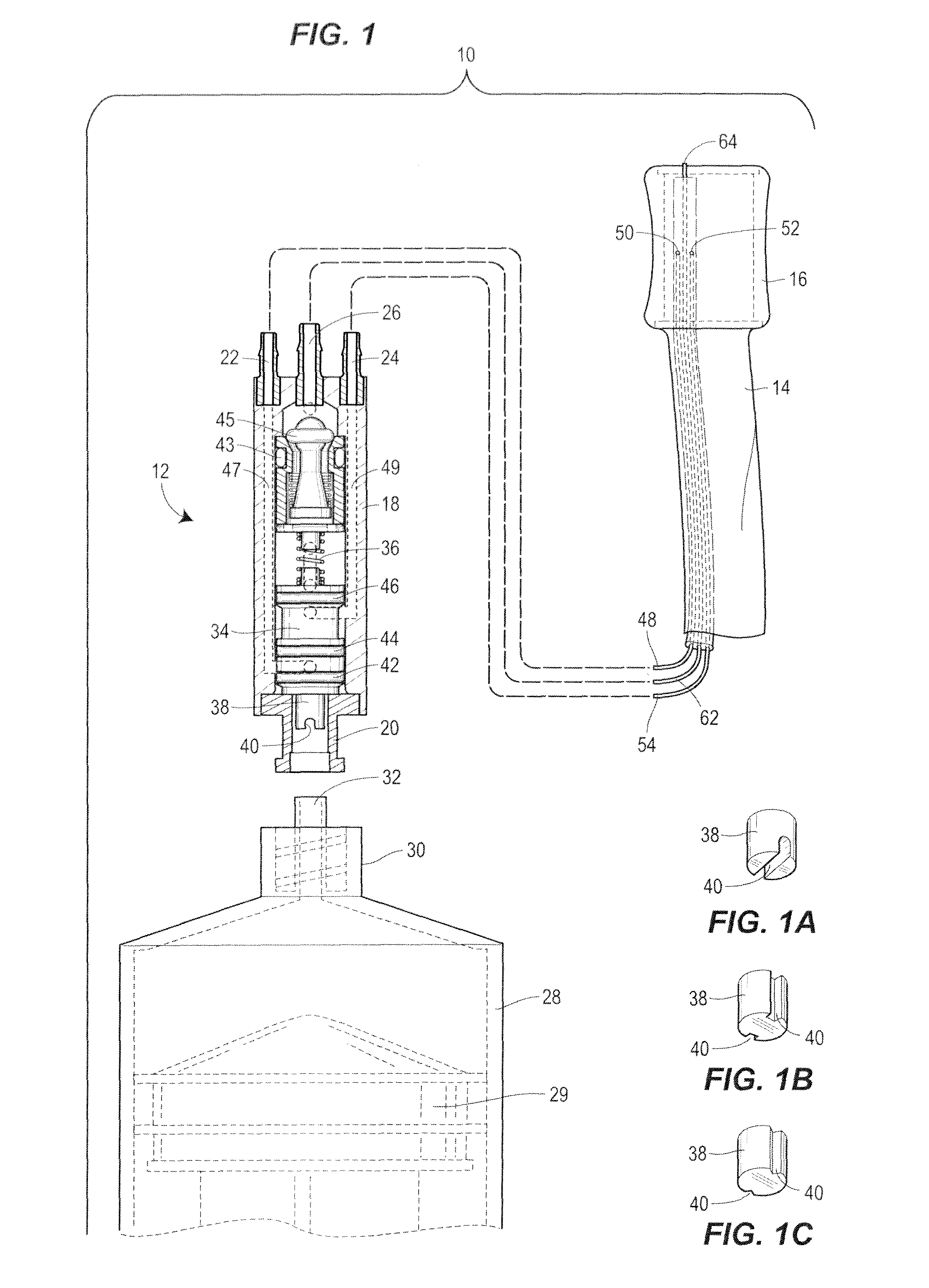
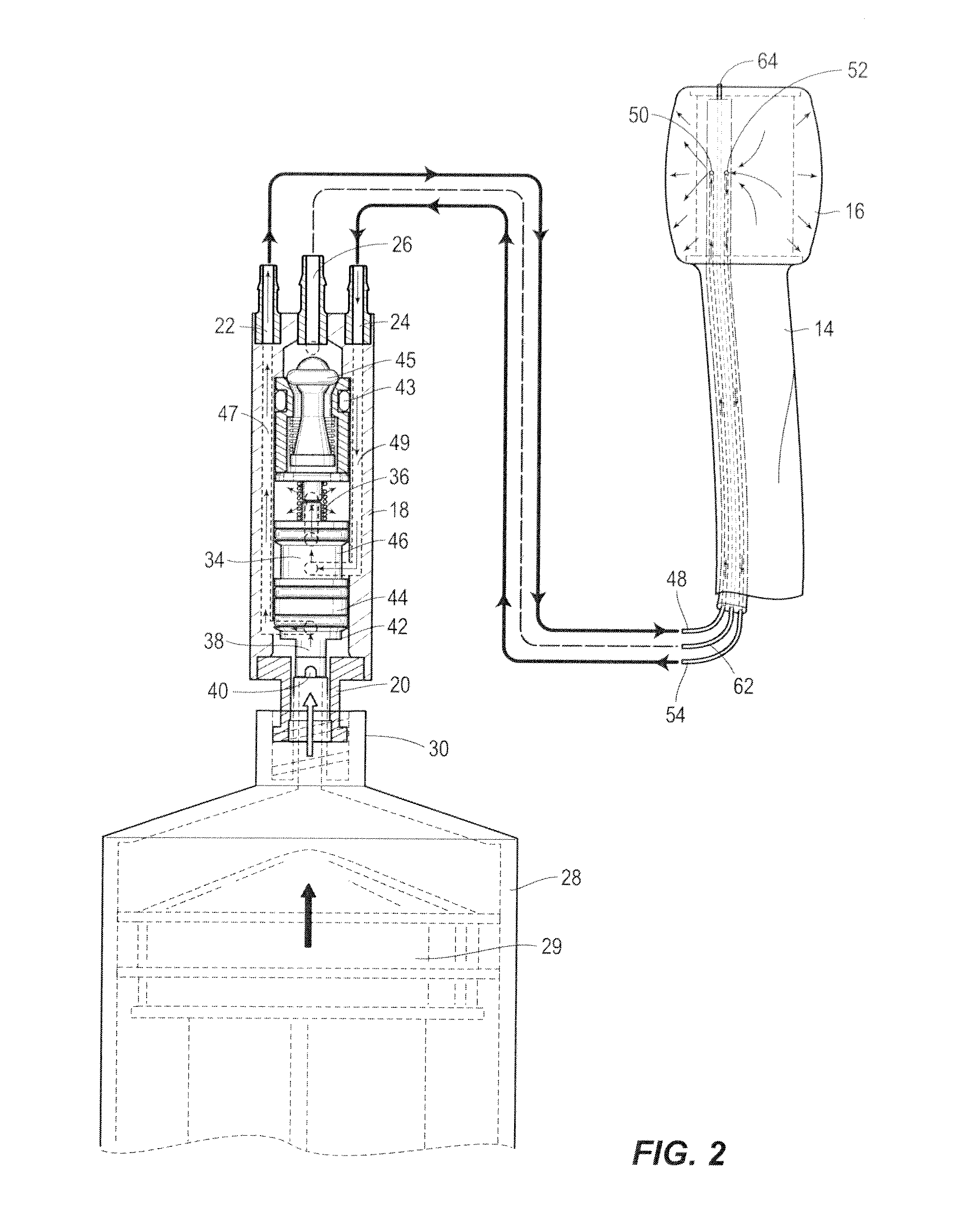
[0027]A catheter system 10 including a valve assembly 12 of a preferred embodiment of the present disclosure and its method of operation are illustrated in FIGS. 1-12. The catheter system 10 includes a catheter tube 14, such as a drainage tube, and a cuff or balloon 16. In the illustrated catheter system 10, the cuff or balloon 16 surrounds the catheter tube 14 and is provided at a patient-proximal end of the catheter tube 14, but it will be understood that the cuff or balloon 16 may alternatively be disposed at other locations along the catheter tube 14 besides the patient-proximal end, and may be an intralumenal balloon disposed in the wall of the catheter tube 14, such as a balloon that, upon inflation, occludes the catheter tube 14. The valve assembly 12 includes a valve body 18 that may have a threaded or unthreaded female luer lock connection 20 at an upstream end thereof. The valve body 18 further includes a primary valve body outlet 22, a valve body feedback inlet 24, and a ...