

Video encoding device, video encoding method, and program-containing non-transitory computer-readable medium
a video encoding and video encoding technology, applied in the field of video processing technology, can solve the problems of deteriorating the image quality of the latter macroblock, reducing the output quality of the generated code, and reducing the subjective image quality, so as to achieve high quality
- Summary
- Abstract
- Description
- Claims
- Application Information
AI Technical Summary
Benefits of technology
Problems solved by technology
Method used
Image



Examples
first exemplary embodiment
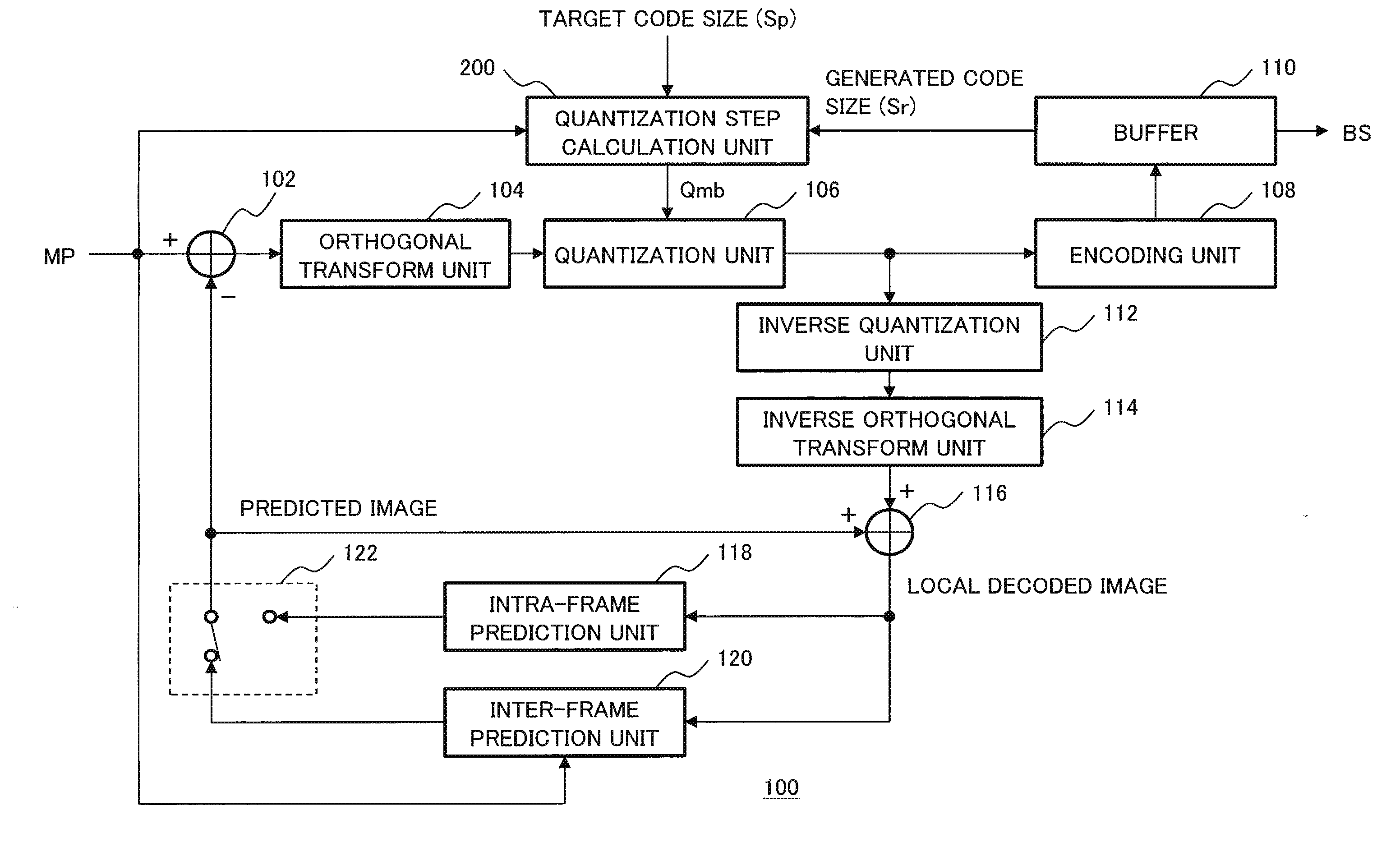
[0064]FIG. 1 illustrates a video encoding device 100 according to a first exemplary embodiment of the present invention. The video encoding device 100 encodes a video MP at a variable rate in accordance with, for example, an MPEG format to obtain a bitstream BS and output the bitstream, and includes an arithmetic unit 102, an orthogonal transform unit 104, a quantization unit 106, an encoding unit 108, a buffer 110, an inverse quantization unit 112, an inverse orthogonal transform unit 114, an arithmetic unit 116, an intra-frame prediction unit 118, an inter-frame prediction unit 120, a switch 122, and a quantization step calculation unit 200.
[0065]The data of the video MP is received by the arithmetic unit 102. The arithmetic unit 102 calculates, for each macroblock of the input video MP, a difference between the data and data of a predicted image of the macroblock input from the intra-frame prediction unit 118 or the inter-frame prediction unit 120 through the switch 122, and outp...
second exemplary embodiment
[0100]In the video encoding device 100 of the first exemplary embodiment described above, the complexity estimation unit 202 of the quantization step calculation unit 200 estimates, as the complexity Xest of the target picture, the product of the generated code size and the average quantization step of the encoded picture whose type is the same as that of the target picture in accordance with the technology of TM5. Then, the complexity estimation unit 202 calculates the complexity Xmb of each macroblock by dividing the estimated complexity Xest by the total number n of macroblocks.
[0101]The technology disclosed in PTL 3, for example, may be used for the estimation of the complexity of the target picture in the complexity estimation unit 202. Specifically, the complexity Xest for an I picture to be encoded first after a scene change is estimated on the basis of the variance value of the picture, and the complexity Xest for a picture that is a P picture or a B picture to be encoded fi...
third exemplary embodiment
[0105]In the first and second exemplary embodiments described above, the same complexity Xmb is calculated for each macroblock by estimating the complexity of the target picture and dividing the estimated complexity by the total number of the macroblocks, but the complexity Xmb may be calculated for each macroblock.
[0106]In this case, following Equation (10), for example, can be used for calculation of the complexity Xmb.
Xmb=a×(Fmb)2+b×Fmb+c (10)
[0107]Equation (10) is obtained by replacing the feature quantity F of the entire target picture in Equation (5) with the feature quantity Fmb of the macroblock. The feature quantity F and the feature quantity Fmb are of the same type.
[0108]Needless to say, a fixed value determined in advance may also be used for each coefficient in Equation (10), and each coefficient may also be adjusted dynamically by the multiple regression analysis or the like.
PUM
 Login to View More
 Abstract
Description
Claims
Application Information
 Login to View More